Event submissions
Published
This submission belongs to the session S4. Family Studies of the event The 1st International Online Conference on Social Sciences
Published date
25 May, 2026
Academic Editor
'%3e%3cpath%20d='M12.6657%2010.9104C12.4185%2010.325%2012.0599%209.79327%2011.6097%209.34482C11.1609%208.89508%2010.6293%208.5365%2010.0442%208.28888C10.0389%208.28626%2010.0337%208.28495%2010.0285%208.28233C10.8446%207.69279%2011.3752%206.73249%2011.3752%205.64904C11.3752%203.8542%209.92103%202.39999%208.1262%202.39999C6.33136%202.39999%204.87715%203.8542%204.87715%205.64904C4.87715%206.73249%205.40774%207.69279%206.22393%208.28364C6.21869%208.28626%206.21345%208.28757%206.20821%208.29019C5.62129%208.5378%205.09463%208.89284%204.64265%209.34613C4.1929%209.79493%203.83432%2010.3266%203.58671%2010.9117C3.34345%2011.4845%203.21226%2012.0987%203.20023%2012.7209C3.19988%2012.7349%203.20233%2012.7488%203.20744%2012.7619C3.21255%2012.7749%203.22022%2012.7867%203.22998%2012.7968C3.23975%2012.8068%203.25142%2012.8147%203.26431%2012.8202C3.2772%2012.8256%203.29105%2012.8284%203.30504%2012.8284H4.09109C4.14874%2012.8284%204.19459%2012.7825%204.1959%2012.7262C4.2221%2011.7148%204.62823%2010.7676%205.34617%2010.0497C6.08899%209.30683%207.0755%208.89808%208.1262%208.89808C9.17689%208.89808%2010.1634%209.30683%2010.9062%2010.0497C11.6242%2010.7676%2012.0303%2011.7148%2012.0565%2012.7262C12.0578%2012.7838%2012.1037%2012.8284%2012.1613%2012.8284H12.9474C12.9613%2012.8284%2012.9752%2012.8256%2012.9881%2012.8202C13.001%2012.8147%2013.0126%2012.8068%2013.0224%2012.7968C13.0322%2012.7867%2013.0398%2012.7749%2013.0449%2012.7619C13.0501%2012.7488%2013.0525%2012.7349%2013.0522%2012.7209C13.0391%2012.0947%2012.9094%2011.4855%2012.6657%2010.9104ZM8.1262%207.9024C7.52486%207.9024%206.9589%207.6679%206.53312%207.24211C6.10733%206.81633%205.87283%206.25037%205.87283%205.64904C5.87283%205.0477%206.10733%204.48174%206.53312%204.05596C6.9589%203.63018%207.52486%203.39567%208.1262%203.39567C8.72753%203.39567%209.29349%203.63018%209.71927%204.05596C10.1451%204.48174%2010.3796%205.0477%2010.3796%205.64904C10.3796%206.25037%2010.1451%206.81633%209.71927%207.24211C9.29349%207.6679%208.72753%207.9024%208.1262%207.9024Z'%20fill='%235D1EE1'/%3e%3c/g%3e%3c/svg%3e) Antonio Bova
Antonio BovaCitation
Wemimo Virtue Davies, Predictive Child Protection: Can AI Justify State Intervention in “High-Risk” Families?, in Proceedings of The 1st International Online Conference on Social Sciences, 28 May–29 May 2026, MDPI: Basel, Switzerland
Share
Email
Facebook
Twitter
LinkedIn
Predictive Child Protection: Can AI Justify State Intervention in “High-Risk” Families?
'%3e%3cpath%20d='M12.6647%2010.9104C12.4176%2010.325%2012.0589%209.7933%2011.6088%209.34485C11.16%208.89511%2010.6283%208.53653%2010.0432%208.28891C10.038%208.28629%2010.0327%208.28498%2010.0275%208.28236C10.8437%207.69282%2011.3743%206.73252%2011.3743%205.64907C11.3743%203.85423%209.92005%202.40002%208.12522%202.40002C6.33038%202.40002%204.87618%203.85423%204.87618%205.64907C4.87618%206.73252%205.40677%207.69282%206.22296%208.28367C6.21772%208.28629%206.21248%208.2876%206.20724%208.29022C5.62031%208.53783%205.09365%208.89287%204.64167%209.34616C4.19192%209.79496%203.83334%2010.3266%203.58573%2010.9117C3.34247%2011.4846%203.21128%2012.0987%203.19925%2012.721C3.1989%2012.735%203.20135%2012.7489%203.20646%2012.7619C3.21157%2012.7749%203.21924%2012.7868%203.22901%2012.7968C3.23877%2012.8068%203.25045%2012.8148%203.26334%2012.8202C3.27623%2012.8256%203.29007%2012.8284%203.30406%2012.8284H4.09012C4.14776%2012.8284%204.19362%2012.7825%204.19493%2012.7262C4.22113%2011.7148%204.62726%2010.7676%205.34519%2010.0497C6.08802%209.30686%207.07452%208.89811%208.12522%208.89811C9.17592%208.89811%2010.1624%209.30686%2010.9052%2010.0497C11.6232%2010.7676%2012.0293%2011.7148%2012.0555%2012.7262C12.0568%2012.7839%2012.1027%2012.8284%2012.1603%2012.8284H12.9464C12.9604%2012.8284%2012.9742%2012.8256%2012.9871%2012.8202C13%2012.8148%2013.0117%2012.8068%2013.0214%2012.7968C13.0312%2012.7868%2013.0389%2012.7749%2013.044%2012.7619C13.0491%2012.7489%2013.0515%2012.735%2013.0512%2012.721C13.0381%2012.0947%2012.9084%2011.4856%2012.6647%2010.9104ZM8.12522%207.90243C7.52388%207.90243%206.95792%207.66793%206.53214%207.24215C6.10636%206.81636%205.87185%206.2504%205.87185%205.64907C5.87185%205.04773%206.10636%204.48177%206.53214%204.05599C6.95792%203.63021%207.52388%203.3957%208.12522%203.3957C8.72655%203.3957%209.29252%203.63021%209.7183%204.05599C10.1441%204.48177%2010.3786%205.04773%2010.3786%205.64907C10.3786%206.2504%2010.1441%206.81636%209.7183%207.24215C9.29252%207.66793%208.72655%207.90243%208.12522%207.90243Z'%20fill='%235D1EE1'/%3e%3c/g%3e%3c/svg%3e)
Wemimo Virtue Davies 1
1. Department of Economics, Faculty of Social Sciences, University of Abuja, Abuja, 900001, Nigeria.
Abstract
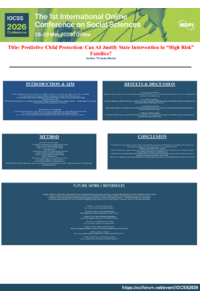
Across multiple jurisdictions, governments are increasingly adopting artificial intelligence tools to predict child neglect, abuse, and family instability. While proponents argue that predictive analytics improves efficiency and protects vulnerable children, critics warn that such systems may reinforce structural inequalities and expand intrusive state surveillance of marginalized families. This paper critically examines the use of AI-driven risk assessment tools in child welfare policy, with particular attention to their implications for family autonomy, privacy, and social justice.
The study adopts a qualitative comparative approach, drawing on secondary data and policy documents from predictive child protection systems in the United States, while situating the analysis within broader debates on family policy and emerging digital governance contexts such as Nigeria. Through document analysis and case-based comparison, it examines how algorithmic risk models are designed, implemented, and integrated into decision-making processes within child welfare institutions.
Findings suggest that AI systems do not operate neutrally; rather, they reproduce existing socio-economic biases embedded in administrative data, particularly those related to poverty, race, and family structure. By categorizing families as “high-risk,” these systems tend to intensify monitoring of already disadvantaged communities, while diverting attention from structural drivers of vulnerability such as unemployment, housing insecurity, and weak social protection systems.
The paper addresses three central questions: (1) Does predictive AI enhance child welfare outcomes, or does it expand punitive surveillance under the guise of protection? (2) How does algorithmic risk scoring reshape the relationship between families and the state? (3) To what extent can regulatory frameworks mitigate discriminatory outcomes without constraining innovation?
By bridging family studies, public policy, and digital governance, this paper challenges the assumption that technological efficiency equates to ethical legitimacy. It concludes that the future of family policy will depend on how societies balance child protection objectives with data governance standards and the preservation of fundamental family rights, particularly in emerging policy environments such as Nigeria.
Keywords
Family policy
Child welfare
Artificial intelligence
Predictive governance
Surveillance
Social inequality
Algorithmic bias.
Poster
22e484ffd0f06dcccd24f89f63bfdb0dc32cc6f0ae850909c448482e0a7.pdf
Family Dynamics in the United Kingdom and Pakistan: A Comparative Analysis of Structure, Roles, and Socio-Cultural Change
Insecurity as a Stressor: Legal Uncertainty, Identity Disruption, and Coping Among Undocumented Pakistani Migrants in Italy