Event submissions
Published
This submission belongs to the session S4. Family Studies of the event The 1st International Online Conference on Social Sciences
Published date
25 May, 2026
Academic Editor
'%3e%3cpath%20d='M12.6657%2010.9104C12.4185%2010.325%2012.0599%209.79327%2011.6097%209.34482C11.1609%208.89508%2010.6293%208.5365%2010.0442%208.28888C10.0389%208.28626%2010.0337%208.28495%2010.0285%208.28233C10.8446%207.69279%2011.3752%206.73249%2011.3752%205.64904C11.3752%203.8542%209.92103%202.39999%208.1262%202.39999C6.33136%202.39999%204.87715%203.8542%204.87715%205.64904C4.87715%206.73249%205.40774%207.69279%206.22393%208.28364C6.21869%208.28626%206.21345%208.28757%206.20821%208.29019C5.62129%208.5378%205.09463%208.89284%204.64265%209.34613C4.1929%209.79493%203.83432%2010.3266%203.58671%2010.9117C3.34345%2011.4845%203.21226%2012.0987%203.20023%2012.7209C3.19988%2012.7349%203.20233%2012.7488%203.20744%2012.7619C3.21255%2012.7749%203.22022%2012.7867%203.22998%2012.7968C3.23975%2012.8068%203.25142%2012.8147%203.26431%2012.8202C3.2772%2012.8256%203.29105%2012.8284%203.30504%2012.8284H4.09109C4.14874%2012.8284%204.19459%2012.7825%204.1959%2012.7262C4.2221%2011.7148%204.62823%2010.7676%205.34617%2010.0497C6.08899%209.30683%207.0755%208.89808%208.1262%208.89808C9.17689%208.89808%2010.1634%209.30683%2010.9062%2010.0497C11.6242%2010.7676%2012.0303%2011.7148%2012.0565%2012.7262C12.0578%2012.7838%2012.1037%2012.8284%2012.1613%2012.8284H12.9474C12.9613%2012.8284%2012.9752%2012.8256%2012.9881%2012.8202C13.001%2012.8147%2013.0126%2012.8068%2013.0224%2012.7968C13.0322%2012.7867%2013.0398%2012.7749%2013.0449%2012.7619C13.0501%2012.7488%2013.0525%2012.7349%2013.0522%2012.7209C13.0391%2012.0947%2012.9094%2011.4855%2012.6657%2010.9104ZM8.1262%207.9024C7.52486%207.9024%206.9589%207.6679%206.53312%207.24211C6.10733%206.81633%205.87283%206.25037%205.87283%205.64904C5.87283%205.0477%206.10733%204.48174%206.53312%204.05596C6.9589%203.63018%207.52486%203.39567%208.1262%203.39567C8.72753%203.39567%209.29349%203.63018%209.71927%204.05596C10.1451%204.48174%2010.3796%205.0477%2010.3796%205.64904C10.3796%206.25037%2010.1451%206.81633%209.71927%207.24211C9.29349%207.6679%208.72753%207.9024%208.1262%207.9024Z'%20fill='%235D1EE1'/%3e%3c/g%3e%3c/svg%3e) Antonio Bova
Antonio BovaCitation
Yi Sing Wee, Shyh Poh Teo, Demographic and Epidemiological Transitions and Their Implications for Family Support in Brunei Darussalam, in Proceedings of The 1st International Online Conference on Social Sciences, 28 May–29 May 2026, MDPI: Basel, Switzerland
Share
Email
Facebook
Twitter
LinkedIn
Demographic and Epidemiological Transitions and Their Implications for Family Support in Brunei Darussalam
'%3e%3cpath%20d='M12.6647%2010.9104C12.4176%2010.325%2012.0589%209.7933%2011.6088%209.34485C11.16%208.89511%2010.6283%208.53653%2010.0432%208.28891C10.038%208.28629%2010.0327%208.28498%2010.0275%208.28236C10.8437%207.69282%2011.3743%206.73252%2011.3743%205.64907C11.3743%203.85423%209.92005%202.40002%208.12522%202.40002C6.33038%202.40002%204.87618%203.85423%204.87618%205.64907C4.87618%206.73252%205.40677%207.69282%206.22296%208.28367C6.21772%208.28629%206.21248%208.2876%206.20724%208.29022C5.62031%208.53783%205.09365%208.89287%204.64167%209.34616C4.19192%209.79496%203.83334%2010.3266%203.58573%2010.9117C3.34247%2011.4846%203.21128%2012.0987%203.19925%2012.721C3.1989%2012.735%203.20135%2012.7489%203.20646%2012.7619C3.21157%2012.7749%203.21924%2012.7868%203.22901%2012.7968C3.23877%2012.8068%203.25045%2012.8148%203.26334%2012.8202C3.27623%2012.8256%203.29007%2012.8284%203.30406%2012.8284H4.09012C4.14776%2012.8284%204.19362%2012.7825%204.19493%2012.7262C4.22113%2011.7148%204.62726%2010.7676%205.34519%2010.0497C6.08802%209.30686%207.07452%208.89811%208.12522%208.89811C9.17592%208.89811%2010.1624%209.30686%2010.9052%2010.0497C11.6232%2010.7676%2012.0293%2011.7148%2012.0555%2012.7262C12.0568%2012.7839%2012.1027%2012.8284%2012.1603%2012.8284H12.9464C12.9604%2012.8284%2012.9742%2012.8256%2012.9871%2012.8202C13%2012.8148%2013.0117%2012.8068%2013.0214%2012.7968C13.0312%2012.7868%2013.0389%2012.7749%2013.044%2012.7619C13.0491%2012.7489%2013.0515%2012.735%2013.0512%2012.721C13.0381%2012.0947%2012.9084%2011.4856%2012.6647%2010.9104ZM8.12522%207.90243C7.52388%207.90243%206.95792%207.66793%206.53214%207.24215C6.10636%206.81636%205.87185%206.2504%205.87185%205.64907C5.87185%205.04773%206.10636%204.48177%206.53214%204.05599C6.95792%203.63021%207.52388%203.3957%208.12522%203.3957C8.72655%203.3957%209.29252%203.63021%209.7183%204.05599C10.1441%204.48177%2010.3786%205.04773%2010.3786%205.64907C10.3786%206.2504%2010.1441%206.81636%209.7183%207.24215C9.29252%207.66793%208.72655%207.90243%208.12522%207.90243Z'%20fill='%235D1EE1'/%3e%3c/g%3e%3c/svg%3e)
Yi Sing Wee 1
Shyh Poh Teo 1,2
1. Health in Ageing Department, Tauranga Hospital, Health New Zealand (Bay of Plenty) Te Whatu Ora Huaora a Toi, Tauranga 5022, New Zealand.
2. PAPRSB Institute of Health Sciences, Universiti Brunei Darussalam, Bandar Seri Begawan, Brunei Darussalam.
Abstract
Introduction:
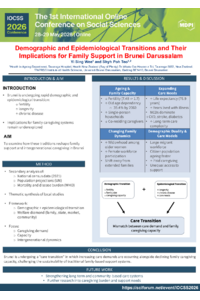
Brunei Darussalam has undergone a rapid demographic and epidemiological transition characterised by declining fertility, increased life expectancy, and a shift from infectious diseases to chronic non-communicable conditions. While these transitions are often examined through macro-level demographic and health indicators, their implications for family systems and intergenerational support structures remain less frequently explored. This study examines how these transitions impact family support systems in Brunei, drawing on a demographic transition and intergenerational support framework situated within the welfare diamond to examine shifts in the roles of family, state, market and community in caregiving.
Methods:
This study draws on secondary analysis and synthesis of national census data, mortality trends, population projections and local studies from Brunei to examine changes in demographic structure and disease patterns. The analysis focuses on their implications for family support and caregiving arrangements, and intergenerational dynamics within households.
Results:
The analysis highlights several intersecting dynamics affecting families. Sustained low fertility and shrinking household size reduce the number of adult children available to support ageing parents, contributing to a rising old-age dependency ratio. Increased longevity, combined with a growing burden of chronic disease extends the duration and complexity of caregiving, particularly for conditions such as cardiovascular disease, diabetes, and dementia. Gendered patterns of widowhood and increased female workforce participation reshape traditional caregiving expectations within households. The presence of a large temporary migrant workforce further produces a demographic duality in which the overall population appears demographically younger, while citizen families age more rapidly.
Conclusions:
These demographic and epidemiological changes are transforming family roles, intergenerational reciprocity, and caregiving arrangements in Brunei. By integrating local demographic and epidemiological data with a family-centred analytic lens, this study highlights pressures on the family as the primary care provider within the welfare diamond. As families become smaller and chronic illness more prevalent, the sustainability of family-based care systems warrants further scrutiny. The experience of Brunei illustrates how rapid transitions can reshape family support structures in small, rapidly modernising societies, offering insights for other ageing populations undergoing similar social and demographic change.
Keywords
Brunei Darussalam
caregiving
demographic transition
family support
population ageing
Poster
Poster - Demographic and epidemiological transitions family support - DRAFT 2.pdf
From Hustle to Hacking: Income–Tech Interactions and Youth Pathways into Cybercrime in Lagos State, Nigeria
Gravity of Policing: A Computational Framework for Measuring Force Intensity in News Coverage