Event submissions
Published
This submission belongs to the session S4. Family Studies of the event The 1st International Online Conference on Social Sciences
Published date
25 May, 2026
Academic Editor
'%3e%3cpath%20d='M12.6657%2010.9104C12.4185%2010.325%2012.0599%209.79327%2011.6097%209.34482C11.1609%208.89508%2010.6293%208.5365%2010.0442%208.28888C10.0389%208.28626%2010.0337%208.28495%2010.0285%208.28233C10.8446%207.69279%2011.3752%206.73249%2011.3752%205.64904C11.3752%203.8542%209.92103%202.39999%208.1262%202.39999C6.33136%202.39999%204.87715%203.8542%204.87715%205.64904C4.87715%206.73249%205.40774%207.69279%206.22393%208.28364C6.21869%208.28626%206.21345%208.28757%206.20821%208.29019C5.62129%208.5378%205.09463%208.89284%204.64265%209.34613C4.1929%209.79493%203.83432%2010.3266%203.58671%2010.9117C3.34345%2011.4845%203.21226%2012.0987%203.20023%2012.7209C3.19988%2012.7349%203.20233%2012.7488%203.20744%2012.7619C3.21255%2012.7749%203.22022%2012.7867%203.22998%2012.7968C3.23975%2012.8068%203.25142%2012.8147%203.26431%2012.8202C3.2772%2012.8256%203.29105%2012.8284%203.30504%2012.8284H4.09109C4.14874%2012.8284%204.19459%2012.7825%204.1959%2012.7262C4.2221%2011.7148%204.62823%2010.7676%205.34617%2010.0497C6.08899%209.30683%207.0755%208.89808%208.1262%208.89808C9.17689%208.89808%2010.1634%209.30683%2010.9062%2010.0497C11.6242%2010.7676%2012.0303%2011.7148%2012.0565%2012.7262C12.0578%2012.7838%2012.1037%2012.8284%2012.1613%2012.8284H12.9474C12.9613%2012.8284%2012.9752%2012.8256%2012.9881%2012.8202C13.001%2012.8147%2013.0126%2012.8068%2013.0224%2012.7968C13.0322%2012.7867%2013.0398%2012.7749%2013.0449%2012.7619C13.0501%2012.7488%2013.0525%2012.7349%2013.0522%2012.7209C13.0391%2012.0947%2012.9094%2011.4855%2012.6657%2010.9104ZM8.1262%207.9024C7.52486%207.9024%206.9589%207.6679%206.53312%207.24211C6.10733%206.81633%205.87283%206.25037%205.87283%205.64904C5.87283%205.0477%206.10733%204.48174%206.53312%204.05596C6.9589%203.63018%207.52486%203.39567%208.1262%203.39567C8.72753%203.39567%209.29349%203.63018%209.71927%204.05596C10.1451%204.48174%2010.3796%205.0477%2010.3796%205.64904C10.3796%206.25037%2010.1451%206.81633%209.71927%207.24211C9.29349%207.6679%208.72753%207.9024%208.1262%207.9024Z'%20fill='%235D1EE1'/%3e%3c/g%3e%3c/svg%3e) Antonio Bova
Antonio BovaCitation
Patricia Castro-López, María Sánchez-Jiménez, Pablo Fernández-Arias, Diego Vergara, The emotional burden on families supporting children with ADHD at school, in Proceedings of The 1st International Online Conference on Social Sciences, 28 May–29 May 2026, MDPI: Basel, Switzerland
Share
Email
Facebook
Twitter
LinkedIn
The emotional burden on families supporting children with ADHD at school

Patricia Castro-López 1

María Sánchez-Jiménez 1

Pablo Fernández-Arias 1

Diego Vergara 1
1. Technology, Instruction and Design in Engineering and Education Research Group (TiDEE.rg), Facultad de Ciencias y Artes, Universidad Católica de Ávila (UCAV), Calle Canteros s/n, 05005, Ávila, España.
Abstract
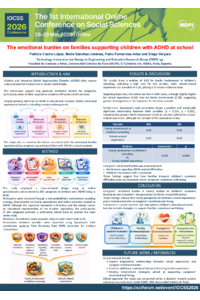
Introduction: Supporting children with Attention Deficit Hyperactivity Disorder (ADHD) at school involves constant family supervision, which can affect the emotional well-being of caregivers. This study examines factors associated with this emotional burden in the context of school support, focusing on family experiences.
Method: A cross-sectional study was conducted using an online questionnaire administered to 205 caregivers of children with ADHD residing in Spain. Participants were recruited through a non-probabilistic convenience sampling procedure via family associations an online networks in Spain. Although this constitutes a limitation and the sample is not representative of the wider population, the participation of 205 caregivers provides a sufficiently robust basis to offer insights into the topic under study. Six indicators were assessed using a 5-point Likert scale (1-5), focusing on (i) help with schoolwork, (ii) the emotional impact of the children's behavior, (iii) attributions concerning ADHD-related difficulties, (iv) frustration with tasks, (v) perceived teacher support, and (vi) extracurricular support. Given the ordinal nature of the variables, descriptive statistics were calculated using medians (Md) and quartile deviations (QD). Descriptive statistics and Spearman correlations with correction for multiple comparisons (FDR) were calculated.
Results: Findings showed high levels of family involvement in the children's schooling (Md= 4.33; QD= 0.33), accompanied by a school-related experience perceived as moderately demanding (Md= 3.33; QD= 0.50). Caregivers' emotional burden was associated with attributions concerning ADHD-related difficulties and with children's frustration regarding schoolwork. These results suggest that families' interpretations of children's academic difficulties play an important role in caregivers' emotional well-being.
Conclusions: Emotional burden among families is associated with children's frustration and with attributions concerning ADHD-related difficulties, suggesting that how families interpret these experiences plays a fundamental role in their emotional well-being. These findings highlight the need for interventions that not only address the children's educational needs but also incorporate specific strategies aimed at supporting families' emotional well-being.
Keywords
ADHD
Caregivers
Schooling
Wellbeing
Poster
The emotional burden on families supporting children with ADHD at school_Patricia_Castro_et_al.pdf
Union formalization, pregnancy support, and exclusive breastfeeding for six months among young mothers in Nairobi, Kenya
Do Family Ties Matter for Volunteerism in Later Life? Evidence From Asian Midlife and Older Adults and Other Ethnoracial Groups