Event submissions
Published
This submission belongs to the session S2. Aging, Childhood and Youth Studies of the event The 1st International Online Conference on Social Sciences
Published date
25 May, 2026
Academic Editor
'%3e%3cpath%20d='M12.6657%2010.9104C12.4185%2010.325%2012.0599%209.79327%2011.6097%209.34482C11.1609%208.89508%2010.6293%208.5365%2010.0442%208.28888C10.0389%208.28626%2010.0337%208.28495%2010.0285%208.28233C10.8446%207.69279%2011.3752%206.73249%2011.3752%205.64904C11.3752%203.8542%209.92103%202.39999%208.1262%202.39999C6.33136%202.39999%204.87715%203.8542%204.87715%205.64904C4.87715%206.73249%205.40774%207.69279%206.22393%208.28364C6.21869%208.28626%206.21345%208.28757%206.20821%208.29019C5.62129%208.5378%205.09463%208.89284%204.64265%209.34613C4.1929%209.79493%203.83432%2010.3266%203.58671%2010.9117C3.34345%2011.4845%203.21226%2012.0987%203.20023%2012.7209C3.19988%2012.7349%203.20233%2012.7488%203.20744%2012.7619C3.21255%2012.7749%203.22022%2012.7867%203.22998%2012.7968C3.23975%2012.8068%203.25142%2012.8147%203.26431%2012.8202C3.2772%2012.8256%203.29105%2012.8284%203.30504%2012.8284H4.09109C4.14874%2012.8284%204.19459%2012.7825%204.1959%2012.7262C4.2221%2011.7148%204.62823%2010.7676%205.34617%2010.0497C6.08899%209.30683%207.0755%208.89808%208.1262%208.89808C9.17689%208.89808%2010.1634%209.30683%2010.9062%2010.0497C11.6242%2010.7676%2012.0303%2011.7148%2012.0565%2012.7262C12.0578%2012.7838%2012.1037%2012.8284%2012.1613%2012.8284H12.9474C12.9613%2012.8284%2012.9752%2012.8256%2012.9881%2012.8202C13.001%2012.8147%2013.0126%2012.8068%2013.0224%2012.7968C13.0322%2012.7867%2013.0398%2012.7749%2013.0449%2012.7619C13.0501%2012.7488%2013.0525%2012.7349%2013.0522%2012.7209C13.0391%2012.0947%2012.9094%2011.4855%2012.6657%2010.9104ZM8.1262%207.9024C7.52486%207.9024%206.9589%207.6679%206.53312%207.24211C6.10733%206.81633%205.87283%206.25037%205.87283%205.64904C5.87283%205.0477%206.10733%204.48174%206.53312%204.05596C6.9589%203.63018%207.52486%203.39567%208.1262%203.39567C8.72753%203.39567%209.29349%203.63018%209.71927%204.05596C10.1451%204.48174%2010.3796%205.0477%2010.3796%205.64904C10.3796%206.25037%2010.1451%206.81633%209.71927%207.24211C9.29349%207.6679%208.72753%207.9024%208.1262%207.9024Z'%20fill='%235D1EE1'/%3e%3c/g%3e%3c/svg%3e) Louis Moustakas
Louis MoustakasCitation
Ana Belén García-López, César Bernal-Bravo, Francisco Nieto Escámez, Enhancing Quality of Life in Institutionalized Older Adults through Immersive Virtual Reality: A Feasibility and Acceptance Pilot Study based on Ryff’s Model, in Proceedings of The 1st International Online Conference on Social Sciences, 28 May–29 May 2026, MDPI: Basel, Switzerland
Share
Email
Facebook
Twitter
LinkedIn
Enhancing Quality of Life in Institutionalized Older Adults through Immersive Virtual Reality: A Feasibility and Acceptance Pilot Study based on Ryff’s Model
'%3e%3cpath%20d='M12.6647%2010.9104C12.4176%2010.325%2012.0589%209.7933%2011.6088%209.34485C11.16%208.89511%2010.6283%208.53653%2010.0432%208.28891C10.038%208.28629%2010.0327%208.28498%2010.0275%208.28236C10.8437%207.69282%2011.3743%206.73252%2011.3743%205.64907C11.3743%203.85423%209.92005%202.40002%208.12522%202.40002C6.33038%202.40002%204.87618%203.85423%204.87618%205.64907C4.87618%206.73252%205.40677%207.69282%206.22296%208.28367C6.21772%208.28629%206.21248%208.2876%206.20724%208.29022C5.62031%208.53783%205.09365%208.89287%204.64167%209.34616C4.19192%209.79496%203.83334%2010.3266%203.58573%2010.9117C3.34247%2011.4846%203.21128%2012.0987%203.19925%2012.721C3.1989%2012.735%203.20135%2012.7489%203.20646%2012.7619C3.21157%2012.7749%203.21924%2012.7868%203.22901%2012.7968C3.23877%2012.8068%203.25045%2012.8148%203.26334%2012.8202C3.27623%2012.8256%203.29007%2012.8284%203.30406%2012.8284H4.09012C4.14776%2012.8284%204.19362%2012.7825%204.19493%2012.7262C4.22113%2011.7148%204.62726%2010.7676%205.34519%2010.0497C6.08802%209.30686%207.07452%208.89811%208.12522%208.89811C9.17592%208.89811%2010.1624%209.30686%2010.9052%2010.0497C11.6232%2010.7676%2012.0293%2011.7148%2012.0555%2012.7262C12.0568%2012.7839%2012.1027%2012.8284%2012.1603%2012.8284H12.9464C12.9604%2012.8284%2012.9742%2012.8256%2012.9871%2012.8202C13%2012.8148%2013.0117%2012.8068%2013.0214%2012.7968C13.0312%2012.7868%2013.0389%2012.7749%2013.044%2012.7619C13.0491%2012.7489%2013.0515%2012.735%2013.0512%2012.721C13.0381%2012.0947%2012.9084%2011.4856%2012.6647%2010.9104ZM8.12522%207.90243C7.52388%207.90243%206.95792%207.66793%206.53214%207.24215C6.10636%206.81636%205.87185%206.2504%205.87185%205.64907C5.87185%205.04773%206.10636%204.48177%206.53214%204.05599C6.95792%203.63021%207.52388%203.3957%208.12522%203.3957C8.72655%203.3957%209.29252%203.63021%209.7183%204.05599C10.1441%204.48177%2010.3786%205.04773%2010.3786%205.64907C10.3786%206.2504%2010.1441%206.81636%209.7183%207.24215C9.29252%207.66793%208.72655%207.90243%208.12522%207.90243Z'%20fill='%235D1EE1'/%3e%3c/g%3e%3c/svg%3e)
Ana Belén García-López 1,2

César Bernal-Bravo 3

Francisco Nieto Escámez 1,4
1. Department of Psychology, University of Almería, Almería, 04120, Spain.
2. San Juan de Dios Residence, Sevilla, 41004, Spain.
3. Department of Education Sciences, King Juan Carlos University, Fuenlabrada Campus, Madrid, 28943, Spain.
4. Research Center for Wellbeing and Social Inclusion (CIBIS), University of Almería, Almería, 04120, Spain.
Abstract
Introduction: Older adults residing in long-term care facilities often face challenges such as reduced autonomy and limited opportunities for personal growth. While Immersive Virtual Reality (IVR) offers potential for psychological support, evidence regarding its acceptance and feasibility among this population, particularly for those without cognitive impairment, is limited. This study aims to evaluate the feasibility, user engagement, and safety of an IVR intervention designed around Ryff’s Psychological Well-Being dimensions, contrasting active versus passive participation.
Method: An exploratory pilot study was conducted with 12 residents of a long-term care facility (aged 67–95) without cognitive impairment. Participants were assigned to three groups: Active IVR (interactive tasks within WebXR environments), Passive IVR (observational experience of the same environments), and Control. The intervention comprised eight sessions. Assessment included the Ryff Psychological Well-Being Scale (pre-post), the NPT-ES scale (engagement/social interaction), and presence/satisfaction questionnaires.
Results: Although pre–post statistical analysis of the Ryff scale showed no significant changes—consistent with the pilot's exploratory sample size—feasibility indicators were highly positive. Both IVR groups reported high scores in presence and strong engagement (NPT-ES), with participants expressing enjoyment and positive social interaction. Crucially, rejection rates and adverse effects (cybersickness) were negligible, with most participants feeling safe and willing to repeat the experience, regardless of the active or passive modality.
Conclusions: Implementing IVR interventions for older adults in residential care is feasible and safe, generating high satisfaction and positive engagement. While the eight-session pilot did not yield statistical shifts in deep psychological constructs, the high acceptance suggests IVR is a promising tool for social enrichment and meaningful engagement. Future research should scale up the sample size to test clinical efficacy.
Keywords: Virtual Reality; Older Adults; Feasibility; Ryff’s Well-Being; Long-Term Care; Quality of Life.
Keywords
Virtual Reality
Older Adults
Feasibility
Ryff’s Well-Being
Social Sciences
Quality of Life.
Poster
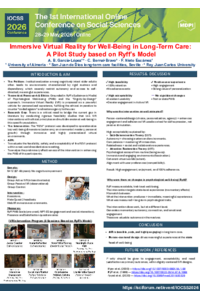
Poster 1 st international Conference on Social science.pdf
Mosque Architecture in Bali as Social Technology: Islamic–Hindu Acculturation and Cultural Sustainability
Perceptions of Algorithmic Fairness, Income Stability, and Social Protection as Determinants of Income Volatility in India’s Gig Economy