Event submissions
Published
This submission belongs to the session S2. Aging, Childhood and Youth Studies of the event The 1st International Online Conference on Social Sciences
Published date
25 May, 2026
Academic Editor
'%3e%3cpath%20d='M12.6657%2010.9104C12.4185%2010.325%2012.0599%209.79327%2011.6097%209.34482C11.1609%208.89508%2010.6293%208.5365%2010.0442%208.28888C10.0389%208.28626%2010.0337%208.28495%2010.0285%208.28233C10.8446%207.69279%2011.3752%206.73249%2011.3752%205.64904C11.3752%203.8542%209.92103%202.39999%208.1262%202.39999C6.33136%202.39999%204.87715%203.8542%204.87715%205.64904C4.87715%206.73249%205.40774%207.69279%206.22393%208.28364C6.21869%208.28626%206.21345%208.28757%206.20821%208.29019C5.62129%208.5378%205.09463%208.89284%204.64265%209.34613C4.1929%209.79493%203.83432%2010.3266%203.58671%2010.9117C3.34345%2011.4845%203.21226%2012.0987%203.20023%2012.7209C3.19988%2012.7349%203.20233%2012.7488%203.20744%2012.7619C3.21255%2012.7749%203.22022%2012.7867%203.22998%2012.7968C3.23975%2012.8068%203.25142%2012.8147%203.26431%2012.8202C3.2772%2012.8256%203.29105%2012.8284%203.30504%2012.8284H4.09109C4.14874%2012.8284%204.19459%2012.7825%204.1959%2012.7262C4.2221%2011.7148%204.62823%2010.7676%205.34617%2010.0497C6.08899%209.30683%207.0755%208.89808%208.1262%208.89808C9.17689%208.89808%2010.1634%209.30683%2010.9062%2010.0497C11.6242%2010.7676%2012.0303%2011.7148%2012.0565%2012.7262C12.0578%2012.7838%2012.1037%2012.8284%2012.1613%2012.8284H12.9474C12.9613%2012.8284%2012.9752%2012.8256%2012.9881%2012.8202C13.001%2012.8147%2013.0126%2012.8068%2013.0224%2012.7968C13.0322%2012.7867%2013.0398%2012.7749%2013.0449%2012.7619C13.0501%2012.7488%2013.0525%2012.7349%2013.0522%2012.7209C13.0391%2012.0947%2012.9094%2011.4855%2012.6657%2010.9104ZM8.1262%207.9024C7.52486%207.9024%206.9589%207.6679%206.53312%207.24211C6.10733%206.81633%205.87283%206.25037%205.87283%205.64904C5.87283%205.0477%206.10733%204.48174%206.53312%204.05596C6.9589%203.63018%207.52486%203.39567%208.1262%203.39567C8.72753%203.39567%209.29349%203.63018%209.71927%204.05596C10.1451%204.48174%2010.3796%205.0477%2010.3796%205.64904C10.3796%206.25037%2010.1451%206.81633%209.71927%207.24211C9.29349%207.6679%208.72753%207.9024%208.1262%207.9024Z'%20fill='%235D1EE1'/%3e%3c/g%3e%3c/svg%3e) Daniel McCarthy
Daniel McCarthyCitation
Gintarė Vaznonienė, Agnieszka Wojewódzka Wiewiórska, HOW DO WE FEEL AT DIFFERENT AGES? APERSPECTIVE ON SUBJECTIVE WELL-BEING AND HEALTH IN LITHUANIA AND POLAND, in Proceedings of The 1st International Online Conference on Social Sciences, 28 May–29 May 2026, MDPI: Basel, Switzerland
Share
Email
Facebook
Twitter
LinkedIn
HOW DO WE FEEL AT DIFFERENT AGES? APERSPECTIVE ON SUBJECTIVE WELL-BEING AND HEALTH IN LITHUANIA AND POLAND
'%3e%3cpath%20d='M12.6647%2010.9104C12.4176%2010.325%2012.0589%209.7933%2011.6088%209.34485C11.16%208.89511%2010.6283%208.53653%2010.0432%208.28891C10.038%208.28629%2010.0327%208.28498%2010.0275%208.28236C10.8437%207.69282%2011.3743%206.73252%2011.3743%205.64907C11.3743%203.85423%209.92005%202.40002%208.12522%202.40002C6.33038%202.40002%204.87618%203.85423%204.87618%205.64907C4.87618%206.73252%205.40677%207.69282%206.22296%208.28367C6.21772%208.28629%206.21248%208.2876%206.20724%208.29022C5.62031%208.53783%205.09365%208.89287%204.64167%209.34616C4.19192%209.79496%203.83334%2010.3266%203.58573%2010.9117C3.34247%2011.4846%203.21128%2012.0987%203.19925%2012.721C3.1989%2012.735%203.20135%2012.7489%203.20646%2012.7619C3.21157%2012.7749%203.21924%2012.7868%203.22901%2012.7968C3.23877%2012.8068%203.25045%2012.8148%203.26334%2012.8202C3.27623%2012.8256%203.29007%2012.8284%203.30406%2012.8284H4.09012C4.14776%2012.8284%204.19362%2012.7825%204.19493%2012.7262C4.22113%2011.7148%204.62726%2010.7676%205.34519%2010.0497C6.08802%209.30686%207.07452%208.89811%208.12522%208.89811C9.17592%208.89811%2010.1624%209.30686%2010.9052%2010.0497C11.6232%2010.7676%2012.0293%2011.7148%2012.0555%2012.7262C12.0568%2012.7839%2012.1027%2012.8284%2012.1603%2012.8284H12.9464C12.9604%2012.8284%2012.9742%2012.8256%2012.9871%2012.8202C13%2012.8148%2013.0117%2012.8068%2013.0214%2012.7968C13.0312%2012.7868%2013.0389%2012.7749%2013.044%2012.7619C13.0491%2012.7489%2013.0515%2012.735%2013.0512%2012.721C13.0381%2012.0947%2012.9084%2011.4856%2012.6647%2010.9104ZM8.12522%207.90243C7.52388%207.90243%206.95792%207.66793%206.53214%207.24215C6.10636%206.81636%205.87185%206.2504%205.87185%205.64907C5.87185%205.04773%206.10636%204.48177%206.53214%204.05599C6.95792%203.63021%207.52388%203.3957%208.12522%203.3957C8.72655%203.3957%209.29252%203.63021%209.7183%204.05599C10.1441%204.48177%2010.3786%205.04773%2010.3786%205.64907C10.3786%206.2504%2010.1441%206.81636%209.7183%207.24215C9.29252%207.66793%208.72655%207.90243%208.12522%207.90243Z'%20fill='%235D1EE1'/%3e%3c/g%3e%3c/svg%3e)
Gintarė Vaznonienė 1
Agnieszka Wojewódzka Wiewiórska 2
1. Faculty of Bioeconomy Development, Vytautas Magnus university, Akademija, Lithuania.
2. Faculty of Economics, Warsaw University of Life Sciences, Warsaw, Poland
Abstract
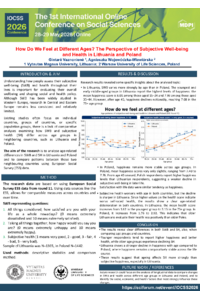
Understanding how people assess their subjective well-being (SWB) and health throughout their lives is important for evaluating their overall well-being and shaping social and health policy. Although SWB has been widely studied in Western Europe, research in Central and Eastern Europe remains less consistent and relatively limited. Existing studies often focus on individual countries, groups of countries, or specific population groups; there is a lack of comparative analyses examining how SWB and subjective health (SH) differ across age groups in neighbouring countries, such as Lithuania and Poland. The aim of this study is to analyse age-related differences in SWB and SH in Lithuania and Poland and to compare patterns between these two neighbouring countries using European Social Survey (ESS) data. The study uses data from the ESS according to selected survey rounds. SWB is measured according to respondents' self-reported happiness, and SH is assessed according to individuals' assessment of their general health. The analysis compares different age groups in order to identify trends in perceived well-being and health throughout life. In addition, the study examines possible changes over time. The study is based on a quantitative comparative research design, employing descriptive statistical methods and conducting a cross-national (Lithuania and Poland) and cross-age-group comparative analysis, while also assessing changes in the indicators under study over time. The results reveal clear differences in both SWB and SH, both when comparing age groups and countries. By examining the relationship between age, SWB and SH, this study contributes to the broader literature on well-being, aging, and subjective health in Central and Eastern Europe. Moreover, these results may also be important for policymakers seeking to improve the well-being and health indicators of different age groups.
Keywords
Age groups
subjective wellbeing
subjective health
Lithuania
Poland
Poster
Poster_Vaznoniene_Wiewiorska 2026 05.pdf
Representation of Minority Groups in Pakistani Media
Technology-Facilitated Intimate Partner Sexual Violence: An Empirical Study on Socio-Techno Patterns, Prevalence, and Impacts Among Survivors of Intimate Partner Violence (IPV)