Event submissions
Published
This submission belongs to the session S3. Gender Studies of the event The 1st International Online Conference on Social Sciences
Published date
25 May, 2026
Academic Editor
'%3e%3cpath%20d='M12.6657%2010.9104C12.4185%2010.325%2012.0599%209.79327%2011.6097%209.34482C11.1609%208.89508%2010.6293%208.5365%2010.0442%208.28888C10.0389%208.28626%2010.0337%208.28495%2010.0285%208.28233C10.8446%207.69279%2011.3752%206.73249%2011.3752%205.64904C11.3752%203.8542%209.92103%202.39999%208.1262%202.39999C6.33136%202.39999%204.87715%203.8542%204.87715%205.64904C4.87715%206.73249%205.40774%207.69279%206.22393%208.28364C6.21869%208.28626%206.21345%208.28757%206.20821%208.29019C5.62129%208.5378%205.09463%208.89284%204.64265%209.34613C4.1929%209.79493%203.83432%2010.3266%203.58671%2010.9117C3.34345%2011.4845%203.21226%2012.0987%203.20023%2012.7209C3.19988%2012.7349%203.20233%2012.7488%203.20744%2012.7619C3.21255%2012.7749%203.22022%2012.7867%203.22998%2012.7968C3.23975%2012.8068%203.25142%2012.8147%203.26431%2012.8202C3.2772%2012.8256%203.29105%2012.8284%203.30504%2012.8284H4.09109C4.14874%2012.8284%204.19459%2012.7825%204.1959%2012.7262C4.2221%2011.7148%204.62823%2010.7676%205.34617%2010.0497C6.08899%209.30683%207.0755%208.89808%208.1262%208.89808C9.17689%208.89808%2010.1634%209.30683%2010.9062%2010.0497C11.6242%2010.7676%2012.0303%2011.7148%2012.0565%2012.7262C12.0578%2012.7838%2012.1037%2012.8284%2012.1613%2012.8284H12.9474C12.9613%2012.8284%2012.9752%2012.8256%2012.9881%2012.8202C13.001%2012.8147%2013.0126%2012.8068%2013.0224%2012.7968C13.0322%2012.7867%2013.0398%2012.7749%2013.0449%2012.7619C13.0501%2012.7488%2013.0525%2012.7349%2013.0522%2012.7209C13.0391%2012.0947%2012.9094%2011.4855%2012.6657%2010.9104ZM8.1262%207.9024C7.52486%207.9024%206.9589%207.6679%206.53312%207.24211C6.10733%206.81633%205.87283%206.25037%205.87283%205.64904C5.87283%205.0477%206.10733%204.48174%206.53312%204.05596C6.9589%203.63018%207.52486%203.39567%208.1262%203.39567C8.72753%203.39567%209.29349%203.63018%209.71927%204.05596C10.1451%204.48174%2010.3796%205.0477%2010.3796%205.64904C10.3796%206.25037%2010.1451%206.81633%209.71927%207.24211C9.29349%207.6679%208.72753%207.9024%208.1262%207.9024Z'%20fill='%235D1EE1'/%3e%3c/g%3e%3c/svg%3e) Pan Wang
Pan WangCitation
María Sánchez-Jiménez, Pablo Fernández-Arias, Diego Vergara, Engineering programs in rural Spain towards 2030: Enrollment trends and the gender gap, in Proceedings of The 1st International Online Conference on Social Sciences, 28 May–29 May 2026, MDPI: Basel, Switzerland
Share
Email
Facebook
Twitter
LinkedIn
Engineering programs in rural Spain towards 2030: Enrollment trends and the gender gap

María Sánchez-Jiménez 1

Pablo Fernández-Arias 1

Diego Vergara 1
1. Research Group on Technology, Instruction and Design in Engineering and Education (TiDEE.rg), Universidad Católica de Ávila, C/ Canteros s/n, 05005 Ávila, Spain
Abstract
Introduction
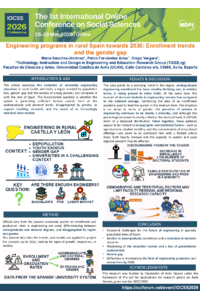
This article examines university engineering education in Spain’s rural areas, with particular attention paid to depopulated regions such as Castile and León, and identifies the gender gap as the system’s principal constraint. In addition to demographic decline, it assesses the extent to which limited female participation is constraining the development of human capital in comparison with the rest of the country.
Method
Official data on engineering enrollment and graduation rates are used, broken down by level (bachelor's and doctorate), region, and gender. The analysis prioritizes the evolution of female participation and projects trends up to 2030.
Results
The data show a decrease in enrollment and low participation at the doctoral level, but the most significant problem is the persistent underrepresentation of women. Women remain a minority at the undergraduate level and have not achieved parity at the doctoral level. This gap directly reduces the available talent pool and exacerbates the effects of demographic decline.
Conclusions
The gender gap is not only a matter of equity, but also the main obstacle to the system's sustainability. Without the greater incorporation of women, Castile and León will continue to lose training and research capacity by 2030.
Keywords
Despoblación
Matrícula de ingeniería
Canal de doctorado
Brecha de género
Poster
IOCSS - Sánchez-Jiménez et al 2026.pdf
Gender Norms and Popular Culture: Feminism and Masculinity Perceptions in Türkiye
Intersectionality and Triple Marginalization: A Gendered Analysis of the Educational Migration of Indigenous Women Students in Bangladesh