Event submissions
Published
This submission belongs to the session S3. Statistics and Operational Research of the event The 2nd International Online Conference on Mathematics and Applications
Published date
04 Jun, 2026
Academic Editor
'%3e%3cpath%20d='M12.6657%2010.9104C12.4185%2010.325%2012.0599%209.79327%2011.6097%209.34482C11.1609%208.89508%2010.6293%208.5365%2010.0442%208.28888C10.0389%208.28626%2010.0337%208.28495%2010.0285%208.28233C10.8446%207.69279%2011.3752%206.73249%2011.3752%205.64904C11.3752%203.8542%209.92103%202.39999%208.1262%202.39999C6.33136%202.39999%204.87715%203.8542%204.87715%205.64904C4.87715%206.73249%205.40774%207.69279%206.22393%208.28364C6.21869%208.28626%206.21345%208.28757%206.20821%208.29019C5.62129%208.5378%205.09463%208.89284%204.64265%209.34613C4.1929%209.79493%203.83432%2010.3266%203.58671%2010.9117C3.34345%2011.4845%203.21226%2012.0987%203.20023%2012.7209C3.19988%2012.7349%203.20233%2012.7488%203.20744%2012.7619C3.21255%2012.7749%203.22022%2012.7867%203.22998%2012.7968C3.23975%2012.8068%203.25142%2012.8147%203.26431%2012.8202C3.2772%2012.8256%203.29105%2012.8284%203.30504%2012.8284H4.09109C4.14874%2012.8284%204.19459%2012.7825%204.1959%2012.7262C4.2221%2011.7148%204.62823%2010.7676%205.34617%2010.0497C6.08899%209.30683%207.0755%208.89808%208.1262%208.89808C9.17689%208.89808%2010.1634%209.30683%2010.9062%2010.0497C11.6242%2010.7676%2012.0303%2011.7148%2012.0565%2012.7262C12.0578%2012.7838%2012.1037%2012.8284%2012.1613%2012.8284H12.9474C12.9613%2012.8284%2012.9752%2012.8256%2012.9881%2012.8202C13.001%2012.8147%2013.0126%2012.8068%2013.0224%2012.7968C13.0322%2012.7867%2013.0398%2012.7749%2013.0449%2012.7619C13.0501%2012.7488%2013.0525%2012.7349%2013.0522%2012.7209C13.0391%2012.0947%2012.9094%2011.4855%2012.6657%2010.9104ZM8.1262%207.9024C7.52486%207.9024%206.9589%207.6679%206.53312%207.24211C6.10733%206.81633%205.87283%206.25037%205.87283%205.64904C5.87283%205.0477%206.10733%204.48174%206.53312%204.05596C6.9589%203.63018%207.52486%203.39567%208.1262%203.39567C8.72753%203.39567%209.29349%203.63018%209.71927%204.05596C10.1451%204.48174%2010.3796%205.0477%2010.3796%205.64904C10.3796%206.25037%2010.1451%206.81633%209.71927%207.24211C9.29349%207.6679%208.72753%207.9024%208.1262%207.9024Z'%20fill='%235D1EE1'/%3e%3c/g%3e%3c/svg%3e) Antonio Di Crescenzo
Antonio Di CrescenzoCitation
Arnulfo Dominguez-Hernandez, Elisa Dominguez-Hernandez, Martha Elena Domínguez Hernandez, Free-energy structure of the entropy–extropy ratio on the probability simplex, in Proceedings of The 2nd International Online Conference on Mathematics and Applications, 10 June–12 June 2026, MDPI: Basel, Switzerland
Share
Email
Facebook
Twitter
LinkedIn
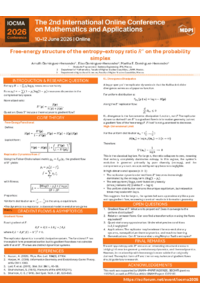
Free-energy structure of the entropy–extropy ratio on the probability simplex
'%3e%3cpath%20d='M12.6647%2010.9104C12.4176%2010.325%2012.0589%209.7933%2011.6088%209.34485C11.16%208.89511%2010.6283%208.53653%2010.0432%208.28891C10.038%208.28629%2010.0327%208.28498%2010.0275%208.28236C10.8437%207.69282%2011.3743%206.73252%2011.3743%205.64907C11.3743%203.85423%209.92005%202.40002%208.12522%202.40002C6.33038%202.40002%204.87618%203.85423%204.87618%205.64907C4.87618%206.73252%205.40677%207.69282%206.22296%208.28367C6.21772%208.28629%206.21248%208.2876%206.20724%208.29022C5.62031%208.53783%205.09365%208.89287%204.64167%209.34616C4.19192%209.79496%203.83334%2010.3266%203.58573%2010.9117C3.34247%2011.4846%203.21128%2012.0987%203.19925%2012.721C3.1989%2012.735%203.20135%2012.7489%203.20646%2012.7619C3.21157%2012.7749%203.21924%2012.7868%203.22901%2012.7968C3.23877%2012.8068%203.25045%2012.8148%203.26334%2012.8202C3.27623%2012.8256%203.29007%2012.8284%203.30406%2012.8284H4.09012C4.14776%2012.8284%204.19362%2012.7825%204.19493%2012.7262C4.22113%2011.7148%204.62726%2010.7676%205.34519%2010.0497C6.08802%209.30686%207.07452%208.89811%208.12522%208.89811C9.17592%208.89811%2010.1624%209.30686%2010.9052%2010.0497C11.6232%2010.7676%2012.0293%2011.7148%2012.0555%2012.7262C12.0568%2012.7839%2012.1027%2012.8284%2012.1603%2012.8284H12.9464C12.9604%2012.8284%2012.9742%2012.8256%2012.9871%2012.8202C13%2012.8148%2013.0117%2012.8068%2013.0214%2012.7968C13.0312%2012.7868%2013.0389%2012.7749%2013.044%2012.7619C13.0491%2012.7489%2013.0515%2012.735%2013.0512%2012.721C13.0381%2012.0947%2012.9084%2011.4856%2012.6647%2010.9104ZM8.12522%207.90243C7.52388%207.90243%206.95792%207.66793%206.53214%207.24215C6.10636%206.81636%205.87185%206.2504%205.87185%205.64907C5.87185%205.04773%206.10636%204.48177%206.53214%204.05599C6.95792%203.63021%207.52388%203.3957%208.12522%203.3957C8.72655%203.3957%209.29252%203.63021%209.7183%204.05599C10.1441%204.48177%2010.3786%205.04773%2010.3786%205.64907C10.3786%206.2504%2010.1441%206.81636%209.7183%207.24215C9.29252%207.66793%208.72655%207.90243%208.12522%207.90243Z'%20fill='%235D1EE1'/%3e%3c/g%3e%3c/svg%3e)
Arnulfo Dominguez-Hernandez 1
Elisa Dominguez-Hernandez 2

Martha Elena Domínguez Hernandez 3
1. Graduate Programme in Systems Engineering, Research and Graduate Studies Section, Higher School of Mechanical and Electrical Engineering, National Polytechnic Institute, Gustavo A. Madero, 07738, Mexico.
2. Department of Mathematics, Faculty of Higher Studies Cuautitlán, National Autonomous University of Mexico, Cuautitlán Izcalli,54714, Mexico.
3. Department of Agricultural Sciences, Faculty of Higher Studies Cuautitlán, National Autonomous University of Mexico, Cuautitlán Izcalli 54714, Mexico
Abstract
Background:
Information measures such as Shannon entropy and its complementary quantity, extropy, play a central role in statistical physics, information theory, and eco-evolutionary dynamics. However, the geometric and thermodynamic interpretation of entropy–extropy relationships on the probability simplex remains largely unexplored.
Objective:
This work aims to establish a variational and thermodynamic structure for the normalised entropy–extropy ratio, and to determine whether it induces a dissipative gradient flow compatible with nonequilibrium relaxation.
Methods:
Using the Fisher–Shahshahani metric on the probability simplex, the Riemannian gradient flow is derived and expressed in replicator form. The relationship with Kullback–Leibler dissipation is analysed, and a generalised free energy functional is constructed to compare gradient dynamics.
Results:
The gradient flow is shown to be equivalent, up to time reparametrization, to the Fisher–Shahshahani gradient flow of the generalised free energy. The functional decreases monotonically along trajectories, the uniform distribution emerges as the unique equilibrium, and the evolution corresponds to nonequilibrium thermodynamic relaxation governed by the KL-divergence dissipation.
Conclusions:
The entropy–extropy ratio admits a free energy interpretation linking information geometry, replicator dynamics, and thermodynamic dissipation. This framework provides a structural measure of the balance between dispersion and organisation in probabilistic systems and suggests its relevance in quasi-stationary nonequilibrium regimes and to high dimensional limits.
Keywords
Information Geometry
Fisher Information Metric
Gradient Flow
Entropy–Extropy Ratio
Kullback–Leibler Divergence
Replicator Dynamics
Nonequilibrium Thermodynamics
Free Energy
Poster
poster sciforum-171449_ufo.pdf
A Deep Learning-based Comparative Analysis for EUR/USD Exchange Rate Prediction
Asymptotic Properties of M-estimators