Event submissions
Published
This submission belongs to the session S3. Statistics and Operational Research of the event The 2nd International Online Conference on Mathematics and Applications
Published date
04 Jun, 2026
Academic Editor
'%3e%3cpath%20d='M12.6657%2010.9104C12.4185%2010.325%2012.0599%209.79327%2011.6097%209.34482C11.1609%208.89508%2010.6293%208.5365%2010.0442%208.28888C10.0389%208.28626%2010.0337%208.28495%2010.0285%208.28233C10.8446%207.69279%2011.3752%206.73249%2011.3752%205.64904C11.3752%203.8542%209.92103%202.39999%208.1262%202.39999C6.33136%202.39999%204.87715%203.8542%204.87715%205.64904C4.87715%206.73249%205.40774%207.69279%206.22393%208.28364C6.21869%208.28626%206.21345%208.28757%206.20821%208.29019C5.62129%208.5378%205.09463%208.89284%204.64265%209.34613C4.1929%209.79493%203.83432%2010.3266%203.58671%2010.9117C3.34345%2011.4845%203.21226%2012.0987%203.20023%2012.7209C3.19988%2012.7349%203.20233%2012.7488%203.20744%2012.7619C3.21255%2012.7749%203.22022%2012.7867%203.22998%2012.7968C3.23975%2012.8068%203.25142%2012.8147%203.26431%2012.8202C3.2772%2012.8256%203.29105%2012.8284%203.30504%2012.8284H4.09109C4.14874%2012.8284%204.19459%2012.7825%204.1959%2012.7262C4.2221%2011.7148%204.62823%2010.7676%205.34617%2010.0497C6.08899%209.30683%207.0755%208.89808%208.1262%208.89808C9.17689%208.89808%2010.1634%209.30683%2010.9062%2010.0497C11.6242%2010.7676%2012.0303%2011.7148%2012.0565%2012.7262C12.0578%2012.7838%2012.1037%2012.8284%2012.1613%2012.8284H12.9474C12.9613%2012.8284%2012.9752%2012.8256%2012.9881%2012.8202C13.001%2012.8147%2013.0126%2012.8068%2013.0224%2012.7968C13.0322%2012.7867%2013.0398%2012.7749%2013.0449%2012.7619C13.0501%2012.7488%2013.0525%2012.7349%2013.0522%2012.7209C13.0391%2012.0947%2012.9094%2011.4855%2012.6657%2010.9104ZM8.1262%207.9024C7.52486%207.9024%206.9589%207.6679%206.53312%207.24211C6.10733%206.81633%205.87283%206.25037%205.87283%205.64904C5.87283%205.0477%206.10733%204.48174%206.53312%204.05596C6.9589%203.63018%207.52486%203.39567%208.1262%203.39567C8.72753%203.39567%209.29349%203.63018%209.71927%204.05596C10.1451%204.48174%2010.3796%205.0477%2010.3796%205.64904C10.3796%206.25037%2010.1451%206.81633%209.71927%207.24211C9.29349%207.6679%208.72753%207.9024%208.1262%207.9024Z'%20fill='%235D1EE1'/%3e%3c/g%3e%3c/svg%3e) Antonio Di Crescenzo
Antonio Di CrescenzoCitation
BENAOUDIA Hassina, Kernel-Based Nonparametric Tests for Exponentiality Against Decreasing or Increasing Residual Entropy Alternatives, in Proceedings of The 2nd International Online Conference on Mathematics and Applications, 10 June–12 June 2026, MDPI: Basel, Switzerland
Share
Email
Facebook
Twitter
LinkedIn
Kernel-Based Nonparametric Tests for Exponentiality Against Decreasing or Increasing Residual Entropy Alternatives
'%3e%3cpath%20d='M12.6647%2010.9104C12.4176%2010.325%2012.0589%209.7933%2011.6088%209.34485C11.16%208.89511%2010.6283%208.53653%2010.0432%208.28891C10.038%208.28629%2010.0327%208.28498%2010.0275%208.28236C10.8437%207.69282%2011.3743%206.73252%2011.3743%205.64907C11.3743%203.85423%209.92005%202.40002%208.12522%202.40002C6.33038%202.40002%204.87618%203.85423%204.87618%205.64907C4.87618%206.73252%205.40677%207.69282%206.22296%208.28367C6.21772%208.28629%206.21248%208.2876%206.20724%208.29022C5.62031%208.53783%205.09365%208.89287%204.64167%209.34616C4.19192%209.79496%203.83334%2010.3266%203.58573%2010.9117C3.34247%2011.4846%203.21128%2012.0987%203.19925%2012.721C3.1989%2012.735%203.20135%2012.7489%203.20646%2012.7619C3.21157%2012.7749%203.21924%2012.7868%203.22901%2012.7968C3.23877%2012.8068%203.25045%2012.8148%203.26334%2012.8202C3.27623%2012.8256%203.29007%2012.8284%203.30406%2012.8284H4.09012C4.14776%2012.8284%204.19362%2012.7825%204.19493%2012.7262C4.22113%2011.7148%204.62726%2010.7676%205.34519%2010.0497C6.08802%209.30686%207.07452%208.89811%208.12522%208.89811C9.17592%208.89811%2010.1624%209.30686%2010.9052%2010.0497C11.6232%2010.7676%2012.0293%2011.7148%2012.0555%2012.7262C12.0568%2012.7839%2012.1027%2012.8284%2012.1603%2012.8284H12.9464C12.9604%2012.8284%2012.9742%2012.8256%2012.9871%2012.8202C13%2012.8148%2013.0117%2012.8068%2013.0214%2012.7968C13.0312%2012.7868%2013.0389%2012.7749%2013.044%2012.7619C13.0491%2012.7489%2013.0515%2012.735%2013.0512%2012.721C13.0381%2012.0947%2012.9084%2011.4856%2012.6647%2010.9104ZM8.12522%207.90243C7.52388%207.90243%206.95792%207.66793%206.53214%207.24215C6.10636%206.81636%205.87185%206.2504%205.87185%205.64907C5.87185%205.04773%206.10636%204.48177%206.53214%204.05599C6.95792%203.63021%207.52388%203.3957%208.12522%203.3957C8.72655%203.3957%209.29252%203.63021%209.7183%204.05599C10.1441%204.48177%2010.3786%205.04773%2010.3786%205.64907C10.3786%206.2504%2010.1441%206.81636%209.7183%207.24215C9.29252%207.66793%208.72655%207.90243%208.12522%207.90243Z'%20fill='%235D1EE1'/%3e%3c/g%3e%3c/svg%3e)
BENAOUDIA Hassina 1,2
1. Laboratory of Research in Intelligent Informatics, Mathematics and Applications (RIIMA), Department of probability and statistics, Faculty of mathematics, University of Science and Technology Houari Boumedienne, Bab Ezzouar, Algiers, 16111, Algeria
2. Faculty of Economics, University of Tipaza, Tipaza, 42000, Algeria
Abstract
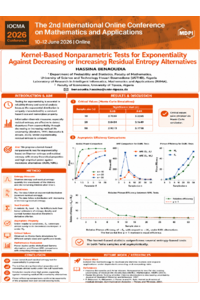
Introduction. Testing for exponentiality plays a central role in reliability theory and survival analysis, since the exponential distribution is uniquely characterized by a constant hazard rate and memoryless property. Classical goodness-of-fit procedures often rely on moment-based methods or distribution-function approaches. More recent developments emphasize information-theoretic measures such as entropy. In particular, residual entropy has proven useful for detecting departures from exponentiality under decreasing or increasing residual life uncertainty alternatives (see Ebrahimi, 1997; Benaoudia and Aissani, 2023), since under exponentiality, the residual entropy is constant.
Methods. In this paper, we propose a nonparametric test for exponentiality based on kernel estimators of Shannon entropy and residual entropy. The approach follows the framework introduced by Belzunce, Navarro, and Guillamon (2001), replacing histogram-based estimators with kernel smoothing techniques. This approach improves the smoothness and convergence of the estimators and reduces dependence on bin selection. A test statistic is constructed to test exponentiality, which exhibits constant residual uncertainty against decreasing or increasing uncertainty. Theoretical properties of the statistic are established under regularity assumptions, including almost-sure convergence of the empirical statistic to the theoretical one under the null hypothesis, applying the standard result on convergence of Stieltjes integrals and using the almost-sure convergence of the empirical kernel distribution to the theoretical distribution.
Results. Critical values of the proposed test are obtained via Monte Carlo simulations for various sample sizes and significance levels. Under regularity conditions, the test converges almost surely. Power studies under Weibull and Gamma alternatives show that the procedure achieves high sensitivity against increasing residual life uncertainty alternatives. Moreover, Pitman asymptotic efficiency comparisons indicate that the proposed kernel-based statistic consistently outperforms several competing entropy-based tests. It is not only effective in finite samples but also asymptotically more efficient in detecting exponentiality against monotonic residual entropy alternatives.
Conclusions. Overall, the proposed test provides a robust and efficient tool for assessing exponentiality. Its strong finite-sample behavior, superior asymptotic efficiency, and stability induced by kernel estimation make it especially suitable for applications in reliability and survival analysis. Future work may extend the methodology to multivariate lifetime models.
Keywords
Reliability Theory
Nonparametric test
Shannon entropy
Residual entropy
Kernel entropy estimation.
Poster
Poster_IOCMA_Conf_2026 (1).pdf
Sharp Null Hypothesis Testing and Jeffreys-Lindley Paradox
A Stochastic Epidemic Model with Deep Learning Correction for Real-Time Estimation of COVID-19 Under-Reporting