Event submissions
Published
This submission belongs to the session S5. Control Theory and Mechanics of the event The 2nd International Online Conference on Mathematics and Applications
Published date
04 Jun, 2026
Academic Editor
'%3e%3cpath%20d='M12.6657%2010.9104C12.4185%2010.325%2012.0599%209.79327%2011.6097%209.34482C11.1609%208.89508%2010.6293%208.5365%2010.0442%208.28888C10.0389%208.28626%2010.0337%208.28495%2010.0285%208.28233C10.8446%207.69279%2011.3752%206.73249%2011.3752%205.64904C11.3752%203.8542%209.92103%202.39999%208.1262%202.39999C6.33136%202.39999%204.87715%203.8542%204.87715%205.64904C4.87715%206.73249%205.40774%207.69279%206.22393%208.28364C6.21869%208.28626%206.21345%208.28757%206.20821%208.29019C5.62129%208.5378%205.09463%208.89284%204.64265%209.34613C4.1929%209.79493%203.83432%2010.3266%203.58671%2010.9117C3.34345%2011.4845%203.21226%2012.0987%203.20023%2012.7209C3.19988%2012.7349%203.20233%2012.7488%203.20744%2012.7619C3.21255%2012.7749%203.22022%2012.7867%203.22998%2012.7968C3.23975%2012.8068%203.25142%2012.8147%203.26431%2012.8202C3.2772%2012.8256%203.29105%2012.8284%203.30504%2012.8284H4.09109C4.14874%2012.8284%204.19459%2012.7825%204.1959%2012.7262C4.2221%2011.7148%204.62823%2010.7676%205.34617%2010.0497C6.08899%209.30683%207.0755%208.89808%208.1262%208.89808C9.17689%208.89808%2010.1634%209.30683%2010.9062%2010.0497C11.6242%2010.7676%2012.0303%2011.7148%2012.0565%2012.7262C12.0578%2012.7838%2012.1037%2012.8284%2012.1613%2012.8284H12.9474C12.9613%2012.8284%2012.9752%2012.8256%2012.9881%2012.8202C13.001%2012.8147%2013.0126%2012.8068%2013.0224%2012.7968C13.0322%2012.7867%2013.0398%2012.7749%2013.0449%2012.7619C13.0501%2012.7488%2013.0525%2012.7349%2013.0522%2012.7209C13.0391%2012.0947%2012.9094%2011.4855%2012.6657%2010.9104ZM8.1262%207.9024C7.52486%207.9024%206.9589%207.6679%206.53312%207.24211C6.10733%206.81633%205.87283%206.25037%205.87283%205.64904C5.87283%205.0477%206.10733%204.48174%206.53312%204.05596C6.9589%203.63018%207.52486%203.39567%208.1262%203.39567C8.72753%203.39567%209.29349%203.63018%209.71927%204.05596C10.1451%204.48174%2010.3796%205.0477%2010.3796%205.64904C10.3796%206.25037%2010.1451%206.81633%209.71927%207.24211C9.29349%207.6679%208.72753%207.9024%208.1262%207.9024Z'%20fill='%235D1EE1'/%3e%3c/g%3e%3c/svg%3e) Paolo Mercorelli
Paolo MercorelliCitation
Nidhi Shukla, Performance Degradation and Stabilization of Semilinear Stochastic Systems Driven by α-Stable Lévy Noise, in Proceedings of The 2nd International Online Conference on Mathematics and Applications, 10 June–12 June 2026, MDPI: Basel, Switzerland
Share
Email
Facebook
Twitter
LinkedIn
Performance Degradation and Stabilization of Semilinear Stochastic Systems Driven by α-Stable Lévy Noise
'%3e%3cpath%20d='M12.6647%2010.9104C12.4176%2010.325%2012.0589%209.7933%2011.6088%209.34485C11.16%208.89511%2010.6283%208.53653%2010.0432%208.28891C10.038%208.28629%2010.0327%208.28498%2010.0275%208.28236C10.8437%207.69282%2011.3743%206.73252%2011.3743%205.64907C11.3743%203.85423%209.92005%202.40002%208.12522%202.40002C6.33038%202.40002%204.87618%203.85423%204.87618%205.64907C4.87618%206.73252%205.40677%207.69282%206.22296%208.28367C6.21772%208.28629%206.21248%208.2876%206.20724%208.29022C5.62031%208.53783%205.09365%208.89287%204.64167%209.34616C4.19192%209.79496%203.83334%2010.3266%203.58573%2010.9117C3.34247%2011.4846%203.21128%2012.0987%203.19925%2012.721C3.1989%2012.735%203.20135%2012.7489%203.20646%2012.7619C3.21157%2012.7749%203.21924%2012.7868%203.22901%2012.7968C3.23877%2012.8068%203.25045%2012.8148%203.26334%2012.8202C3.27623%2012.8256%203.29007%2012.8284%203.30406%2012.8284H4.09012C4.14776%2012.8284%204.19362%2012.7825%204.19493%2012.7262C4.22113%2011.7148%204.62726%2010.7676%205.34519%2010.0497C6.08802%209.30686%207.07452%208.89811%208.12522%208.89811C9.17592%208.89811%2010.1624%209.30686%2010.9052%2010.0497C11.6232%2010.7676%2012.0293%2011.7148%2012.0555%2012.7262C12.0568%2012.7839%2012.1027%2012.8284%2012.1603%2012.8284H12.9464C12.9604%2012.8284%2012.9742%2012.8256%2012.9871%2012.8202C13%2012.8148%2013.0117%2012.8068%2013.0214%2012.7968C13.0312%2012.7868%2013.0389%2012.7749%2013.044%2012.7619C13.0491%2012.7489%2013.0515%2012.735%2013.0512%2012.721C13.0381%2012.0947%2012.9084%2011.4856%2012.6647%2010.9104ZM8.12522%207.90243C7.52388%207.90243%206.95792%207.66793%206.53214%207.24215C6.10636%206.81636%205.87185%206.2504%205.87185%205.64907C5.87185%205.04773%206.10636%204.48177%206.53214%204.05599C6.95792%203.63021%207.52388%203.3957%208.12522%203.3957C8.72655%203.3957%209.29252%203.63021%209.7183%204.05599C10.1441%204.48177%2010.3786%205.04773%2010.3786%205.64907C10.3786%206.2504%2010.1441%206.81636%209.7183%207.24215C9.29252%207.66793%208.72655%207.90243%208.12522%207.90243Z'%20fill='%235D1EE1'/%3e%3c/g%3e%3c/svg%3e)
Nidhi Shukla 1
1. Applied Mathematics and Scientific Computing, Indian Institute of Technology Roorkee, Roorkee 247667, India
Abstract
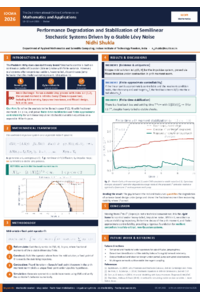
Classical stochastic control theory predominantly relies on Gaussian noise models driven by continuous Wiener processes. However, these models fail to capture the heavy-tailed, discontinuous jump phenomena frequently observed in modern complex systems, such as power grids under fault conditions or networks experiencing sudden cyber-anomalies. This paper investigates the finite-time stabilization and approximate controllability of a class of semilinear impulsive stochastic evolution equations defined on a separable Hilbert space and subjected to non-Gaussian α-stable Lévy noise.
When the perturbation paradigm shifts from continuous diffusion to discontinuous jump processes, standard feedback control strategies designed under strict second-moment assumptions often experience severe performance degradation or total loss of stability. Because the variance of the Lévy process diverges for α∈(1,2), classical mean-square L2 stability analysis entirely collapses. To address this fundamental limitation, we shift our analytical framework to the Banach space Lp(Ω, H) of fractional-moment integrable processes, where the moments remain finite for 1<p<α.
Within this space, we establish finite-approximate controllability by formulating a parameterized feedback control law and constructing a nonlinear operator mapping based on the mild solution of the impulsive system. By employing Picard iterations and the Banach fixed-point principle under the p-th moment norm, we theoretically guarantee the existence of a unique stabilizing state trajectory that compensates for both continuous nonlinear drift and discrete impulsive shocks.
To complement the theoretical framework, we present a preliminary numerical investigation to assess controller degradation explicitly. Through extensive simulations utilizing the Chambers–Mallows–Stuck method to generate symmetric α-stable increments, we demonstrate the failure modes of classical controllers under heavy-tailed perturbations. Ultimately, this work illustrates how control adjustments based on fractional moments facilitate finite-time stabilization, establishing a mathematically rigorous foundation for the synthesis of resilient controllers in non-Gaussian, impulsive stochastic environments.
Keywords
Stochastic control
Lévy noise
Stabilization
Semilinear evolution equations
Poster
IOCMA2026_Poster_NidhiShukla.pdf
New Parametric Curves for the Brachistochrone Optimal Control Problem Using the Dynamic Programming Method
Adaptive Wavefront Correction Algorithms for Enhancing Transmission Efficiency in Atmospheric Optical Communication Links