Event submissions
Published
This submission belongs to the session S5. Control Theory and Mechanics of the event The 2nd International Online Conference on Mathematics and Applications
Published date
04 Jun, 2026
Academic Editor
'%3e%3cpath%20d='M12.6657%2010.9104C12.4185%2010.325%2012.0599%209.79327%2011.6097%209.34482C11.1609%208.89508%2010.6293%208.5365%2010.0442%208.28888C10.0389%208.28626%2010.0337%208.28495%2010.0285%208.28233C10.8446%207.69279%2011.3752%206.73249%2011.3752%205.64904C11.3752%203.8542%209.92103%202.39999%208.1262%202.39999C6.33136%202.39999%204.87715%203.8542%204.87715%205.64904C4.87715%206.73249%205.40774%207.69279%206.22393%208.28364C6.21869%208.28626%206.21345%208.28757%206.20821%208.29019C5.62129%208.5378%205.09463%208.89284%204.64265%209.34613C4.1929%209.79493%203.83432%2010.3266%203.58671%2010.9117C3.34345%2011.4845%203.21226%2012.0987%203.20023%2012.7209C3.19988%2012.7349%203.20233%2012.7488%203.20744%2012.7619C3.21255%2012.7749%203.22022%2012.7867%203.22998%2012.7968C3.23975%2012.8068%203.25142%2012.8147%203.26431%2012.8202C3.2772%2012.8256%203.29105%2012.8284%203.30504%2012.8284H4.09109C4.14874%2012.8284%204.19459%2012.7825%204.1959%2012.7262C4.2221%2011.7148%204.62823%2010.7676%205.34617%2010.0497C6.08899%209.30683%207.0755%208.89808%208.1262%208.89808C9.17689%208.89808%2010.1634%209.30683%2010.9062%2010.0497C11.6242%2010.7676%2012.0303%2011.7148%2012.0565%2012.7262C12.0578%2012.7838%2012.1037%2012.8284%2012.1613%2012.8284H12.9474C12.9613%2012.8284%2012.9752%2012.8256%2012.9881%2012.8202C13.001%2012.8147%2013.0126%2012.8068%2013.0224%2012.7968C13.0322%2012.7867%2013.0398%2012.7749%2013.0449%2012.7619C13.0501%2012.7488%2013.0525%2012.7349%2013.0522%2012.7209C13.0391%2012.0947%2012.9094%2011.4855%2012.6657%2010.9104ZM8.1262%207.9024C7.52486%207.9024%206.9589%207.6679%206.53312%207.24211C6.10733%206.81633%205.87283%206.25037%205.87283%205.64904C5.87283%205.0477%206.10733%204.48174%206.53312%204.05596C6.9589%203.63018%207.52486%203.39567%208.1262%203.39567C8.72753%203.39567%209.29349%203.63018%209.71927%204.05596C10.1451%204.48174%2010.3796%205.0477%2010.3796%205.64904C10.3796%206.25037%2010.1451%206.81633%209.71927%207.24211C9.29349%207.6679%208.72753%207.9024%208.1262%207.9024Z'%20fill='%235D1EE1'/%3e%3c/g%3e%3c/svg%3e) Paolo Mercorelli
Paolo MercorelliCitation
Ilya Galaktionov, Mark Mesyatsev, Vladimir Toporovsky, Oleg Kolesnikov, Adaptive Wavefront Correction Algorithms for Enhancing Transmission Efficiency in Atmospheric Optical Communication Links, in Proceedings of The 2nd International Online Conference on Mathematics and Applications, 10 June–12 June 2026, MDPI: Basel, Switzerland
Share
Email
Facebook
Twitter
LinkedIn
Adaptive Wavefront Correction Algorithms for Enhancing Transmission Efficiency in Atmospheric Optical Communication Links
'%3e%3cpath%20d='M12.6647%2010.9104C12.4176%2010.325%2012.0589%209.7933%2011.6088%209.34485C11.16%208.89511%2010.6283%208.53653%2010.0432%208.28891C10.038%208.28629%2010.0327%208.28498%2010.0275%208.28236C10.8437%207.69282%2011.3743%206.73252%2011.3743%205.64907C11.3743%203.85423%209.92005%202.40002%208.12522%202.40002C6.33038%202.40002%204.87618%203.85423%204.87618%205.64907C4.87618%206.73252%205.40677%207.69282%206.22296%208.28367C6.21772%208.28629%206.21248%208.2876%206.20724%208.29022C5.62031%208.53783%205.09365%208.89287%204.64167%209.34616C4.19192%209.79496%203.83334%2010.3266%203.58573%2010.9117C3.34247%2011.4846%203.21128%2012.0987%203.19925%2012.721C3.1989%2012.735%203.20135%2012.7489%203.20646%2012.7619C3.21157%2012.7749%203.21924%2012.7868%203.22901%2012.7968C3.23877%2012.8068%203.25045%2012.8148%203.26334%2012.8202C3.27623%2012.8256%203.29007%2012.8284%203.30406%2012.8284H4.09012C4.14776%2012.8284%204.19362%2012.7825%204.19493%2012.7262C4.22113%2011.7148%204.62726%2010.7676%205.34519%2010.0497C6.08802%209.30686%207.07452%208.89811%208.12522%208.89811C9.17592%208.89811%2010.1624%209.30686%2010.9052%2010.0497C11.6232%2010.7676%2012.0293%2011.7148%2012.0555%2012.7262C12.0568%2012.7839%2012.1027%2012.8284%2012.1603%2012.8284H12.9464C12.9604%2012.8284%2012.9742%2012.8256%2012.9871%2012.8202C13%2012.8148%2013.0117%2012.8068%2013.0214%2012.7968C13.0312%2012.7868%2013.0389%2012.7749%2013.044%2012.7619C13.0491%2012.7489%2013.0515%2012.735%2013.0512%2012.721C13.0381%2012.0947%2012.9084%2011.4856%2012.6647%2010.9104ZM8.12522%207.90243C7.52388%207.90243%206.95792%207.66793%206.53214%207.24215C6.10636%206.81636%205.87185%206.2504%205.87185%205.64907C5.87185%205.04773%206.10636%204.48177%206.53214%204.05599C6.95792%203.63021%207.52388%203.3957%208.12522%203.3957C8.72655%203.3957%209.29252%203.63021%209.7183%204.05599C10.1441%204.48177%2010.3786%205.04773%2010.3786%205.64907C10.3786%206.2504%2010.1441%206.81636%209.7183%207.24215C9.29252%207.66793%208.72655%207.90243%208.12522%207.90243Z'%20fill='%235D1EE1'/%3e%3c/g%3e%3c/svg%3e)
Ilya Galaktionov 1,2
Mark Mesyatsev 1

Vladimir Toporovsky 1
Oleg Kolesnikov 1
1. Quantum Center, Moscow Technical University of Communications and Informatics, Moscow, 111024, Russia
2. Physics Department, Moscow Polytechnic University, Moscow, 107023, Russia
Abstract
Atmospheric optical communication links represent a promising solution for long-distance information transmission, including classical and quantum communication systems. However, their performance is limited by wavefront distortions caused by atmospheric turbulence.
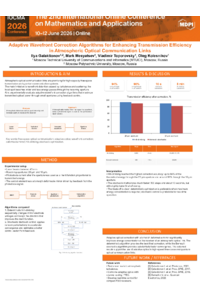
This work presents experimental approaches to improving transmission efficiency in atmospheric optical channels through adaptive wavefront correction. The experimental setup involved focusing a laser beam with a diameter of 45 mm by means of a bimorph mirror through apertures of 20 μm and 10 μm, simulating signal reception conditions in free-space optical communication systems. The photodiode current, proportional to the transmitted optical energy, was used as the objective function for optimization. Maximization of this signal provided an indirect measure of the effectiveness of wavefront correction and energy concentration in the focal spot.
Two different optimization algorithms were implemented. The first approach was a deterministic hill-climbing algorithm aimed at sequentially increasing the energy density in the far-field focal spot. The optimization process lasted approximately 8 minutes and consisted of 5800 control steps. As a result, a maximum signal value of 25,823 was achieved, compared to a theoretically attainable value of 27,472. This corresponds to a transmission efficiency of 94% through the 20 μm aperture. For the 10 μm aperture, the efficiency achieved was approximately 90%.
The second approach was based on a stochastic algorithm employing random control voltages distributed according to a Bernoulli distribution. It demonstrated a significantly faster convergence rate: the optimization process required approximately 10 seconds and involved 500 iterations. The maximum recorded signal value was 23,200, corresponding to about 90% energy transmission through the 20 μm aperture and approximately 82% through the 10 μm aperture.
A comparative analysis indicates that the deterministic hill-climbing algorithm provides higher correction accuracy, while the stochastic method offers a substantial advantage in terms of optimization speed. The obtained experimental results confirm the effectiveness of adaptive optics algorithms for compensating for atmospheric wavefront distortions and demonstrate their potential application in optical communication systems.
Keywords
adaptive control algorithm
adaptive optics
bimorph deformable mirror
quantum communication
free space optics
Poster
IOCMA2026_poster_Mesyatsev.pdf
Performance Degradation and Stabilization of Semilinear Stochastic Systems Driven by α-Stable Lévy Noise
Energy-Optimal Control of Singular Continuous-Time Linear Systems Using the Weierstrass–Kronecker Decomposition.