Event submissions
Published
This submission belongs to the session S5. Control Theory and Mechanics of the event The 2nd International Online Conference on Mathematics and Applications
Published date
04 Jun, 2026
Academic Editor
'%3e%3cpath%20d='M12.6657%2010.9104C12.4185%2010.325%2012.0599%209.79327%2011.6097%209.34482C11.1609%208.89508%2010.6293%208.5365%2010.0442%208.28888C10.0389%208.28626%2010.0337%208.28495%2010.0285%208.28233C10.8446%207.69279%2011.3752%206.73249%2011.3752%205.64904C11.3752%203.8542%209.92103%202.39999%208.1262%202.39999C6.33136%202.39999%204.87715%203.8542%204.87715%205.64904C4.87715%206.73249%205.40774%207.69279%206.22393%208.28364C6.21869%208.28626%206.21345%208.28757%206.20821%208.29019C5.62129%208.5378%205.09463%208.89284%204.64265%209.34613C4.1929%209.79493%203.83432%2010.3266%203.58671%2010.9117C3.34345%2011.4845%203.21226%2012.0987%203.20023%2012.7209C3.19988%2012.7349%203.20233%2012.7488%203.20744%2012.7619C3.21255%2012.7749%203.22022%2012.7867%203.22998%2012.7968C3.23975%2012.8068%203.25142%2012.8147%203.26431%2012.8202C3.2772%2012.8256%203.29105%2012.8284%203.30504%2012.8284H4.09109C4.14874%2012.8284%204.19459%2012.7825%204.1959%2012.7262C4.2221%2011.7148%204.62823%2010.7676%205.34617%2010.0497C6.08899%209.30683%207.0755%208.89808%208.1262%208.89808C9.17689%208.89808%2010.1634%209.30683%2010.9062%2010.0497C11.6242%2010.7676%2012.0303%2011.7148%2012.0565%2012.7262C12.0578%2012.7838%2012.1037%2012.8284%2012.1613%2012.8284H12.9474C12.9613%2012.8284%2012.9752%2012.8256%2012.9881%2012.8202C13.001%2012.8147%2013.0126%2012.8068%2013.0224%2012.7968C13.0322%2012.7867%2013.0398%2012.7749%2013.0449%2012.7619C13.0501%2012.7488%2013.0525%2012.7349%2013.0522%2012.7209C13.0391%2012.0947%2012.9094%2011.4855%2012.6657%2010.9104ZM8.1262%207.9024C7.52486%207.9024%206.9589%207.6679%206.53312%207.24211C6.10733%206.81633%205.87283%206.25037%205.87283%205.64904C5.87283%205.0477%206.10733%204.48174%206.53312%204.05596C6.9589%203.63018%207.52486%203.39567%208.1262%203.39567C8.72753%203.39567%209.29349%203.63018%209.71927%204.05596C10.1451%204.48174%2010.3796%205.0477%2010.3796%205.64904C10.3796%206.25037%2010.1451%206.81633%209.71927%207.24211C9.29349%207.6679%208.72753%207.9024%208.1262%207.9024Z'%20fill='%235D1EE1'/%3e%3c/g%3e%3c/svg%3e) Paolo Mercorelli
Paolo MercorelliCitation
G.V.R.K. Vithanage, M.A.Y. Yashodha, H.P.S.M. Caldera, D.M.D.K. Dissanayaka, Indika Gihan Gunawardhana Ilandari Dewage, A.R. Adhikari, M.M.K Ranpathidewage, Optimal Control of Combined Chemotherapy and Immunotherapy in a Tumor–Immune Model with Sensitivity Analysis, in Proceedings of The 2nd International Online Conference on Mathematics and Applications, 10 June–12 June 2026, MDPI: Basel, Switzerland
Share
Email
Facebook
Twitter
LinkedIn
Optimal Control of Combined Chemotherapy and Immunotherapy in a Tumor–Immune Model with Sensitivity Analysis

G.V.R.K. Vithanage 1
'%3e%3cpath%20d='M12.6647%2010.9104C12.4176%2010.325%2012.0589%209.7933%2011.6088%209.34485C11.16%208.89511%2010.6283%208.53653%2010.0432%208.28891C10.038%208.28629%2010.0327%208.28498%2010.0275%208.28236C10.8437%207.69282%2011.3743%206.73252%2011.3743%205.64907C11.3743%203.85423%209.92005%202.40002%208.12522%202.40002C6.33038%202.40002%204.87618%203.85423%204.87618%205.64907C4.87618%206.73252%205.40677%207.69282%206.22296%208.28367C6.21772%208.28629%206.21248%208.2876%206.20724%208.29022C5.62031%208.53783%205.09365%208.89287%204.64167%209.34616C4.19192%209.79496%203.83334%2010.3266%203.58573%2010.9117C3.34247%2011.4846%203.21128%2012.0987%203.19925%2012.721C3.1989%2012.735%203.20135%2012.7489%203.20646%2012.7619C3.21157%2012.7749%203.21924%2012.7868%203.22901%2012.7968C3.23877%2012.8068%203.25045%2012.8148%203.26334%2012.8202C3.27623%2012.8256%203.29007%2012.8284%203.30406%2012.8284H4.09012C4.14776%2012.8284%204.19362%2012.7825%204.19493%2012.7262C4.22113%2011.7148%204.62726%2010.7676%205.34519%2010.0497C6.08802%209.30686%207.07452%208.89811%208.12522%208.89811C9.17592%208.89811%2010.1624%209.30686%2010.9052%2010.0497C11.6232%2010.7676%2012.0293%2011.7148%2012.0555%2012.7262C12.0568%2012.7839%2012.1027%2012.8284%2012.1603%2012.8284H12.9464C12.9604%2012.8284%2012.9742%2012.8256%2012.9871%2012.8202C13%2012.8148%2013.0117%2012.8068%2013.0214%2012.7968C13.0312%2012.7868%2013.0389%2012.7749%2013.044%2012.7619C13.0491%2012.7489%2013.0515%2012.735%2013.0512%2012.721C13.0381%2012.0947%2012.9084%2011.4856%2012.6647%2010.9104ZM8.12522%207.90243C7.52388%207.90243%206.95792%207.66793%206.53214%207.24215C6.10636%206.81636%205.87185%206.2504%205.87185%205.64907C5.87185%205.04773%206.10636%204.48177%206.53214%204.05599C6.95792%203.63021%207.52388%203.3957%208.12522%203.3957C8.72655%203.3957%209.29252%203.63021%209.7183%204.05599C10.1441%204.48177%2010.3786%205.04773%2010.3786%205.64907C10.3786%206.2504%2010.1441%206.81636%209.7183%207.24215C9.29252%207.66793%208.72655%207.90243%208.12522%207.90243Z'%20fill='%235D1EE1'/%3e%3c/g%3e%3c/svg%3e)
M.A.Y. Yashodha 1
H.P.S.M. Caldera 1
D.M.D.K. Dissanayaka 1

Indika Gihan Gunawardhana Ilandari Dewage 2
A.R. Adhikari 3
M.M.K Ranpathidewage 4
1. Department of Mathematical Sciences, Faculty of Applied Sciences, Wayamba University of Sri Lanka, Kuliyapitiya,60300, Sri Lanka
2. Department of Mathematics and Statistics, Eastern Washinton University, Cheney,Kingston 316,510 C Street,Cheney, WA 99004, United States
3. Natural Sciences and Mathematics Divison, Southwestern College,Winfield KS,67156, United States.
4. School of Arts and Sciences, Ottawa University Arizona,15950 N Civic Center Plaza, Surprise, AZ 85374, United States
Abstract
Introduction
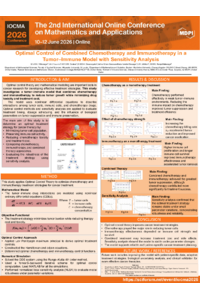
Cancer treatment increasingly relies on combination therapies to improve patient outcomes while reducing toxicity. Chemotherapy directly kills tumor cells, whereas immunotherapy enhances the body’s immune response. Determining optimal dosing schedules for both therapies remains a major challenge. This study develops an optimal control framework to investigate combined chemotherapy and immunotherapy strategies that minimize tumor burden while controlling treatment cost and side effects.
Methods
We consider a nonlinear system of ordinary differential equations describing interactions among tumor cells, immune cells, and chemotherapeutic drug concentration. Two time-dependent control variables are introduced: chemotherapy dosage and immunotherapy input. Pontryagin’s Maximum Principle is applied to derive necessary optimality conditions for minimizing an objective functional that balances tumor reduction, immune preservation, and treatment cost. The optimality system is solved numerically using a forward–backward Runge–Kutta method. In addition, normalized local sensitivity analysis is performed to evaluate the robustness of the optimal strategy to parameter uncertainty.
Results
Numerical simulations compare chemotherapy, immunotherapy, and combined therapy. Chemotherapy is most effective in weak immune environments, while immunotherapy success depends strongly on immune proliferation and lifespan. Combined therapy reduces tumor burden more efficiently than single therapies, although chemotherapy contributes more strongly to tumor elimination. Sensitivity analysis shows that tumor growth rate, immune proliferation, and drug efficacy are the most influential parameters. The optimal strategies remain stable under small parameter perturbations.
Conclusions
The proposed dual-control framework demonstrates how optimal scheduling of chemotherapy and immunotherapy can improve treatment effectiveness while limiting drug usage. The results provide quantitative insight into combination therapy design and highlight the importance of treatment timing and immune dynamics in cancer therapy optimization.
Keywords
Optimal Control
Sensitivity Analysis
Chemotherapy
Immunotherapy
Pontryagin’s Maximum Principle
Poster
170638 Latest Updated.pdf
LSTM-Based Predictive Control for Robotic Manipulators: Numerical Experiments and Pathways to Formal Robustness Guarantees
Fault-Tolerant Prescribed-Performance Intelligent Control of Fractional-Order Nonlinear Systems with State Error Constraints: Application to Electromechanical Dynamics of Electric Vehicles Motors