Event submissions
Published
This submission belongs to the session S1. Algebra, Geometry, Topology and Logic with Applications of the event The 2nd International Online Conference on Mathematics and Applications
Published date
04 Jun, 2026
Academic Editor
'%3e%3cpath%20d='M12.6657%2010.9104C12.4185%2010.325%2012.0599%209.79327%2011.6097%209.34482C11.1609%208.89508%2010.6293%208.5365%2010.0442%208.28888C10.0389%208.28626%2010.0337%208.28495%2010.0285%208.28233C10.8446%207.69279%2011.3752%206.73249%2011.3752%205.64904C11.3752%203.8542%209.92103%202.39999%208.1262%202.39999C6.33136%202.39999%204.87715%203.8542%204.87715%205.64904C4.87715%206.73249%205.40774%207.69279%206.22393%208.28364C6.21869%208.28626%206.21345%208.28757%206.20821%208.29019C5.62129%208.5378%205.09463%208.89284%204.64265%209.34613C4.1929%209.79493%203.83432%2010.3266%203.58671%2010.9117C3.34345%2011.4845%203.21226%2012.0987%203.20023%2012.7209C3.19988%2012.7349%203.20233%2012.7488%203.20744%2012.7619C3.21255%2012.7749%203.22022%2012.7867%203.22998%2012.7968C3.23975%2012.8068%203.25142%2012.8147%203.26431%2012.8202C3.2772%2012.8256%203.29105%2012.8284%203.30504%2012.8284H4.09109C4.14874%2012.8284%204.19459%2012.7825%204.1959%2012.7262C4.2221%2011.7148%204.62823%2010.7676%205.34617%2010.0497C6.08899%209.30683%207.0755%208.89808%208.1262%208.89808C9.17689%208.89808%2010.1634%209.30683%2010.9062%2010.0497C11.6242%2010.7676%2012.0303%2011.7148%2012.0565%2012.7262C12.0578%2012.7838%2012.1037%2012.8284%2012.1613%2012.8284H12.9474C12.9613%2012.8284%2012.9752%2012.8256%2012.9881%2012.8202C13.001%2012.8147%2013.0126%2012.8068%2013.0224%2012.7968C13.0322%2012.7867%2013.0398%2012.7749%2013.0449%2012.7619C13.0501%2012.7488%2013.0525%2012.7349%2013.0522%2012.7209C13.0391%2012.0947%2012.9094%2011.4855%2012.6657%2010.9104ZM8.1262%207.9024C7.52486%207.9024%206.9589%207.6679%206.53312%207.24211C6.10733%206.81633%205.87283%206.25037%205.87283%205.64904C5.87283%205.0477%206.10733%204.48174%206.53312%204.05596C6.9589%203.63018%207.52486%203.39567%208.1262%203.39567C8.72753%203.39567%209.29349%203.63018%209.71927%204.05596C10.1451%204.48174%2010.3796%205.0477%2010.3796%205.64904C10.3796%206.25037%2010.1451%206.81633%209.71927%207.24211C9.29349%207.6679%208.72753%207.9024%208.1262%207.9024Z'%20fill='%235D1EE1'/%3e%3c/g%3e%3c/svg%3e) Irina Cristea
Irina CristeaCitation
Mingyu Zhao, Mathematical Proof of the Existence of Intrinsic Spatial Mass: A Rigorous Framework Based on Discrete Groups and Complex Linear Spaces, in Proceedings of The 2nd International Online Conference on Mathematics and Applications, 10 June–12 June 2026, MDPI: Basel, Switzerland
Share
Email
Facebook
Twitter
LinkedIn
Mathematical Proof of the Existence of Intrinsic Spatial Mass: A Rigorous Framework Based on Discrete Groups and Complex Linear Spaces

Mingyu Zhao 1
1. Independent Researcher, Xiangtan, Hunan, 411100, China
Abstract
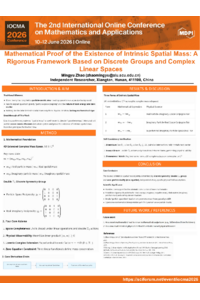
Existing studies mostly infer the existence of intrinsic spatial mass from physical intuition through a qualitative analysis of wave–particle duality (e.g., empirical application of the zero equation) but lack a proof process that meets mathematical rigor. The core contribution of this paper lies in constructing a strict “axiom–lemma–theorem” derivation system based on the discrete group Z2 (describing the binary reciprocity of “particle nature–spatial nature”) and the complex linear space M (representing mass states), combined with the kernel space theory of linear functionals and the positivity of Hermitian inner products.
Intrinsic spatial mass is a core concept in the mass mathematics system that connects abstract mathematical structures to the properties of physical spacetime. A rigorous proof of its existence is crucial for ensuring the theoretical consistency of this field. Using discrete group representation theory, complex linear space theory, and linear functional analysis as tools, this paper constructs a theoretical framework comprising four core axioms (Discrete Symmetry Group Axiom, Complex Mass Space Axiom, Zero equation Constraint Axiom, and Physical Observability Axiom). Through a three-level derivation chain—non-emptiness of the kernel of a linear functional–non-vanishing of intrinsic spatial mass–consistency of discrete group action—the existence of intrinsic spatial mass is strictly proven. This study shows that intrinsic spatial mass has three cases in the complex mass space M≅C2: m_is = im_rp; m_rs = −im_ip; and m_is = -m_ip (where m_p is the particle mass, m_s is spatial mass, r is the real number, and i is the imaginary number). It satisfies both physical observability (its squared norm is a non-negative real number) and discrete symmetry consistency (closure under Z2 group action). This proof provides core support for the axiomatic construction of mass mathematics and offers a new perspective on the mathematical interpretation of wave–particle duality in quantum mechanics.
Keywords
Intrinsic spatial mass
Discrete group representation
Complex linear space
Linear functional
Zero-equation
Hermitian inner product
Poster
Mathematical Proof of the Existence of Intrinsic Spatial Mass.pdf
(α, β)-Intuitionistic Fuzzy Ideals in BCK-Algebras: A New Approach
Optimizing Emergency-Station Placement through Roman and Double Roman Domination in Zero-Divisor Graphs of Finite Rings