Event submissions
Published
This submission belongs to the session S4. Applied Mathematics of the event The 2nd International Online Conference on Mathematics and Applications
Published date
04 Jun, 2026
Academic Editor
'%3e%3cpath%20d='M12.6657%2010.9104C12.4185%2010.325%2012.0599%209.79327%2011.6097%209.34482C11.1609%208.89508%2010.6293%208.5365%2010.0442%208.28888C10.0389%208.28626%2010.0337%208.28495%2010.0285%208.28233C10.8446%207.69279%2011.3752%206.73249%2011.3752%205.64904C11.3752%203.8542%209.92103%202.39999%208.1262%202.39999C6.33136%202.39999%204.87715%203.8542%204.87715%205.64904C4.87715%206.73249%205.40774%207.69279%206.22393%208.28364C6.21869%208.28626%206.21345%208.28757%206.20821%208.29019C5.62129%208.5378%205.09463%208.89284%204.64265%209.34613C4.1929%209.79493%203.83432%2010.3266%203.58671%2010.9117C3.34345%2011.4845%203.21226%2012.0987%203.20023%2012.7209C3.19988%2012.7349%203.20233%2012.7488%203.20744%2012.7619C3.21255%2012.7749%203.22022%2012.7867%203.22998%2012.7968C3.23975%2012.8068%203.25142%2012.8147%203.26431%2012.8202C3.2772%2012.8256%203.29105%2012.8284%203.30504%2012.8284H4.09109C4.14874%2012.8284%204.19459%2012.7825%204.1959%2012.7262C4.2221%2011.7148%204.62823%2010.7676%205.34617%2010.0497C6.08899%209.30683%207.0755%208.89808%208.1262%208.89808C9.17689%208.89808%2010.1634%209.30683%2010.9062%2010.0497C11.6242%2010.7676%2012.0303%2011.7148%2012.0565%2012.7262C12.0578%2012.7838%2012.1037%2012.8284%2012.1613%2012.8284H12.9474C12.9613%2012.8284%2012.9752%2012.8256%2012.9881%2012.8202C13.001%2012.8147%2013.0126%2012.8068%2013.0224%2012.7968C13.0322%2012.7867%2013.0398%2012.7749%2013.0449%2012.7619C13.0501%2012.7488%2013.0525%2012.7349%2013.0522%2012.7209C13.0391%2012.0947%2012.9094%2011.4855%2012.6657%2010.9104ZM8.1262%207.9024C7.52486%207.9024%206.9589%207.6679%206.53312%207.24211C6.10733%206.81633%205.87283%206.25037%205.87283%205.64904C5.87283%205.0477%206.10733%204.48174%206.53312%204.05596C6.9589%203.63018%207.52486%203.39567%208.1262%203.39567C8.72753%203.39567%209.29349%203.63018%209.71927%204.05596C10.1451%204.48174%2010.3796%205.0477%2010.3796%205.64904C10.3796%206.25037%2010.1451%206.81633%209.71927%207.24211C9.29349%207.6679%208.72753%207.9024%208.1262%207.9024Z'%20fill='%235D1EE1'/%3e%3c/g%3e%3c/svg%3e) Francisco Chiclana
Francisco ChiclanaCitation
Muhammad Abbas, A Complex Analysis-Based Framework for Harmonic Distortion Estimation in Single-Phase Power Systems, in Proceedings of The 2nd International Online Conference on Mathematics and Applications, 10 June–12 June 2026, MDPI: Basel, Switzerland
Share
Email
Facebook
Twitter
LinkedIn
A Complex Analysis-Based Framework for Harmonic Distortion Estimation in Single-Phase Power Systems

Muhammad Abbas 1
1. Department of Electrical Engineering, University of Engineering and Technology Peshawar, Peshawar, Pakistan.
Abstract
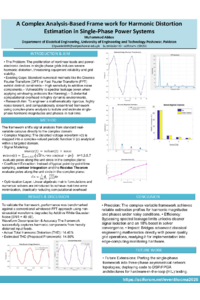
Harmonic distortion remains a critical issue in modern single-phase power systems, primarily due to the increasing penetration of nonlinear loads and power-electronic devices. Accurate estimation of harmonic content is essential for maintaining voltage quality, ensuring equipment reliability, and supporting overall grid stability. Existing numerical approaches, including discrete Fourier transform (DFT)-based methods, often face limitations such as high sensitivity to noise, spectral leakage, and increased computational load.
This study introduces a complex-analysis-based mathematical framework for harmonic distortion estimation, offering improved analytical insight and computational efficiency. The distorted voltage waveform is modeled as a complex-valued periodic function, enabling decomposition through Fourier series in the complex plane. Key tools from complex variables—such as contour integration, residue theorem, and analytic continuation—are employed to derive harmonic coefficients with enhanced precision. Linear algebraic formulations and numerical approximation methods from advanced engineering mathematics (including iterative solvers and error minimization techniques) further optimize coefficient extraction and reduce computational overhead.
Simulation results on multiple non-sinusoidal test signals demonstrate that the proposed method achieves higher accuracy in estimating harmonic magnitudes and phases, with up to an 18% improvement in convergence compared to conventional DFT-based approaches. The framework also exhibits strong noise tolerance, providing clearer differentiation between dominant and weak harmonic components.
Overall, this work offers a mathematically rigorous and efficient methodology for real-time harmonic analysis in power systems. The framework bridges complex analysis with power-engineering applications and has strong potential for integration into modern power quality monitoring and control systems.
Keywords
Harmonic Distortion
Complex Analysis
Fourier Series
Power Quality
Single-Phase Power Systems
Numerical Methods
Signal Decomposition
Analytic Functions
Residue Theory
Engineering Mathematics
Harmonic Estimation
Nonlinear Loads
Poster
A Complex Analysis-Based Framework for Harmonic Distortion Estimation in Single-Phase Power Systems.pdf
Reinforcement Learning-Based Optimization of Energy Consumption in Distributed Flow Shop Scheduling
Modeling Vaccination Decisions in Heterogeneous Populations