Event submissions
Published
This submission belongs to the session S4. Applied Mathematics of the event The 2nd International Online Conference on Mathematics and Applications
Published date
04 Jun, 2026
Academic Editor
'%3e%3cpath%20d='M12.6657%2010.9104C12.4185%2010.325%2012.0599%209.79327%2011.6097%209.34482C11.1609%208.89508%2010.6293%208.5365%2010.0442%208.28888C10.0389%208.28626%2010.0337%208.28495%2010.0285%208.28233C10.8446%207.69279%2011.3752%206.73249%2011.3752%205.64904C11.3752%203.8542%209.92103%202.39999%208.1262%202.39999C6.33136%202.39999%204.87715%203.8542%204.87715%205.64904C4.87715%206.73249%205.40774%207.69279%206.22393%208.28364C6.21869%208.28626%206.21345%208.28757%206.20821%208.29019C5.62129%208.5378%205.09463%208.89284%204.64265%209.34613C4.1929%209.79493%203.83432%2010.3266%203.58671%2010.9117C3.34345%2011.4845%203.21226%2012.0987%203.20023%2012.7209C3.19988%2012.7349%203.20233%2012.7488%203.20744%2012.7619C3.21255%2012.7749%203.22022%2012.7867%203.22998%2012.7968C3.23975%2012.8068%203.25142%2012.8147%203.26431%2012.8202C3.2772%2012.8256%203.29105%2012.8284%203.30504%2012.8284H4.09109C4.14874%2012.8284%204.19459%2012.7825%204.1959%2012.7262C4.2221%2011.7148%204.62823%2010.7676%205.34617%2010.0497C6.08899%209.30683%207.0755%208.89808%208.1262%208.89808C9.17689%208.89808%2010.1634%209.30683%2010.9062%2010.0497C11.6242%2010.7676%2012.0303%2011.7148%2012.0565%2012.7262C12.0578%2012.7838%2012.1037%2012.8284%2012.1613%2012.8284H12.9474C12.9613%2012.8284%2012.9752%2012.8256%2012.9881%2012.8202C13.001%2012.8147%2013.0126%2012.8068%2013.0224%2012.7968C13.0322%2012.7867%2013.0398%2012.7749%2013.0449%2012.7619C13.0501%2012.7488%2013.0525%2012.7349%2013.0522%2012.7209C13.0391%2012.0947%2012.9094%2011.4855%2012.6657%2010.9104ZM8.1262%207.9024C7.52486%207.9024%206.9589%207.6679%206.53312%207.24211C6.10733%206.81633%205.87283%206.25037%205.87283%205.64904C5.87283%205.0477%206.10733%204.48174%206.53312%204.05596C6.9589%203.63018%207.52486%203.39567%208.1262%203.39567C8.72753%203.39567%209.29349%203.63018%209.71927%204.05596C10.1451%204.48174%2010.3796%205.0477%2010.3796%205.64904C10.3796%206.25037%2010.1451%206.81633%209.71927%207.24211C9.29349%207.6679%208.72753%207.9024%208.1262%207.9024Z'%20fill='%235D1EE1'/%3e%3c/g%3e%3c/svg%3e) David Carfì
David CarfìCitation
Guillermo Alvarez-Pardo, Sunny Jung Kim, Oleg Korenok, Gabriela Leon-Perez, Hyunju Oh, Jan Rychtar, Daniel Stephenson, Dewey Taylor, Oyita Udiani, Modeling Vaccination Decisions in Heterogeneous Populations, in Proceedings of The 2nd International Online Conference on Mathematics and Applications, 10 June–12 June 2026, MDPI: Basel, Switzerland
Share
Email
Facebook
Twitter
LinkedIn
Modeling Vaccination Decisions in Heterogeneous Populations
'%3e%3cpath%20d='M12.6647%2010.9104C12.4176%2010.325%2012.0589%209.7933%2011.6088%209.34485C11.16%208.89511%2010.6283%208.53653%2010.0432%208.28891C10.038%208.28629%2010.0327%208.28498%2010.0275%208.28236C10.8437%207.69282%2011.3743%206.73252%2011.3743%205.64907C11.3743%203.85423%209.92005%202.40002%208.12522%202.40002C6.33038%202.40002%204.87618%203.85423%204.87618%205.64907C4.87618%206.73252%205.40677%207.69282%206.22296%208.28367C6.21772%208.28629%206.21248%208.2876%206.20724%208.29022C5.62031%208.53783%205.09365%208.89287%204.64167%209.34616C4.19192%209.79496%203.83334%2010.3266%203.58573%2010.9117C3.34247%2011.4846%203.21128%2012.0987%203.19925%2012.721C3.1989%2012.735%203.20135%2012.7489%203.20646%2012.7619C3.21157%2012.7749%203.21924%2012.7868%203.22901%2012.7968C3.23877%2012.8068%203.25045%2012.8148%203.26334%2012.8202C3.27623%2012.8256%203.29007%2012.8284%203.30406%2012.8284H4.09012C4.14776%2012.8284%204.19362%2012.7825%204.19493%2012.7262C4.22113%2011.7148%204.62726%2010.7676%205.34519%2010.0497C6.08802%209.30686%207.07452%208.89811%208.12522%208.89811C9.17592%208.89811%2010.1624%209.30686%2010.9052%2010.0497C11.6232%2010.7676%2012.0293%2011.7148%2012.0555%2012.7262C12.0568%2012.7839%2012.1027%2012.8284%2012.1603%2012.8284H12.9464C12.9604%2012.8284%2012.9742%2012.8256%2012.9871%2012.8202C13%2012.8148%2013.0117%2012.8068%2013.0214%2012.7968C13.0312%2012.7868%2013.0389%2012.7749%2013.044%2012.7619C13.0491%2012.7489%2013.0515%2012.735%2013.0512%2012.721C13.0381%2012.0947%2012.9084%2011.4856%2012.6647%2010.9104ZM8.12522%207.90243C7.52388%207.90243%206.95792%207.66793%206.53214%207.24215C6.10636%206.81636%205.87185%206.2504%205.87185%205.64907C5.87185%205.04773%206.10636%204.48177%206.53214%204.05599C6.95792%203.63021%207.52388%203.3957%208.12522%203.3957C8.72655%203.3957%209.29252%203.63021%209.7183%204.05599C10.1441%204.48177%2010.3786%205.04773%2010.3786%205.64907C10.3786%206.2504%2010.1441%206.81636%209.7183%207.24215C9.29252%207.66793%208.72655%207.90243%208.12522%207.90243Z'%20fill='%235D1EE1'/%3e%3c/g%3e%3c/svg%3e)
Guillermo Alvarez-Pardo 1
Sunny Jung Kim 2
Oleg Korenok 3
Gabriela Leon-Perez 4
Hyunju Oh 5

Jan Rychtar 6
Daniel Stephenson 3
Dewey Taylor 6
Oyita Udiani 6
1. Mathematics Department, Cuesta College, San Luis Obispo, CA 93405, USA
2. Social and Behavioral Sciences, School of Public Health, Massey Comprehensive Cancer Center, Virginia Commonwealth University, Richmond, VA 23284, USA
3. School of Business, Virginia Commonwealth University, Richmond, VA 23284, USA
4. Department of Sociology, Virginia Commonwealth University, Richmond, VA 23284, USA
5. Division of Mathematics and Computer Science, University of Guam, Mangilao, GU, 96923, USA
6. Department of Mathematics and Applied Mathematics, Virginia Commonwealth University, Richmond, VA 23284, USA
Abstract
In classical vaccination game theory, population groups are typically treated as homogeneous, with individuals assumed to share identical disease risks, cost perceptions, and beliefs about vaccine performance. In this talk, we depart from this assumption and introduce a vaccination game model designed for an infinite population whose members exhibit heterogeneous preferences and characteristics. Specifically, we allow individuals to differ in three key dimensions: (1) their susceptibility to infection, (2) their perceived costs associated with both contracting the disease and receiving the vaccine, and (3) their subjective assessment of vaccine efficacy. We encode this heterogeneity using a quantile function that captures the distribution of agents’ net relative vaccination costs, providing a flexible and analytically tractable representation of diverse behavioral responses. Within this framework, we derive an explicit closed-form expression for the Nash equilibrium vaccination rate, offering transparent insights into how population-level behavior emerges from heterogeneous individual incentives. We then demonstrate how our model can be calibrated using real-world survey data to generate empirical predictions about vaccination uptake. A systematic comparison with the standard homogeneous model reveals that our heterogeneous approach yields consistently improved predictive accuracy, particularly in data-sparse settings where only a limited number of survey responses are available. Across a range of scenarios, the heterogeneous model not only reduces prediction error but also exhibits greater robustness to sampling variability and model misspecification. Overall, our results highlight the importance of accounting for preference diversity in vaccination games and illustrate how heterogeneity can significantly enhance the realism and reliability of epidemiological behavior models.
Keywords
vaccination
Nash equilibrium
game theory
Poster
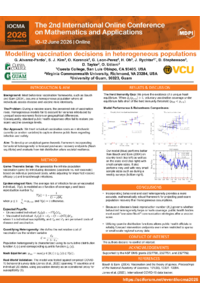
RychtarIOCMA2026.pdf
A Complex Analysis-Based Framework for Harmonic Distortion Estimation in Single-Phase Power Systems
Modelling the Role of Environmental Reservoirs and Asymptomatic Carriers in HPAI Transmission within Dairy Herds