Event submissions
Published
This submission belongs to the session S4. Applied Mathematics of the event The 2nd International Online Conference on Mathematics and Applications
Published date
04 Jun, 2026
Academic Editor
'%3e%3cpath%20d='M12.6657%2010.9104C12.4185%2010.325%2012.0599%209.79327%2011.6097%209.34482C11.1609%208.89508%2010.6293%208.5365%2010.0442%208.28888C10.0389%208.28626%2010.0337%208.28495%2010.0285%208.28233C10.8446%207.69279%2011.3752%206.73249%2011.3752%205.64904C11.3752%203.8542%209.92103%202.39999%208.1262%202.39999C6.33136%202.39999%204.87715%203.8542%204.87715%205.64904C4.87715%206.73249%205.40774%207.69279%206.22393%208.28364C6.21869%208.28626%206.21345%208.28757%206.20821%208.29019C5.62129%208.5378%205.09463%208.89284%204.64265%209.34613C4.1929%209.79493%203.83432%2010.3266%203.58671%2010.9117C3.34345%2011.4845%203.21226%2012.0987%203.20023%2012.7209C3.19988%2012.7349%203.20233%2012.7488%203.20744%2012.7619C3.21255%2012.7749%203.22022%2012.7867%203.22998%2012.7968C3.23975%2012.8068%203.25142%2012.8147%203.26431%2012.8202C3.2772%2012.8256%203.29105%2012.8284%203.30504%2012.8284H4.09109C4.14874%2012.8284%204.19459%2012.7825%204.1959%2012.7262C4.2221%2011.7148%204.62823%2010.7676%205.34617%2010.0497C6.08899%209.30683%207.0755%208.89808%208.1262%208.89808C9.17689%208.89808%2010.1634%209.30683%2010.9062%2010.0497C11.6242%2010.7676%2012.0303%2011.7148%2012.0565%2012.7262C12.0578%2012.7838%2012.1037%2012.8284%2012.1613%2012.8284H12.9474C12.9613%2012.8284%2012.9752%2012.8256%2012.9881%2012.8202C13.001%2012.8147%2013.0126%2012.8068%2013.0224%2012.7968C13.0322%2012.7867%2013.0398%2012.7749%2013.0449%2012.7619C13.0501%2012.7488%2013.0525%2012.7349%2013.0522%2012.7209C13.0391%2012.0947%2012.9094%2011.4855%2012.6657%2010.9104ZM8.1262%207.9024C7.52486%207.9024%206.9589%207.6679%206.53312%207.24211C6.10733%206.81633%205.87283%206.25037%205.87283%205.64904C5.87283%205.0477%206.10733%204.48174%206.53312%204.05596C6.9589%203.63018%207.52486%203.39567%208.1262%203.39567C8.72753%203.39567%209.29349%203.63018%209.71927%204.05596C10.1451%204.48174%2010.3796%205.0477%2010.3796%205.64904C10.3796%206.25037%2010.1451%206.81633%209.71927%207.24211C9.29349%207.6679%208.72753%207.9024%208.1262%207.9024Z'%20fill='%235D1EE1'/%3e%3c/g%3e%3c/svg%3e) Juan Torregrosa
Juan TorregrosaCitation
Ilhem Kadri,
Bridging Analytical and Numerical Methods for Fractional 4D Chaotic Systems
, in Proceedings of The 2nd International Online Conference on Mathematics and Applications, 10 June–12 June 2026, MDPI: Basel, Switzerland
Share
Email
Facebook
Twitter
LinkedIn
- Bridging Analytical and Numerical Methods for Fractional 4D Chaotic Systems
- Bridging Analytical and Numerical Methods for Fractional 4D Chaotic Systems

Ilhem Kadri 1
1. Department of Mathematics, University of Oran 1 Ahmed Ben Bella, Oran, 31000, Algeria.
Abstract
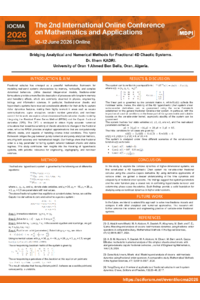
Fractional calculus has emerged as a powerful mathematical framework for modeling real-world systems characterized by memory, nonlocality, and complex dynamical behaviors. Unlike classical integer-order models, fractional-order formulations provide a more flexible description of processes with long-term memory and hereditary effects, which are commonly observed in physics, engineering, biology, and information sciences. In particular, fractional-order chaotic and hyperchaotic systems have received considerable attention for their ability to capture richer dynamical features, making them highly relevant in areas such as secure communications, signal encryption, random number generation, and nonlinear control. In this work, we explore a four-dimensional fractional-order chaotic model by integrating the Residual Power Series Method (RPSM) and the Caputo fractional derivative (CFD). The CFD is employed to obtain highly accurate numerical simulations that reveal the sensitivity of chaotic attractors to changes in the fractional order, while the RPSM provides analytical approximations that are computationally efficient, stable, and capable of handling diverse initial conditions. This hybrid framework bridges the gap between purely numerical and purely analytical methods, ensuring both accuracy and mathematical insight. Our findings show that fractional order is a key parameter for tuning system behavior between chaotic and stable regimes. This study contributes new insights into the modeling of hyperchaotic systems, with potential relevance for engineering, cryptography, and nonlinear sciences.
Keywords
Fractional Calculus
Caputo Fractional Derivative
Residual Power Series Method
Fractional-Order Chaotic Systems
Numerical and Analytical Methods.
Poster
My Poster Presentation.pdf
Modeling Driver Sensitivity through Velocity and Headway Dynamics for Safe Autonomous Vehicle Operation
On Curvature Inheritance in Generalized Fifth Recurrent Finsler Space