Event submissions
Published
This submission belongs to the session S6. Mathematics, Computer Science and Artificial Intelligence of the event The 2nd International Online Conference on Mathematics and Applications
Published date
04 Jun, 2026
Academic Editor
'%3e%3cpath%20d='M12.6657%2010.9104C12.4185%2010.325%2012.0599%209.79327%2011.6097%209.34482C11.1609%208.89508%2010.6293%208.5365%2010.0442%208.28888C10.0389%208.28626%2010.0337%208.28495%2010.0285%208.28233C10.8446%207.69279%2011.3752%206.73249%2011.3752%205.64904C11.3752%203.8542%209.92103%202.39999%208.1262%202.39999C6.33136%202.39999%204.87715%203.8542%204.87715%205.64904C4.87715%206.73249%205.40774%207.69279%206.22393%208.28364C6.21869%208.28626%206.21345%208.28757%206.20821%208.29019C5.62129%208.5378%205.09463%208.89284%204.64265%209.34613C4.1929%209.79493%203.83432%2010.3266%203.58671%2010.9117C3.34345%2011.4845%203.21226%2012.0987%203.20023%2012.7209C3.19988%2012.7349%203.20233%2012.7488%203.20744%2012.7619C3.21255%2012.7749%203.22022%2012.7867%203.22998%2012.7968C3.23975%2012.8068%203.25142%2012.8147%203.26431%2012.8202C3.2772%2012.8256%203.29105%2012.8284%203.30504%2012.8284H4.09109C4.14874%2012.8284%204.19459%2012.7825%204.1959%2012.7262C4.2221%2011.7148%204.62823%2010.7676%205.34617%2010.0497C6.08899%209.30683%207.0755%208.89808%208.1262%208.89808C9.17689%208.89808%2010.1634%209.30683%2010.9062%2010.0497C11.6242%2010.7676%2012.0303%2011.7148%2012.0565%2012.7262C12.0578%2012.7838%2012.1037%2012.8284%2012.1613%2012.8284H12.9474C12.9613%2012.8284%2012.9752%2012.8256%2012.9881%2012.8202C13.001%2012.8147%2013.0126%2012.8068%2013.0224%2012.7968C13.0322%2012.7867%2013.0398%2012.7749%2013.0449%2012.7619C13.0501%2012.7488%2013.0525%2012.7349%2013.0522%2012.7209C13.0391%2012.0947%2012.9094%2011.4855%2012.6657%2010.9104ZM8.1262%207.9024C7.52486%207.9024%206.9589%207.6679%206.53312%207.24211C6.10733%206.81633%205.87283%206.25037%205.87283%205.64904C5.87283%205.0477%206.10733%204.48174%206.53312%204.05596C6.9589%203.63018%207.52486%203.39567%208.1262%203.39567C8.72753%203.39567%209.29349%203.63018%209.71927%204.05596C10.1451%204.48174%2010.3796%205.0477%2010.3796%205.64904C10.3796%206.25037%2010.1451%206.81633%209.71927%207.24211C9.29349%207.6679%208.72753%207.9024%208.1262%207.9024Z'%20fill='%235D1EE1'/%3e%3c/g%3e%3c/svg%3e) Marjan Mernik
Marjan MernikCitation
Sainath Nagnath Admankar, Vidya Vyankatrao Deshpande, Comparative Evaluation of Crop Production under Uncertainty Using Two-stage FM-TOPSIS., in Proceedings of The 2nd International Online Conference on Mathematics and Applications, 10 June–12 June 2026, MDPI: Basel, Switzerland
Share
Email
Facebook
Twitter
LinkedIn
Comparative Evaluation of Crop Production under Uncertainty Using Two-stage FM-TOPSIS.
'%3e%3cpath%20d='M12.6647%2010.9104C12.4176%2010.325%2012.0589%209.7933%2011.6088%209.34485C11.16%208.89511%2010.6283%208.53653%2010.0432%208.28891C10.038%208.28629%2010.0327%208.28498%2010.0275%208.28236C10.8437%207.69282%2011.3743%206.73252%2011.3743%205.64907C11.3743%203.85423%209.92005%202.40002%208.12522%202.40002C6.33038%202.40002%204.87618%203.85423%204.87618%205.64907C4.87618%206.73252%205.40677%207.69282%206.22296%208.28367C6.21772%208.28629%206.21248%208.2876%206.20724%208.29022C5.62031%208.53783%205.09365%208.89287%204.64167%209.34616C4.19192%209.79496%203.83334%2010.3266%203.58573%2010.9117C3.34247%2011.4846%203.21128%2012.0987%203.19925%2012.721C3.1989%2012.735%203.20135%2012.7489%203.20646%2012.7619C3.21157%2012.7749%203.21924%2012.7868%203.22901%2012.7968C3.23877%2012.8068%203.25045%2012.8148%203.26334%2012.8202C3.27623%2012.8256%203.29007%2012.8284%203.30406%2012.8284H4.09012C4.14776%2012.8284%204.19362%2012.7825%204.19493%2012.7262C4.22113%2011.7148%204.62726%2010.7676%205.34519%2010.0497C6.08802%209.30686%207.07452%208.89811%208.12522%208.89811C9.17592%208.89811%2010.1624%209.30686%2010.9052%2010.0497C11.6232%2010.7676%2012.0293%2011.7148%2012.0555%2012.7262C12.0568%2012.7839%2012.1027%2012.8284%2012.1603%2012.8284H12.9464C12.9604%2012.8284%2012.9742%2012.8256%2012.9871%2012.8202C13%2012.8148%2013.0117%2012.8068%2013.0214%2012.7968C13.0312%2012.7868%2013.0389%2012.7749%2013.044%2012.7619C13.0491%2012.7489%2013.0515%2012.735%2013.0512%2012.721C13.0381%2012.0947%2012.9084%2011.4856%2012.6647%2010.9104ZM8.12522%207.90243C7.52388%207.90243%206.95792%207.66793%206.53214%207.24215C6.10636%206.81636%205.87185%206.2504%205.87185%205.64907C5.87185%205.04773%206.10636%204.48177%206.53214%204.05599C6.95792%203.63021%207.52388%203.3957%208.12522%203.3957C8.72655%203.3957%209.29252%203.63021%209.7183%204.05599C10.1441%204.48177%2010.3786%205.04773%2010.3786%205.64907C10.3786%206.2504%2010.1441%206.81636%209.7183%207.24215C9.29252%207.66793%208.72655%207.90243%208.12522%207.90243Z'%20fill='%235D1EE1'/%3e%3c/g%3e%3c/svg%3e)
Sainath Nagnath Admankar 1
Vidya Vyankatrao Deshpande 2
1. Department of Mathematics, Dr Babasaheb Ambedkar Marathwada University (Campus), Chh. Sambhajinagar 431004, India
2. Department of Mathematics, Late. Laxmibai Deshmukh Mahila Mahavidyalaya, Parli Vaijnath 431515, India
Abstract
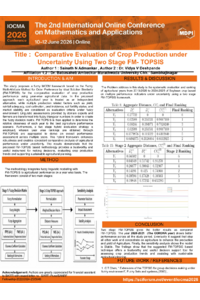
Agriculture production is inherently affected by uncertainty arising from climate variability, input availability, market fluctuations, and management practices. Conventional statistical and time series forecasting models often fail to effectively capture the vagueness and imprecision associated with such agriculture data. To address this issue, the present study proposes a fuzzy multi-criteria decision-making framework based on the Fuzzy Multi-Attribute Technique for Order Preference by Similarity to Ideal Solution (FM-TOPSIS) for the comparative evaluation of crop production performance using year-wise agricultural data. In the proposed approach, each agricultural year is treated as an independent alternative, while multiple production-related factors such as yield, rainfall adequacy, cost cultivation, pest incidence, soil fertility status, and market stability are considered as evaluation criteria under a fuzzy environment. Linguistic assessments provided by domain experts and farmers are converted into triangular fuzzy numbers to construct the fuzzy decision matrix. FM TOPSIS is then applied to determine the relative closeness of each year to the ideal agriculture performance scenario. Furthermore, a two-stage hybrid evaluation strategy is employed, wherein yearwise rankings obtained through FM-TOPSIS are aggregated to derive an overall performance assessment across multiple years. This hybrid framework enhances robustness and enables consistent comparative analysis of agricultural performance under uncertainty. The results demonstrate that the proposed FM-TOPSIS-based methodology provides a reliable and practical decision support tool for evaluating crop production trends and supporting sustainable agricultural planning.
Keywords
Fuzzy TOPSIS
Agricultural decision making,Crop Production analysis
Year wise evaluation
Fuzzy Multi-Criteria decision making,Uncertainty modelling,Sustainable Agriculture.
Poster
Poster for IOCMA june 26.pptx (1).pdf
Heatwave-Driven Disease Dynamics in a Temperature-Dependent SEIR Model with Seasonal Forcing: A Case Study of Bangladesh
Variational AutoEncoder (VAE) and Lie-SVM Approaches in capturing Static and Dynamic Generative-Discriminative Features of Visual Datasets