Event submissions
Published
This submission belongs to the session S6. Mathematics, Computer Science and Artificial Intelligence of the event The 2nd International Online Conference on Mathematics and Applications
Published date
04 Jun, 2026
Academic Editor
'%3e%3cpath%20d='M12.6657%2010.9104C12.4185%2010.325%2012.0599%209.79327%2011.6097%209.34482C11.1609%208.89508%2010.6293%208.5365%2010.0442%208.28888C10.0389%208.28626%2010.0337%208.28495%2010.0285%208.28233C10.8446%207.69279%2011.3752%206.73249%2011.3752%205.64904C11.3752%203.8542%209.92103%202.39999%208.1262%202.39999C6.33136%202.39999%204.87715%203.8542%204.87715%205.64904C4.87715%206.73249%205.40774%207.69279%206.22393%208.28364C6.21869%208.28626%206.21345%208.28757%206.20821%208.29019C5.62129%208.5378%205.09463%208.89284%204.64265%209.34613C4.1929%209.79493%203.83432%2010.3266%203.58671%2010.9117C3.34345%2011.4845%203.21226%2012.0987%203.20023%2012.7209C3.19988%2012.7349%203.20233%2012.7488%203.20744%2012.7619C3.21255%2012.7749%203.22022%2012.7867%203.22998%2012.7968C3.23975%2012.8068%203.25142%2012.8147%203.26431%2012.8202C3.2772%2012.8256%203.29105%2012.8284%203.30504%2012.8284H4.09109C4.14874%2012.8284%204.19459%2012.7825%204.1959%2012.7262C4.2221%2011.7148%204.62823%2010.7676%205.34617%2010.0497C6.08899%209.30683%207.0755%208.89808%208.1262%208.89808C9.17689%208.89808%2010.1634%209.30683%2010.9062%2010.0497C11.6242%2010.7676%2012.0303%2011.7148%2012.0565%2012.7262C12.0578%2012.7838%2012.1037%2012.8284%2012.1613%2012.8284H12.9474C12.9613%2012.8284%2012.9752%2012.8256%2012.9881%2012.8202C13.001%2012.8147%2013.0126%2012.8068%2013.0224%2012.7968C13.0322%2012.7867%2013.0398%2012.7749%2013.0449%2012.7619C13.0501%2012.7488%2013.0525%2012.7349%2013.0522%2012.7209C13.0391%2012.0947%2012.9094%2011.4855%2012.6657%2010.9104ZM8.1262%207.9024C7.52486%207.9024%206.9589%207.6679%206.53312%207.24211C6.10733%206.81633%205.87283%206.25037%205.87283%205.64904C5.87283%205.0477%206.10733%204.48174%206.53312%204.05596C6.9589%203.63018%207.52486%203.39567%208.1262%203.39567C8.72753%203.39567%209.29349%203.63018%209.71927%204.05596C10.1451%204.48174%2010.3796%205.0477%2010.3796%205.64904C10.3796%206.25037%2010.1451%206.81633%209.71927%207.24211C9.29349%207.6679%208.72753%207.9024%208.1262%207.9024Z'%20fill='%235D1EE1'/%3e%3c/g%3e%3c/svg%3e) Marjan Mernik
Marjan MernikCitation
Hugo Wai Leung MAK, Variational AutoEncoder (VAE) and Lie-SVM Approaches in capturing Static and Dynamic Generative-Discriminative Features of Visual Datasets, in Proceedings of The 2nd International Online Conference on Mathematics and Applications, 10 June–12 June 2026, MDPI: Basel, Switzerland
Share
Email
Facebook
Twitter
LinkedIn
Variational AutoEncoder (VAE) and Lie-SVM Approaches in capturing Static and Dynamic Generative-Discriminative Features of Visual Datasets

Hugo Wai Leung MAK 1,2
1. Department of Mathematics, The Chinese University of Hong Kong, Hong Kong, China
2. Department of Mathematics, The Hong Kong University of Science and Technology, Hong Kong, China
Abstract
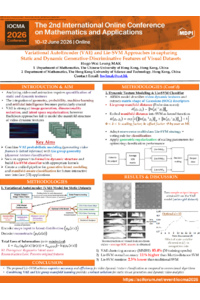
For better quantification of static and dynamic texture features and visual analysis within videos and animations, the combination of geometry, probabilistic formulation, and the latest machine learning and artificial intelligence mechanisms has become essential. Due to the potential and capability in image generation and dimensionality reduction, this study unites the mathematical underpinnings of Variational AutoEncoder (VAE) models for producing video frames with the geometric and algebraic framework of Lie group manifolds for dynamic video texture classification via Support Vector Machines (SVMs). Using VAE models, theoretical foundations of variational inference in autoencoding and decoding processes, the decomposition of the VAE loss function into latent KL divergence, and reconstructing loss for regularizing latent space distribution and preserving input feature fidelity will be explored. Case studies generating new interfaces and validating the effectiveness of data clustering mechanisms with the MNIST database will be used for performance assessments.
Despite VAE’s effectiveness in latent variable disentanglement and categorizing latent spaces, it is necessary to classify the dynamic texture of videos due to their continuous moving nature. Thus, a geometric approach combining an autoregressive moving average (ARMA) model, Lie group manifold, and matrix shape of Gaussian (SOG) descriptors was adopted to formalize video dynamic textures; then, a kernel function based on the Riemannian distance in the Lie group manifold was incorporated into the traditional SVM model to capture non-Euclidean manifold structure and implement the Lie-SVM multi-classifier with rigorous geometric regularization. Empirical validation based on sequences of images from a dynamic video confirms that our proposed algorithm yields superior classification performance, while preserving geometric invariants of manifold in kernel space.
The synergy of these mathematical and artificial intelligence methodologies can effectively handle and analyze both static generative visual content and dynamic texture videos, eventually bridging the gap between latent space design and discriminative manifold-aware feature classification for interactive user interface applications in the future.
Keywords
Variational AutoEncoder (VAE)
Lie-SVM
Image and Video generation
Generator and Discriminator
Dynamic Texture Classification
SOG Descriptors
Data Clustering
Geometric Regularization
User Interface
Poster
IOCMA 2026 conference_poster_MAK HWL.pdf
Comparative Evaluation of Crop Production under Uncertainty Using Two-stage FM-TOPSIS.
Cardiac Disease Classification using Matrix Factorization and Machine Learning