Event submissions
Published
This submission belongs to the session S6. Mathematics, Computer Science and Artificial Intelligence of the event The 2nd International Online Conference on Mathematics and Applications
Published date
04 Jun, 2026
Academic Editor
'%3e%3cpath%20d='M12.6657%2010.9104C12.4185%2010.325%2012.0599%209.79327%2011.6097%209.34482C11.1609%208.89508%2010.6293%208.5365%2010.0442%208.28888C10.0389%208.28626%2010.0337%208.28495%2010.0285%208.28233C10.8446%207.69279%2011.3752%206.73249%2011.3752%205.64904C11.3752%203.8542%209.92103%202.39999%208.1262%202.39999C6.33136%202.39999%204.87715%203.8542%204.87715%205.64904C4.87715%206.73249%205.40774%207.69279%206.22393%208.28364C6.21869%208.28626%206.21345%208.28757%206.20821%208.29019C5.62129%208.5378%205.09463%208.89284%204.64265%209.34613C4.1929%209.79493%203.83432%2010.3266%203.58671%2010.9117C3.34345%2011.4845%203.21226%2012.0987%203.20023%2012.7209C3.19988%2012.7349%203.20233%2012.7488%203.20744%2012.7619C3.21255%2012.7749%203.22022%2012.7867%203.22998%2012.7968C3.23975%2012.8068%203.25142%2012.8147%203.26431%2012.8202C3.2772%2012.8256%203.29105%2012.8284%203.30504%2012.8284H4.09109C4.14874%2012.8284%204.19459%2012.7825%204.1959%2012.7262C4.2221%2011.7148%204.62823%2010.7676%205.34617%2010.0497C6.08899%209.30683%207.0755%208.89808%208.1262%208.89808C9.17689%208.89808%2010.1634%209.30683%2010.9062%2010.0497C11.6242%2010.7676%2012.0303%2011.7148%2012.0565%2012.7262C12.0578%2012.7838%2012.1037%2012.8284%2012.1613%2012.8284H12.9474C12.9613%2012.8284%2012.9752%2012.8256%2012.9881%2012.8202C13.001%2012.8147%2013.0126%2012.8068%2013.0224%2012.7968C13.0322%2012.7867%2013.0398%2012.7749%2013.0449%2012.7619C13.0501%2012.7488%2013.0525%2012.7349%2013.0522%2012.7209C13.0391%2012.0947%2012.9094%2011.4855%2012.6657%2010.9104ZM8.1262%207.9024C7.52486%207.9024%206.9589%207.6679%206.53312%207.24211C6.10733%206.81633%205.87283%206.25037%205.87283%205.64904C5.87283%205.0477%206.10733%204.48174%206.53312%204.05596C6.9589%203.63018%207.52486%203.39567%208.1262%203.39567C8.72753%203.39567%209.29349%203.63018%209.71927%204.05596C10.1451%204.48174%2010.3796%205.0477%2010.3796%205.64904C10.3796%206.25037%2010.1451%206.81633%209.71927%207.24211C9.29349%207.6679%208.72753%207.9024%208.1262%207.9024Z'%20fill='%235D1EE1'/%3e%3c/g%3e%3c/svg%3e) Marjan Mernik
Marjan MernikCitation
Mohamed Mazloum Salem, A Unified Survey of Grand Challenges and Open Problems at the Intersection of Physics, Mathematics, and Computation, in Proceedings of The 2nd International Online Conference on Mathematics and Applications, 10 June–12 June 2026, MDPI: Basel, Switzerland
Share
Email
Facebook
Twitter
LinkedIn
A Unified Survey of Grand Challenges and Open Problems at the Intersection of Physics, Mathematics, and Computation

Mohamed Mazloum Salem 1
1. Department of Computer Science, Faculty of Computers and Information, Mansoura University, Mansoura 35516, Egypt
Abstract
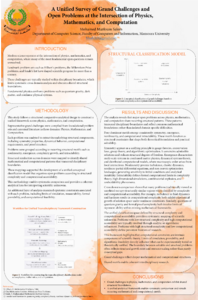
Modern science operates at a critical intersection of physics, mathematics, and computation, where many of the most fundamental open questions remain unresolved. Although landmark problem sets such as Hilbert’s problems, the Millennium Prize problems, and Smale’s list have shaped scientific progress, they are typically treated in isolation, limiting systematic and interdisciplinary analysis. This work aims to construct a unified analytical framework that organizes major unsolved problems across physics, applied mathematics, and computational theory into a coherent transdisciplinary structure.
The study conducts a structured comparative analysis of canonical open problems and foundational literature in three domains: (i) fundamental physics (including quantum gravity, dark matter, and nonlinear physical systems), (ii) mathematical theory (including complexity, topology, and nonlinear dynamics), and (iii) computation (including algorithmic complexity, simulation limits, and predictability). Using conceptual mapping and thematic clustering, the paper identifies shared structural motifs such as symmetry, emergence, nonlinearity, and computational intractability that recur across traditionally separated scientific frontiers.
The results show that many grand challenges can be classified according to a small set of underlying mathematical–computational patterns that govern both physical law and algorithmic limitation. In particular, the analysis demonstrates how computational constraints are not merely technical barriers but fundamental components shaping what can be known, simulated, and experimentally accessed. By proposing a unified classification and conceptual model of open scientific problems, this work provides a systematic lens for interpreting scientific unknowns and establishes a foundation for future interdisciplinary research strategies.
Keywords
Grand challenges
mathematical foundations
computational limits
quantum gravity
nonlinear systems
interdisciplinary research
Poster
Unified_Survey_post.pdf
Towards Real-Time Post-Hoc Explanations: A Universal Framework for Image Models and Beyond
RANDOM FOREST IN FORECASTING RAIN-INDUCED LANDSLIDES