Event submissions
Published
This submission belongs to the session S6. Mathematics, Computer Science and Artificial Intelligence of the event The 2nd International Online Conference on Mathematics and Applications
Published date
04 Jun, 2026
Academic Editor
'%3e%3cpath%20d='M12.6657%2010.9104C12.4185%2010.325%2012.0599%209.79327%2011.6097%209.34482C11.1609%208.89508%2010.6293%208.5365%2010.0442%208.28888C10.0389%208.28626%2010.0337%208.28495%2010.0285%208.28233C10.8446%207.69279%2011.3752%206.73249%2011.3752%205.64904C11.3752%203.8542%209.92103%202.39999%208.1262%202.39999C6.33136%202.39999%204.87715%203.8542%204.87715%205.64904C4.87715%206.73249%205.40774%207.69279%206.22393%208.28364C6.21869%208.28626%206.21345%208.28757%206.20821%208.29019C5.62129%208.5378%205.09463%208.89284%204.64265%209.34613C4.1929%209.79493%203.83432%2010.3266%203.58671%2010.9117C3.34345%2011.4845%203.21226%2012.0987%203.20023%2012.7209C3.19988%2012.7349%203.20233%2012.7488%203.20744%2012.7619C3.21255%2012.7749%203.22022%2012.7867%203.22998%2012.7968C3.23975%2012.8068%203.25142%2012.8147%203.26431%2012.8202C3.2772%2012.8256%203.29105%2012.8284%203.30504%2012.8284H4.09109C4.14874%2012.8284%204.19459%2012.7825%204.1959%2012.7262C4.2221%2011.7148%204.62823%2010.7676%205.34617%2010.0497C6.08899%209.30683%207.0755%208.89808%208.1262%208.89808C9.17689%208.89808%2010.1634%209.30683%2010.9062%2010.0497C11.6242%2010.7676%2012.0303%2011.7148%2012.0565%2012.7262C12.0578%2012.7838%2012.1037%2012.8284%2012.1613%2012.8284H12.9474C12.9613%2012.8284%2012.9752%2012.8256%2012.9881%2012.8202C13.001%2012.8147%2013.0126%2012.8068%2013.0224%2012.7968C13.0322%2012.7867%2013.0398%2012.7749%2013.0449%2012.7619C13.0501%2012.7488%2013.0525%2012.7349%2013.0522%2012.7209C13.0391%2012.0947%2012.9094%2011.4855%2012.6657%2010.9104ZM8.1262%207.9024C7.52486%207.9024%206.9589%207.6679%206.53312%207.24211C6.10733%206.81633%205.87283%206.25037%205.87283%205.64904C5.87283%205.0477%206.10733%204.48174%206.53312%204.05596C6.9589%203.63018%207.52486%203.39567%208.1262%203.39567C8.72753%203.39567%209.29349%203.63018%209.71927%204.05596C10.1451%204.48174%2010.3796%205.0477%2010.3796%205.64904C10.3796%206.25037%2010.1451%206.81633%209.71927%207.24211C9.29349%207.6679%208.72753%207.9024%208.1262%207.9024Z'%20fill='%235D1EE1'/%3e%3c/g%3e%3c/svg%3e) Marjan Mernik
Marjan MernikCitation
Abhishek Bajirao Katkar, Dynamic Analysis for Optimal Power Flow of Wind, Solar PV and BESS-Based Short-Term Hydro-Thermal Scheduling for Tri-Objective Operation Using Hybrid Adaptive Encoding Learning, Artificial Bee Colony, and NSGA-II, in Proceedings of The 2nd International Online Conference on Mathematics and Applications, 10 June–12 June 2026, MDPI: Basel, Switzerland
Share
Email
Facebook
Twitter
LinkedIn
Dynamic Analysis for Optimal Power Flow of Wind, Solar PV and BESS-Based Short-Term Hydro-Thermal Scheduling for Tri-Objective Operation Using Hybrid Adaptive Encoding Learning, Artificial Bee Colony, and NSGA-II
Dynamic Analysis for Optimal Power Flow of Wind, Solar PV and BESS-Based Short-Term Hydro-Thermal Scheduling for Tri-Objective Operation Using Hybrid Adaptive Encoding Learning, Artificial Bee Colony, and NSGA-II
'%3e%3cpath%20d='M12.6647%2010.9104C12.4176%2010.325%2012.0589%209.7933%2011.6088%209.34485C11.16%208.89511%2010.6283%208.53653%2010.0432%208.28891C10.038%208.28629%2010.0327%208.28498%2010.0275%208.28236C10.8437%207.69282%2011.3743%206.73252%2011.3743%205.64907C11.3743%203.85423%209.92005%202.40002%208.12522%202.40002C6.33038%202.40002%204.87618%203.85423%204.87618%205.64907C4.87618%206.73252%205.40677%207.69282%206.22296%208.28367C6.21772%208.28629%206.21248%208.2876%206.20724%208.29022C5.62031%208.53783%205.09365%208.89287%204.64167%209.34616C4.19192%209.79496%203.83334%2010.3266%203.58573%2010.9117C3.34247%2011.4846%203.21128%2012.0987%203.19925%2012.721C3.1989%2012.735%203.20135%2012.7489%203.20646%2012.7619C3.21157%2012.7749%203.21924%2012.7868%203.22901%2012.7968C3.23877%2012.8068%203.25045%2012.8148%203.26334%2012.8202C3.27623%2012.8256%203.29007%2012.8284%203.30406%2012.8284H4.09012C4.14776%2012.8284%204.19362%2012.7825%204.19493%2012.7262C4.22113%2011.7148%204.62726%2010.7676%205.34519%2010.0497C6.08802%209.30686%207.07452%208.89811%208.12522%208.89811C9.17592%208.89811%2010.1624%209.30686%2010.9052%2010.0497C11.6232%2010.7676%2012.0293%2011.7148%2012.0555%2012.7262C12.0568%2012.7839%2012.1027%2012.8284%2012.1603%2012.8284H12.9464C12.9604%2012.8284%2012.9742%2012.8256%2012.9871%2012.8202C13%2012.8148%2013.0117%2012.8068%2013.0214%2012.7968C13.0312%2012.7868%2013.0389%2012.7749%2013.044%2012.7619C13.0491%2012.7489%2013.0515%2012.735%2013.0512%2012.721C13.0381%2012.0947%2012.9084%2011.4856%2012.6647%2010.9104ZM8.12522%207.90243C7.52388%207.90243%206.95792%207.66793%206.53214%207.24215C6.10636%206.81636%205.87185%206.2504%205.87185%205.64907C5.87185%205.04773%206.10636%204.48177%206.53214%204.05599C6.95792%203.63021%207.52388%203.3957%208.12522%203.3957C8.72655%203.3957%209.29252%203.63021%209.7183%204.05599C10.1441%204.48177%2010.3786%205.04773%2010.3786%205.64907C10.3786%206.2504%2010.1441%206.81636%209.7183%207.24215C9.29252%207.66793%208.72655%207.90243%208.12522%207.90243Z'%20fill='%235D1EE1'/%3e%3c/g%3e%3c/svg%3e)
Abhishek Bajirao Katkar 1
1. Electrical Engineering, Lecturer, Government Polytechnic, Kolhapur, Maharashtra, India
Abstract
The rapid depletion of fossil fuel resources and the increasing pressure to mitigate environmental impacts have accelerated the large-scale integration of renewable energy resources into modern power systems. In this context, this paper presents a comprehensive tri-objective optimization framework for the dynamic optimal power flow (OPF) of a short-term hydro-thermal scheduling problem incorporating wind energy, solar photovoltaic (PV) generation, and battery energy storage systems (BESSs). The proposed framework addresses the coordinated operation of four progressively complex system configurations: thermal-only, thermal–wind, thermal–wind–solar PV, and thermal–wind–BESSs. The formulated problem simultaneously minimizes total generation cost, atmospheric emissions, and voltage deviation under a wide range of nonlinear operational constraints, including valve-point loading effects, hydro reservoir dynamics, renewable generation uncertainty, transmission losses, and battery charging–discharging behavior.
To effectively solve this highly nonconvex, large-scale, and constrained optimization problem, a hybrid Adaptive Encoding Learning-based Artificial Bee Colony algorithm integrated with the Non-Dominated Sorting Genetic Algorithm II (AEL-ABC–NSGA-II) is developed. The adaptive encoding mechanism enhances population diversity and convergence speed, while NSGA-II ensures robust Pareto-based tri-objective optimization. The effectiveness of the proposed approach is validated on the IEEE 39-bus test system under 24-hour dynamic load conditions. Comprehensive performance evaluations, including convergence analysis, Pareto front assessment, and statistical validation using ANOVA and box-plot analysis, demonstrate that the proposed method achieves superior solution quality, robust stability, and significant reductions in cost and emissions while maintaining an improved voltage profile. The results confirm the proposed framework as a reliable and efficient tool for next-generation sustainable power system operation.
Keywords
Tri-objective optimal power flow
Renewable-integrated scheduling
Artificial Bee Colony–NSGA-II hybrid algorithm
Battery energy storage system
Emission minimization
Voltage profile optimization
Poster
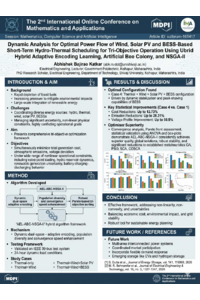
poster_IOCMA.pdf
RANDOM FOREST IN FORECASTING RAIN-INDUCED LANDSLIDES
Toward Robust RL for Autonomous Driving: Lessons from DQN and A2C