Event submissions
Published
This submission belongs to the session S4. Applied Mathematics of the event The 2nd International Online Conference on Mathematics and Applications
Published date
04 Jun, 2026
Academic Editor
'%3e%3cpath%20d='M12.6657%2010.9104C12.4185%2010.325%2012.0599%209.79327%2011.6097%209.34482C11.1609%208.89508%2010.6293%208.5365%2010.0442%208.28888C10.0389%208.28626%2010.0337%208.28495%2010.0285%208.28233C10.8446%207.69279%2011.3752%206.73249%2011.3752%205.64904C11.3752%203.8542%209.92103%202.39999%208.1262%202.39999C6.33136%202.39999%204.87715%203.8542%204.87715%205.64904C4.87715%206.73249%205.40774%207.69279%206.22393%208.28364C6.21869%208.28626%206.21345%208.28757%206.20821%208.29019C5.62129%208.5378%205.09463%208.89284%204.64265%209.34613C4.1929%209.79493%203.83432%2010.3266%203.58671%2010.9117C3.34345%2011.4845%203.21226%2012.0987%203.20023%2012.7209C3.19988%2012.7349%203.20233%2012.7488%203.20744%2012.7619C3.21255%2012.7749%203.22022%2012.7867%203.22998%2012.7968C3.23975%2012.8068%203.25142%2012.8147%203.26431%2012.8202C3.2772%2012.8256%203.29105%2012.8284%203.30504%2012.8284H4.09109C4.14874%2012.8284%204.19459%2012.7825%204.1959%2012.7262C4.2221%2011.7148%204.62823%2010.7676%205.34617%2010.0497C6.08899%209.30683%207.0755%208.89808%208.1262%208.89808C9.17689%208.89808%2010.1634%209.30683%2010.9062%2010.0497C11.6242%2010.7676%2012.0303%2011.7148%2012.0565%2012.7262C12.0578%2012.7838%2012.1037%2012.8284%2012.1613%2012.8284H12.9474C12.9613%2012.8284%2012.9752%2012.8256%2012.9881%2012.8202C13.001%2012.8147%2013.0126%2012.8068%2013.0224%2012.7968C13.0322%2012.7867%2013.0398%2012.7749%2013.0449%2012.7619C13.0501%2012.7488%2013.0525%2012.7349%2013.0522%2012.7209C13.0391%2012.0947%2012.9094%2011.4855%2012.6657%2010.9104ZM8.1262%207.9024C7.52486%207.9024%206.9589%207.6679%206.53312%207.24211C6.10733%206.81633%205.87283%206.25037%205.87283%205.64904C5.87283%205.0477%206.10733%204.48174%206.53312%204.05596C6.9589%203.63018%207.52486%203.39567%208.1262%203.39567C8.72753%203.39567%209.29349%203.63018%209.71927%204.05596C10.1451%204.48174%2010.3796%205.0477%2010.3796%205.64904C10.3796%206.25037%2010.1451%206.81633%209.71927%207.24211C9.29349%207.6679%208.72753%207.9024%208.1262%207.9024Z'%20fill='%235D1EE1'/%3e%3c/g%3e%3c/svg%3e) David Carfì
David CarfìCitation
Anika Rahman Shapnil, Impacts of Time-Varying Aspiration on Vaccination Behavior and Epidemic Control, in Proceedings of The 2nd International Online Conference on Mathematics and Applications, 10 June–12 June 2026, MDPI: Basel, Switzerland
Share
Email
Facebook
Twitter
LinkedIn
Impacts of Time-Varying Aspiration on Vaccination Behavior and Epidemic Control
'%3e%3cpath%20d='M12.6647%2010.9104C12.4176%2010.325%2012.0589%209.7933%2011.6088%209.34485C11.16%208.89511%2010.6283%208.53653%2010.0432%208.28891C10.038%208.28629%2010.0327%208.28498%2010.0275%208.28236C10.8437%207.69282%2011.3743%206.73252%2011.3743%205.64907C11.3743%203.85423%209.92005%202.40002%208.12522%202.40002C6.33038%202.40002%204.87618%203.85423%204.87618%205.64907C4.87618%206.73252%205.40677%207.69282%206.22296%208.28367C6.21772%208.28629%206.21248%208.2876%206.20724%208.29022C5.62031%208.53783%205.09365%208.89287%204.64167%209.34616C4.19192%209.79496%203.83334%2010.3266%203.58573%2010.9117C3.34247%2011.4846%203.21128%2012.0987%203.19925%2012.721C3.1989%2012.735%203.20135%2012.7489%203.20646%2012.7619C3.21157%2012.7749%203.21924%2012.7868%203.22901%2012.7968C3.23877%2012.8068%203.25045%2012.8148%203.26334%2012.8202C3.27623%2012.8256%203.29007%2012.8284%203.30406%2012.8284H4.09012C4.14776%2012.8284%204.19362%2012.7825%204.19493%2012.7262C4.22113%2011.7148%204.62726%2010.7676%205.34519%2010.0497C6.08802%209.30686%207.07452%208.89811%208.12522%208.89811C9.17592%208.89811%2010.1624%209.30686%2010.9052%2010.0497C11.6232%2010.7676%2012.0293%2011.7148%2012.0555%2012.7262C12.0568%2012.7839%2012.1027%2012.8284%2012.1603%2012.8284H12.9464C12.9604%2012.8284%2012.9742%2012.8256%2012.9871%2012.8202C13%2012.8148%2013.0117%2012.8068%2013.0214%2012.7968C13.0312%2012.7868%2013.0389%2012.7749%2013.044%2012.7619C13.0491%2012.7489%2013.0515%2012.735%2013.0512%2012.721C13.0381%2012.0947%2012.9084%2011.4856%2012.6647%2010.9104ZM8.12522%207.90243C7.52388%207.90243%206.95792%207.66793%206.53214%207.24215C6.10636%206.81636%205.87185%206.2504%205.87185%205.64907C5.87185%205.04773%206.10636%204.48177%206.53214%204.05599C6.95792%203.63021%207.52388%203.3957%208.12522%203.3957C8.72655%203.3957%209.29252%203.63021%209.7183%204.05599C10.1441%204.48177%2010.3786%205.04773%2010.3786%205.64907C10.3786%206.2504%2010.1441%206.81636%209.7183%207.24215C9.29252%207.66793%208.72655%207.90243%208.12522%207.90243Z'%20fill='%235D1EE1'/%3e%3c/g%3e%3c/svg%3e)
Anika Rahman Shapnil 1
1. Mathematics Department, University of Dhaka, Dhaka 1000, Bangladesh
Abstract
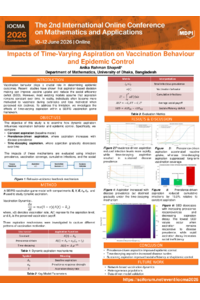
Individual aspiration plays a central role in shaping vaccination decisions and epidemic outcomes. Recent studies have shown that higher aspiration toward immunity can increase vaccine uptake and reduce the social efficiency deficit (SED) [1–4]. However, aspiration in reality is rarely constant. People’s motivation to vaccinate can rise during outbreaks when the risk of infection becomes salient, and decline when cases fall or vaccine fatigue develops. To address this limitation, we extend the aspiration-based vaccination model of Khatun et al. [1] within a SEIRS epidemic framework by incorporating time-varying aspiration. Two simple mechanisms are considered: (i) prevalence-driven aspiration, where aspiration increases with the number of infectious cases, and (ii) time-decaying aspiration, where aspiration gradually declines in the absence of strong risk perception. Using mean-field analysis and numerical simulations, we investigate how dynamic aspiration influences epidemic prevalence, vaccination coverage, and the social efficiency deficit (SED) compared to fixed aspiration levels. Our findings reveal that prevalence-driven aspiration can generate rapid increases in vaccination during outbreaks, effectively suppressing infection peaks, while time-decaying aspiration may lead to delayed responses and higher long-term infection burdens. These results highlight the importance of incorporating dynamic behavioral motivation into vaccination game models and suggest that public health strategies could benefit from actively sustaining aspiration levels over time.
References :
1. Khatun, K., Khan, M. M. U. R., & Tanimoto, J. (2025). Aspiration can decline epidemic disease. Alexandria Eng. J., 112, 151–160. https://www.sciencedirect.com/science/article/pii/S111001682401250X
2. Lyu, Z., Su, Y., & Zhuo, X. (2024). Vaccination games and imitation dynamics with age structure. Chaos Solitons Fractals, 183, 114929. https://doi.org/10.1016/j.chaos.2024.114929
3. Kulsum, U., Alam, M., & Kamrujjaman, M. (2024). Early vs. delayed vaccination under imitation and aspiration dynamics. Chaos Solitons Fractals, 178, 114364. https://doi.org/10.1016/j.chaos.2023.114364
4. Schimit, P. H. T. (2025). Vaccination as a Game: Behavioural Dynamics, Network Effects, and Policy Implications. Mathematics, 13(14), 2242. https://www.mdpi.com/2227-7390/13/14/2242
Keywords
Mathematical epidemiology
Time-varying aspiration
Vaccination game
Behavioral dynamics
Social efficiency deficit (SED)
Poster
IOCMA2026-124917.pdf
A Hybrid Computational Approach for Studying Animal Behavior in T-Mazes: Analytical and Machine Learning Techniques
Numerical Solution of Eighth-Order Boundary Value Problem Using Shifted Horadam Collocation Method