Event submissions
Published
This submission belongs to the session S4. Applied Mathematics of the event The 2nd International Online Conference on Mathematics and Applications
Published date
04 Jun, 2026
Academic Editor
'%3e%3cpath%20d='M12.6657%2010.9104C12.4185%2010.325%2012.0599%209.79327%2011.6097%209.34482C11.1609%208.89508%2010.6293%208.5365%2010.0442%208.28888C10.0389%208.28626%2010.0337%208.28495%2010.0285%208.28233C10.8446%207.69279%2011.3752%206.73249%2011.3752%205.64904C11.3752%203.8542%209.92103%202.39999%208.1262%202.39999C6.33136%202.39999%204.87715%203.8542%204.87715%205.64904C4.87715%206.73249%205.40774%207.69279%206.22393%208.28364C6.21869%208.28626%206.21345%208.28757%206.20821%208.29019C5.62129%208.5378%205.09463%208.89284%204.64265%209.34613C4.1929%209.79493%203.83432%2010.3266%203.58671%2010.9117C3.34345%2011.4845%203.21226%2012.0987%203.20023%2012.7209C3.19988%2012.7349%203.20233%2012.7488%203.20744%2012.7619C3.21255%2012.7749%203.22022%2012.7867%203.22998%2012.7968C3.23975%2012.8068%203.25142%2012.8147%203.26431%2012.8202C3.2772%2012.8256%203.29105%2012.8284%203.30504%2012.8284H4.09109C4.14874%2012.8284%204.19459%2012.7825%204.1959%2012.7262C4.2221%2011.7148%204.62823%2010.7676%205.34617%2010.0497C6.08899%209.30683%207.0755%208.89808%208.1262%208.89808C9.17689%208.89808%2010.1634%209.30683%2010.9062%2010.0497C11.6242%2010.7676%2012.0303%2011.7148%2012.0565%2012.7262C12.0578%2012.7838%2012.1037%2012.8284%2012.1613%2012.8284H12.9474C12.9613%2012.8284%2012.9752%2012.8256%2012.9881%2012.8202C13.001%2012.8147%2013.0126%2012.8068%2013.0224%2012.7968C13.0322%2012.7867%2013.0398%2012.7749%2013.0449%2012.7619C13.0501%2012.7488%2013.0525%2012.7349%2013.0522%2012.7209C13.0391%2012.0947%2012.9094%2011.4855%2012.6657%2010.9104ZM8.1262%207.9024C7.52486%207.9024%206.9589%207.6679%206.53312%207.24211C6.10733%206.81633%205.87283%206.25037%205.87283%205.64904C5.87283%205.0477%206.10733%204.48174%206.53312%204.05596C6.9589%203.63018%207.52486%203.39567%208.1262%203.39567C8.72753%203.39567%209.29349%203.63018%209.71927%204.05596C10.1451%204.48174%2010.3796%205.0477%2010.3796%205.64904C10.3796%206.25037%2010.1451%206.81633%209.71927%207.24211C9.29349%207.6679%208.72753%207.9024%208.1262%207.9024Z'%20fill='%235D1EE1'/%3e%3c/g%3e%3c/svg%3e) David Carfì
David CarfìCitation
David Lazaro, Javier González Villa, Mariano Lázaro, Daniel Alvear, Eral Bele, Inverse Modelling through SCE Optimization for the Thermo‑Kinetic Characterization of Bio‑Based Thermal Insulating Materials, in Proceedings of The 2nd International Online Conference on Mathematics and Applications, 10 June–12 June 2026, MDPI: Basel, Switzerland
Share
Email
Facebook
Twitter
LinkedIn
Inverse Modelling through SCE Optimization for the Thermo‑Kinetic Characterization of Bio‑Based Thermal Insulating Materials
'%3e%3cpath%20d='M12.6647%2010.9104C12.4176%2010.325%2012.0589%209.7933%2011.6088%209.34485C11.16%208.89511%2010.6283%208.53653%2010.0432%208.28891C10.038%208.28629%2010.0327%208.28498%2010.0275%208.28236C10.8437%207.69282%2011.3743%206.73252%2011.3743%205.64907C11.3743%203.85423%209.92005%202.40002%208.12522%202.40002C6.33038%202.40002%204.87618%203.85423%204.87618%205.64907C4.87618%206.73252%205.40677%207.69282%206.22296%208.28367C6.21772%208.28629%206.21248%208.2876%206.20724%208.29022C5.62031%208.53783%205.09365%208.89287%204.64167%209.34616C4.19192%209.79496%203.83334%2010.3266%203.58573%2010.9117C3.34247%2011.4846%203.21128%2012.0987%203.19925%2012.721C3.1989%2012.735%203.20135%2012.7489%203.20646%2012.7619C3.21157%2012.7749%203.21924%2012.7868%203.22901%2012.7968C3.23877%2012.8068%203.25045%2012.8148%203.26334%2012.8202C3.27623%2012.8256%203.29007%2012.8284%203.30406%2012.8284H4.09012C4.14776%2012.8284%204.19362%2012.7825%204.19493%2012.7262C4.22113%2011.7148%204.62726%2010.7676%205.34519%2010.0497C6.08802%209.30686%207.07452%208.89811%208.12522%208.89811C9.17592%208.89811%2010.1624%209.30686%2010.9052%2010.0497C11.6232%2010.7676%2012.0293%2011.7148%2012.0555%2012.7262C12.0568%2012.7839%2012.1027%2012.8284%2012.1603%2012.8284H12.9464C12.9604%2012.8284%2012.9742%2012.8256%2012.9871%2012.8202C13%2012.8148%2013.0117%2012.8068%2013.0214%2012.7968C13.0312%2012.7868%2013.0389%2012.7749%2013.044%2012.7619C13.0491%2012.7489%2013.0515%2012.735%2013.0512%2012.721C13.0381%2012.0947%2012.9084%2011.4856%2012.6647%2010.9104ZM8.12522%207.90243C7.52388%207.90243%206.95792%207.66793%206.53214%207.24215C6.10636%206.81636%205.87185%206.2504%205.87185%205.64907C5.87185%205.04773%206.10636%204.48177%206.53214%204.05599C6.95792%203.63021%207.52388%203.3957%208.12522%203.3957C8.72655%203.3957%209.29252%203.63021%209.7183%204.05599C10.1441%204.48177%2010.3786%205.04773%2010.3786%205.64907C10.3786%206.2504%2010.1441%206.81636%209.7183%207.24215C9.29252%207.66793%208.72655%207.90243%208.12522%207.90243Z'%20fill='%235D1EE1'/%3e%3c/g%3e%3c/svg%3e)
David Lazaro 1
Javier González Villa 1
Mariano Lázaro 2
Daniel Alvear 2
Eral Bele 3
1. Department of Applied Mathematics and Computer Sciences, University of Cantabria, Santander 39005, Spain
2. Department of Transportation and Project and Process Technology, University of Cantabria, Santander 39005, Spain
3. Department of Mechanical Engineering, University College London, London WC1E 7JE, United Kingdom
Abstract
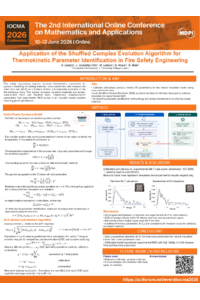
This work presents a computational methodology to determine the thermo‑kinetic parameters governing the fire behaviour of bio‑based thermal insulating materials, focusing on foams derived from flax and banana fibres. The methodology combines experimental mass‑loss‑rate (MLR) data from cone calorimeter tests at 50 kW/m² with a numerical inverse‑modelling framework implemented in the solid‑phase sub-model of Fire Dynamics Simulator (FDS). A simplified computational representation of the cone calorimeter is employed to accelerate simulations, enabling the use of the Shuffle Complex Evolution (SCE) optimization algorithm to identify the optimal set of parameters.
The proposed methodology estimates key thermal and kinetic parameters under a single‑reaction pyrolysis scheme. The optimized FDS models reproduce the experimental MLR curves with high accuracy, achieving mean‑squared errors of 1.36×10⁻⁴ kg·s⁻¹·m⁻² for flax foam and 1.02×10⁻⁴ kg·s⁻¹·m⁻² for banana foam. These results demonstrate the capability of the SCE‑driven inverse modelling framework to provide reliable material characterizations, obtaining appropriate thermos-kinetic parameters to reproduce decomposition reactions even in cases with limited prior information. Due to the optimization in the FDS modelling, and to the SCE approach, the proposed methodology requires only approximately one day of computation to identify optimal thermo-kinetic parameters governing decomposition reactions.
The methodology constitutes a robust applied‑mathematics tool for modelling fire dynamics in emerging sustainable insulation materials, offering a replicable workflow that supports material development, safety assessment, and integration into computational fire‑engineering simulations.
Keywords
Inverse modeling
Bio‑Based Materials
fire dynamics
decomposition reactions
Poster
Poster_Lazaro_SCE_IOCMA2026.pdf
Bifurcation Analysis of a Two-Dimensional Cancer–Immune Model with Antigenicity and Strong Allee Effect
Chaotic Optimization Method Based on Density-Controlled Chaotic Maps