Event submissions
Published
This submission belongs to the session S4. Applied Mathematics of the event The 2nd International Online Conference on Mathematics and Applications
Published date
04 Jun, 2026
Academic Editor
'%3e%3cpath%20d='M12.6657%2010.9104C12.4185%2010.325%2012.0599%209.79327%2011.6097%209.34482C11.1609%208.89508%2010.6293%208.5365%2010.0442%208.28888C10.0389%208.28626%2010.0337%208.28495%2010.0285%208.28233C10.8446%207.69279%2011.3752%206.73249%2011.3752%205.64904C11.3752%203.8542%209.92103%202.39999%208.1262%202.39999C6.33136%202.39999%204.87715%203.8542%204.87715%205.64904C4.87715%206.73249%205.40774%207.69279%206.22393%208.28364C6.21869%208.28626%206.21345%208.28757%206.20821%208.29019C5.62129%208.5378%205.09463%208.89284%204.64265%209.34613C4.1929%209.79493%203.83432%2010.3266%203.58671%2010.9117C3.34345%2011.4845%203.21226%2012.0987%203.20023%2012.7209C3.19988%2012.7349%203.20233%2012.7488%203.20744%2012.7619C3.21255%2012.7749%203.22022%2012.7867%203.22998%2012.7968C3.23975%2012.8068%203.25142%2012.8147%203.26431%2012.8202C3.2772%2012.8256%203.29105%2012.8284%203.30504%2012.8284H4.09109C4.14874%2012.8284%204.19459%2012.7825%204.1959%2012.7262C4.2221%2011.7148%204.62823%2010.7676%205.34617%2010.0497C6.08899%209.30683%207.0755%208.89808%208.1262%208.89808C9.17689%208.89808%2010.1634%209.30683%2010.9062%2010.0497C11.6242%2010.7676%2012.0303%2011.7148%2012.0565%2012.7262C12.0578%2012.7838%2012.1037%2012.8284%2012.1613%2012.8284H12.9474C12.9613%2012.8284%2012.9752%2012.8256%2012.9881%2012.8202C13.001%2012.8147%2013.0126%2012.8068%2013.0224%2012.7968C13.0322%2012.7867%2013.0398%2012.7749%2013.0449%2012.7619C13.0501%2012.7488%2013.0525%2012.7349%2013.0522%2012.7209C13.0391%2012.0947%2012.9094%2011.4855%2012.6657%2010.9104ZM8.1262%207.9024C7.52486%207.9024%206.9589%207.6679%206.53312%207.24211C6.10733%206.81633%205.87283%206.25037%205.87283%205.64904C5.87283%205.0477%206.10733%204.48174%206.53312%204.05596C6.9589%203.63018%207.52486%203.39567%208.1262%203.39567C8.72753%203.39567%209.29349%203.63018%209.71927%204.05596C10.1451%204.48174%2010.3796%205.0477%2010.3796%205.64904C10.3796%206.25037%2010.1451%206.81633%209.71927%207.24211C9.29349%207.6679%208.72753%207.9024%208.1262%207.9024Z'%20fill='%235D1EE1'/%3e%3c/g%3e%3c/svg%3e) David Carfì
David CarfìCitation
Saidul Hossain Al Amin, Ahnaf Ayman, Md Mujtabir Israil Kaif, Md Salah Uddin, A Multi-Objective Optimization Framework for Manufacturing Defect Reduction in Material Extrusion 3D Printing, in Proceedings of The 2nd International Online Conference on Mathematics and Applications, 10 June–12 June 2026, MDPI: Basel, Switzerland
Share
Email
Facebook
Twitter
LinkedIn
A Multi-Objective Optimization Framework for Manufacturing Defect Reduction in Material Extrusion 3D Printing
'%3e%3cpath%20d='M12.6647%2010.9104C12.4176%2010.325%2012.0589%209.7933%2011.6088%209.34485C11.16%208.89511%2010.6283%208.53653%2010.0432%208.28891C10.038%208.28629%2010.0327%208.28498%2010.0275%208.28236C10.8437%207.69282%2011.3743%206.73252%2011.3743%205.64907C11.3743%203.85423%209.92005%202.40002%208.12522%202.40002C6.33038%202.40002%204.87618%203.85423%204.87618%205.64907C4.87618%206.73252%205.40677%207.69282%206.22296%208.28367C6.21772%208.28629%206.21248%208.2876%206.20724%208.29022C5.62031%208.53783%205.09365%208.89287%204.64167%209.34616C4.19192%209.79496%203.83334%2010.3266%203.58573%2010.9117C3.34247%2011.4846%203.21128%2012.0987%203.19925%2012.721C3.1989%2012.735%203.20135%2012.7489%203.20646%2012.7619C3.21157%2012.7749%203.21924%2012.7868%203.22901%2012.7968C3.23877%2012.8068%203.25045%2012.8148%203.26334%2012.8202C3.27623%2012.8256%203.29007%2012.8284%203.30406%2012.8284H4.09012C4.14776%2012.8284%204.19362%2012.7825%204.19493%2012.7262C4.22113%2011.7148%204.62726%2010.7676%205.34519%2010.0497C6.08802%209.30686%207.07452%208.89811%208.12522%208.89811C9.17592%208.89811%2010.1624%209.30686%2010.9052%2010.0497C11.6232%2010.7676%2012.0293%2011.7148%2012.0555%2012.7262C12.0568%2012.7839%2012.1027%2012.8284%2012.1603%2012.8284H12.9464C12.9604%2012.8284%2012.9742%2012.8256%2012.9871%2012.8202C13%2012.8148%2013.0117%2012.8068%2013.0214%2012.7968C13.0312%2012.7868%2013.0389%2012.7749%2013.044%2012.7619C13.0491%2012.7489%2013.0515%2012.735%2013.0512%2012.721C13.0381%2012.0947%2012.9084%2011.4856%2012.6647%2010.9104ZM8.12522%207.90243C7.52388%207.90243%206.95792%207.66793%206.53214%207.24215C6.10636%206.81636%205.87185%206.2504%205.87185%205.64907C5.87185%205.04773%206.10636%204.48177%206.53214%204.05599C6.95792%203.63021%207.52388%203.3957%208.12522%203.3957C8.72655%203.3957%209.29252%203.63021%209.7183%204.05599C10.1441%204.48177%2010.3786%205.04773%2010.3786%205.64907C10.3786%206.2504%2010.1441%206.81636%209.7183%207.24215C9.29252%207.66793%208.72655%207.90243%208.12522%207.90243Z'%20fill='%235D1EE1'/%3e%3c/g%3e%3c/svg%3e)
Saidul Hossain Al Amin 1
Ahnaf Ayman 1
Md Mujtabir Israil Kaif 1
Md Salah Uddin 2
1. Department of Electrical and Computer Engineering, North South University, Dhaka, Bangladesh
2. Department of Mathematics and Physics, School of Engineering and Physical Sciences, North South University, Dhaka, Bangladesh
Abstract
Material extrusion 3D printing is one of the most versatile and accessible additive manufacturing techniques used by researchers and engineers across the globe. The technique is limited by manufacturing parameter-induced defects. These defects develop during the fabrication process, such as warping, poor layer adhesion, and dimensional inaccuracy. The defects can be controlled by optimizing process parameters, such as nozzle temperature, print speed, layer height, and cooling rate. Traditionally, parameter selection relies on iterative trial-and-error or single-objective optimization. These approaches often fail to capture the inherent trade-offs between conflicting quality characteristics. In this research, we used a systematic multi-objective optimization framework (MOO) to minimize manufacturing defects in the fabrication processing conditions.
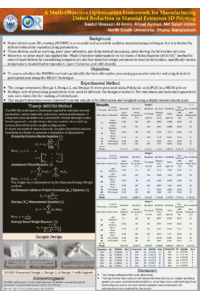
We produced the specimens using the material extrusion 3D printing (ME3DP) method. We used polylactic acid (PLA) for fabricating the specimens in the ME3DP technique. PLA has good manufacturability and is a biodegradable material. We produced manufacturing defects by controlling the temperature and the basic components of material design used in the fabrication process, such as nozzle temperature, heated bed temperature, layer thickness, and infill density. We applied one of the mathematical and multi-attribute decision-making techniques for the MOO framework, used as ‘Multi-Objective Optimization on the Basis of Ratio Analysis (MOORA)’. We used the (MOORA) technique to find the most significant configuration for evaluating manufacturing defect formation during the fabrication process. The MOORA technique is prevalently used in process engineering and optimization in industrial applications. The method simultaneously integrates both beneficial and non-beneficial attributes by using a ratio-based system. It then converts a decision matrix into a ranking system-based sample configuration. The ranking system determines the best parameters to control to reduce the manufacturing defects during the fabrication process. Our investigation shows that the MOORA method successfully determines the best manufacturing processing parameters for the reduction in defects.
Keywords
3D Printing
MOORA
Process Parameters
Manufacturing Defects
Entropy Weight Method
Poster
IOCMA 2026.pdf
Existence of global solutions to a nonlinear reaction–fractional diffusion system with anomalous diffusion
Global Existence Results of Weak Solutions for a Class of Abstract Evolution Problems