Event submissions
Published
This submission belongs to the session S4. Applied Mathematics of the event The 2nd International Online Conference on Mathematics and Applications
Published date
04 Jun, 2026
Academic Editor
'%3e%3cpath%20d='M12.6657%2010.9104C12.4185%2010.325%2012.0599%209.79327%2011.6097%209.34482C11.1609%208.89508%2010.6293%208.5365%2010.0442%208.28888C10.0389%208.28626%2010.0337%208.28495%2010.0285%208.28233C10.8446%207.69279%2011.3752%206.73249%2011.3752%205.64904C11.3752%203.8542%209.92103%202.39999%208.1262%202.39999C6.33136%202.39999%204.87715%203.8542%204.87715%205.64904C4.87715%206.73249%205.40774%207.69279%206.22393%208.28364C6.21869%208.28626%206.21345%208.28757%206.20821%208.29019C5.62129%208.5378%205.09463%208.89284%204.64265%209.34613C4.1929%209.79493%203.83432%2010.3266%203.58671%2010.9117C3.34345%2011.4845%203.21226%2012.0987%203.20023%2012.7209C3.19988%2012.7349%203.20233%2012.7488%203.20744%2012.7619C3.21255%2012.7749%203.22022%2012.7867%203.22998%2012.7968C3.23975%2012.8068%203.25142%2012.8147%203.26431%2012.8202C3.2772%2012.8256%203.29105%2012.8284%203.30504%2012.8284H4.09109C4.14874%2012.8284%204.19459%2012.7825%204.1959%2012.7262C4.2221%2011.7148%204.62823%2010.7676%205.34617%2010.0497C6.08899%209.30683%207.0755%208.89808%208.1262%208.89808C9.17689%208.89808%2010.1634%209.30683%2010.9062%2010.0497C11.6242%2010.7676%2012.0303%2011.7148%2012.0565%2012.7262C12.0578%2012.7838%2012.1037%2012.8284%2012.1613%2012.8284H12.9474C12.9613%2012.8284%2012.9752%2012.8256%2012.9881%2012.8202C13.001%2012.8147%2013.0126%2012.8068%2013.0224%2012.7968C13.0322%2012.7867%2013.0398%2012.7749%2013.0449%2012.7619C13.0501%2012.7488%2013.0525%2012.7349%2013.0522%2012.7209C13.0391%2012.0947%2012.9094%2011.4855%2012.6657%2010.9104ZM8.1262%207.9024C7.52486%207.9024%206.9589%207.6679%206.53312%207.24211C6.10733%206.81633%205.87283%206.25037%205.87283%205.64904C5.87283%205.0477%206.10733%204.48174%206.53312%204.05596C6.9589%203.63018%207.52486%203.39567%208.1262%203.39567C8.72753%203.39567%209.29349%203.63018%209.71927%204.05596C10.1451%204.48174%2010.3796%205.0477%2010.3796%205.64904C10.3796%206.25037%2010.1451%206.81633%209.71927%207.24211C9.29349%207.6679%208.72753%207.9024%208.1262%207.9024Z'%20fill='%235D1EE1'/%3e%3c/g%3e%3c/svg%3e) David Carfì
David CarfìCitation
Thiago Takaji Tsutsui, Danilo Cius, Antonio Sergio Magalhães de Castro, Fabiano Manoel de Andrade, Fractional-Time Jaynes–Cummings Model with Unitary Description: Dynamics for Binomial State of Light, in Proceedings of The 2nd International Online Conference on Mathematics and Applications, 10 June–12 June 2026, MDPI: Basel, Switzerland
Share
Email
Facebook
Twitter
LinkedIn
Fractional-Time Jaynes–Cummings Model with Unitary Description: Dynamics for Binomial State of Light
'%3e%3cpath%20d='M12.6647%2010.9104C12.4176%2010.325%2012.0589%209.7933%2011.6088%209.34485C11.16%208.89511%2010.6283%208.53653%2010.0432%208.28891C10.038%208.28629%2010.0327%208.28498%2010.0275%208.28236C10.8437%207.69282%2011.3743%206.73252%2011.3743%205.64907C11.3743%203.85423%209.92005%202.40002%208.12522%202.40002C6.33038%202.40002%204.87618%203.85423%204.87618%205.64907C4.87618%206.73252%205.40677%207.69282%206.22296%208.28367C6.21772%208.28629%206.21248%208.2876%206.20724%208.29022C5.62031%208.53783%205.09365%208.89287%204.64167%209.34616C4.19192%209.79496%203.83334%2010.3266%203.58573%2010.9117C3.34247%2011.4846%203.21128%2012.0987%203.19925%2012.721C3.1989%2012.735%203.20135%2012.7489%203.20646%2012.7619C3.21157%2012.7749%203.21924%2012.7868%203.22901%2012.7968C3.23877%2012.8068%203.25045%2012.8148%203.26334%2012.8202C3.27623%2012.8256%203.29007%2012.8284%203.30406%2012.8284H4.09012C4.14776%2012.8284%204.19362%2012.7825%204.19493%2012.7262C4.22113%2011.7148%204.62726%2010.7676%205.34519%2010.0497C6.08802%209.30686%207.07452%208.89811%208.12522%208.89811C9.17592%208.89811%2010.1624%209.30686%2010.9052%2010.0497C11.6232%2010.7676%2012.0293%2011.7148%2012.0555%2012.7262C12.0568%2012.7839%2012.1027%2012.8284%2012.1603%2012.8284H12.9464C12.9604%2012.8284%2012.9742%2012.8256%2012.9871%2012.8202C13%2012.8148%2013.0117%2012.8068%2013.0214%2012.7968C13.0312%2012.7868%2013.0389%2012.7749%2013.044%2012.7619C13.0491%2012.7489%2013.0515%2012.735%2013.0512%2012.721C13.0381%2012.0947%2012.9084%2011.4856%2012.6647%2010.9104ZM8.12522%207.90243C7.52388%207.90243%206.95792%207.66793%206.53214%207.24215C6.10636%206.81636%205.87185%206.2504%205.87185%205.64907C5.87185%205.04773%206.10636%204.48177%206.53214%204.05599C6.95792%203.63021%207.52388%203.3957%208.12522%203.3957C8.72655%203.3957%209.29252%203.63021%209.7183%204.05599C10.1441%204.48177%2010.3786%205.04773%2010.3786%205.64907C10.3786%206.2504%2010.1441%206.81636%209.7183%207.24215C9.29252%207.66793%208.72655%207.90243%208.12522%207.90243Z'%20fill='%235D1EE1'/%3e%3c/g%3e%3c/svg%3e)
Thiago Takaji Tsutsui 1
Danilo Cius 2
Antonio Sergio Magalhães de Castro 1,3

Fabiano Manoel de Andrade 1,4
1. QPQI Group, State University of Ponta Grossa, Ponta Grossa, 84030-900, Brazil
2. Department of Mathematical Physics, Institute of Physics of the University of São Paulo, São Paulo, 05508-090, Brazil
3. Department of Physics, State University of Ponta Grossa, Ponta Grossa, 84030-900, Brazil
4. Department of Mathematics and Statistics, State University of Ponta Grossa, Ponta Grossa, 84030-900, Brazil
Abstract
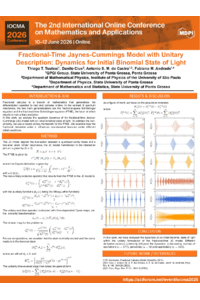
Fractional calculus provides useful extensions to models based on ordinary calculus, enabling the description of physical effects such as dissipation and memory. A notable application of this framework in quantum mechanics is the fractional-time Schrödinger equation (FTSE), in which the standard time derivative is replaced by a Caputo derivative carrying a power-law memory kernel. This modification, however, inherently leads to non-unitary evolution of the quantum state. In this work, we apply the FTSE within the paradigmatic Jaynes–Cummings (JC) model to study the evolution of a binomial state of light interacting with matter. The binomial distribution that characterizes the binomial states possesses both coherent and number states as special cases, while the JC model is a cornerstone for studying quantum light–matter interactions, with experimental validation in cavity quantum electrodynamics and applications in quantum information processing. To restore unitarity in our analysis, we follow a recently introduced technique based on time-dependent Dyson maps -- invertible operators that relate the unitary and non-unitary evolution operators via . Three distinct binomial distributions are analyzed with population inversion as the primary figure of merit. We show how different derivative orders distinctly influence the dynamics: a decreasing number of oscillations , periodicity , and aperiodicity .
Keywords
Quantum mechanics
Quantum optics
Fractional Calculus
Time-dependent Dyson maps
Poster
poster_iocma_2026_thiago.pdf
Perturbative Approach to Quantum State Transfer on Weighted Spin Chains
Optimising testing and antiretroviral therapy for prevention and control of HIV/AIDS transmission dynamics in Indonesia