Event submissions
Published
This submission belongs to the session S4. Applied Mathematics of the event The 2nd International Online Conference on Mathematics and Applications
Published date
04 Jun, 2026
Academic Editor
'%3e%3cpath%20d='M12.6657%2010.9104C12.4185%2010.325%2012.0599%209.79327%2011.6097%209.34482C11.1609%208.89508%2010.6293%208.5365%2010.0442%208.28888C10.0389%208.28626%2010.0337%208.28495%2010.0285%208.28233C10.8446%207.69279%2011.3752%206.73249%2011.3752%205.64904C11.3752%203.8542%209.92103%202.39999%208.1262%202.39999C6.33136%202.39999%204.87715%203.8542%204.87715%205.64904C4.87715%206.73249%205.40774%207.69279%206.22393%208.28364C6.21869%208.28626%206.21345%208.28757%206.20821%208.29019C5.62129%208.5378%205.09463%208.89284%204.64265%209.34613C4.1929%209.79493%203.83432%2010.3266%203.58671%2010.9117C3.34345%2011.4845%203.21226%2012.0987%203.20023%2012.7209C3.19988%2012.7349%203.20233%2012.7488%203.20744%2012.7619C3.21255%2012.7749%203.22022%2012.7867%203.22998%2012.7968C3.23975%2012.8068%203.25142%2012.8147%203.26431%2012.8202C3.2772%2012.8256%203.29105%2012.8284%203.30504%2012.8284H4.09109C4.14874%2012.8284%204.19459%2012.7825%204.1959%2012.7262C4.2221%2011.7148%204.62823%2010.7676%205.34617%2010.0497C6.08899%209.30683%207.0755%208.89808%208.1262%208.89808C9.17689%208.89808%2010.1634%209.30683%2010.9062%2010.0497C11.6242%2010.7676%2012.0303%2011.7148%2012.0565%2012.7262C12.0578%2012.7838%2012.1037%2012.8284%2012.1613%2012.8284H12.9474C12.9613%2012.8284%2012.9752%2012.8256%2012.9881%2012.8202C13.001%2012.8147%2013.0126%2012.8068%2013.0224%2012.7968C13.0322%2012.7867%2013.0398%2012.7749%2013.0449%2012.7619C13.0501%2012.7488%2013.0525%2012.7349%2013.0522%2012.7209C13.0391%2012.0947%2012.9094%2011.4855%2012.6657%2010.9104ZM8.1262%207.9024C7.52486%207.9024%206.9589%207.6679%206.53312%207.24211C6.10733%206.81633%205.87283%206.25037%205.87283%205.64904C5.87283%205.0477%206.10733%204.48174%206.53312%204.05596C6.9589%203.63018%207.52486%203.39567%208.1262%203.39567C8.72753%203.39567%209.29349%203.63018%209.71927%204.05596C10.1451%204.48174%2010.3796%205.0477%2010.3796%205.64904C10.3796%206.25037%2010.1451%206.81633%209.71927%207.24211C9.29349%207.6679%208.72753%207.9024%208.1262%207.9024Z'%20fill='%235D1EE1'/%3e%3c/g%3e%3c/svg%3e) David Carfì
David CarfìCitation
MD Shahidul Islam, Jin Wang, Quantifying Reinfection-Driven COVID-19 Transmission with Physics-Informed Neural Networks, in Proceedings of The 2nd International Online Conference on Mathematics and Applications, 10 June–12 June 2026, MDPI: Basel, Switzerland
Share
Email
Facebook
Twitter
LinkedIn
Quantifying Reinfection-Driven COVID-19 Transmission with Physics-Informed Neural Networks

MD Shahidul Islam 1

Jin Wang 1
1. Department of Mathematics, University of Tennessee at Chattanooga, Chattanooga, TN 37403, USA
Abstract
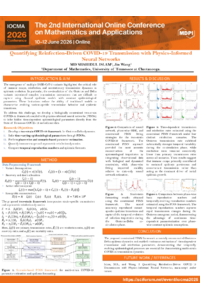
The evolution of SARS-CoV-2 underscores the significance of immune escape and reinfection in the spread of epidemics. This study proposes a two-strain compartmental model of the Omicron and Delta variants of SARS-CoV-2 and combines it with the Physics-Informed Neural Network (PINN) method to estimate time-dependent epidemiological parameters using daily epidemiological and variant-specific COVID-19 data from the State of Tennessee. Furthermore, a methodical superiority of PINN has been revealed over traditional non-linear least squares methods. The model captures the dynamics of primary transmission among susceptible individuals and secondary transmission resulting from the reinfection of recovered individuals with the other variant, thereby providing a mechanistic understanding of partial cross-immunity.
The PINN assimilates the non-linear equations of the two-strain compartmental model into the learning process using automatic differentiation, thereby satisfying the equations with the observed infection and recovery data. Time normalization, scaling of the system states, and log parameterization are used to improve the stability of the optimization process and maintain the positivity of the estimated epidemiological parameters, which are hidden.
To quantify the effect of immune escape on the sustainability of the epidemic, we examine various reinfection cases, including no reinfection and bidirectional reinfection. The trained PINN is used to forecast epidemic trajectories over a 30-day horizon, capturing strain-specific dynamics, variant dominance, and the risk of resurgence. Overall, this work demonstrates that physics-informed neural networks provide a principled and interpretable framework for learning non-stationary multi-strain epidemic dynamics and enabling reliable short-term forecasting from real-world data.
Keywords
Physics-Informed Neural Networks
Two-Strain COVID-19 Model
Non-Stationary Parameters
Immune Escape and Reinfection
Inverse Problems
Data-Driven Dynamical Systems
Poster
Poster COVID-19.pdf
Stochastic Dynamics of a Harvested Two-Species Fishery Model with Random Birth and Death Effects
Four Limit Cycles Surrounding a Single Singularity in Planar Differential Systems