Event submissions
Published
This submission belongs to the session S4. Applied Mathematics of the event The 2nd International Online Conference on Mathematics and Applications
Published date
04 Jun, 2026
Academic Editor
'%3e%3cpath%20d='M12.6657%2010.9104C12.4185%2010.325%2012.0599%209.79327%2011.6097%209.34482C11.1609%208.89508%2010.6293%208.5365%2010.0442%208.28888C10.0389%208.28626%2010.0337%208.28495%2010.0285%208.28233C10.8446%207.69279%2011.3752%206.73249%2011.3752%205.64904C11.3752%203.8542%209.92103%202.39999%208.1262%202.39999C6.33136%202.39999%204.87715%203.8542%204.87715%205.64904C4.87715%206.73249%205.40774%207.69279%206.22393%208.28364C6.21869%208.28626%206.21345%208.28757%206.20821%208.29019C5.62129%208.5378%205.09463%208.89284%204.64265%209.34613C4.1929%209.79493%203.83432%2010.3266%203.58671%2010.9117C3.34345%2011.4845%203.21226%2012.0987%203.20023%2012.7209C3.19988%2012.7349%203.20233%2012.7488%203.20744%2012.7619C3.21255%2012.7749%203.22022%2012.7867%203.22998%2012.7968C3.23975%2012.8068%203.25142%2012.8147%203.26431%2012.8202C3.2772%2012.8256%203.29105%2012.8284%203.30504%2012.8284H4.09109C4.14874%2012.8284%204.19459%2012.7825%204.1959%2012.7262C4.2221%2011.7148%204.62823%2010.7676%205.34617%2010.0497C6.08899%209.30683%207.0755%208.89808%208.1262%208.89808C9.17689%208.89808%2010.1634%209.30683%2010.9062%2010.0497C11.6242%2010.7676%2012.0303%2011.7148%2012.0565%2012.7262C12.0578%2012.7838%2012.1037%2012.8284%2012.1613%2012.8284H12.9474C12.9613%2012.8284%2012.9752%2012.8256%2012.9881%2012.8202C13.001%2012.8147%2013.0126%2012.8068%2013.0224%2012.7968C13.0322%2012.7867%2013.0398%2012.7749%2013.0449%2012.7619C13.0501%2012.7488%2013.0525%2012.7349%2013.0522%2012.7209C13.0391%2012.0947%2012.9094%2011.4855%2012.6657%2010.9104ZM8.1262%207.9024C7.52486%207.9024%206.9589%207.6679%206.53312%207.24211C6.10733%206.81633%205.87283%206.25037%205.87283%205.64904C5.87283%205.0477%206.10733%204.48174%206.53312%204.05596C6.9589%203.63018%207.52486%203.39567%208.1262%203.39567C8.72753%203.39567%209.29349%203.63018%209.71927%204.05596C10.1451%204.48174%2010.3796%205.0477%2010.3796%205.64904C10.3796%206.25037%2010.1451%206.81633%209.71927%207.24211C9.29349%207.6679%208.72753%207.9024%208.1262%207.9024Z'%20fill='%235D1EE1'/%3e%3c/g%3e%3c/svg%3e) Juan Torregrosa
Juan TorregrosaCitation
Aya Zaiem, Amar Makhlouf, A Sixth-Order Averaging Theory for Limit Cycles Bifurcating from Uniform Isochronous Cubic Centers, in Proceedings of The 2nd International Online Conference on Mathematics and Applications, 10 June–12 June 2026, MDPI: Basel, Switzerland
Share
Email
Facebook
Twitter
LinkedIn
A Sixth-Order Averaging Theory for Limit Cycles Bifurcating from Uniform Isochronous Cubic Centers
A Sixth-Order Averaging Theory for Limit Cycles Bifurcating from Uniform Isochronous Cubic Centers
'%3e%3cpath%20d='M12.6647%2010.9104C12.4176%2010.325%2012.0589%209.7933%2011.6088%209.34485C11.16%208.89511%2010.6283%208.53653%2010.0432%208.28891C10.038%208.28629%2010.0327%208.28498%2010.0275%208.28236C10.8437%207.69282%2011.3743%206.73252%2011.3743%205.64907C11.3743%203.85423%209.92005%202.40002%208.12522%202.40002C6.33038%202.40002%204.87618%203.85423%204.87618%205.64907C4.87618%206.73252%205.40677%207.69282%206.22296%208.28367C6.21772%208.28629%206.21248%208.2876%206.20724%208.29022C5.62031%208.53783%205.09365%208.89287%204.64167%209.34616C4.19192%209.79496%203.83334%2010.3266%203.58573%2010.9117C3.34247%2011.4846%203.21128%2012.0987%203.19925%2012.721C3.1989%2012.735%203.20135%2012.7489%203.20646%2012.7619C3.21157%2012.7749%203.21924%2012.7868%203.22901%2012.7968C3.23877%2012.8068%203.25045%2012.8148%203.26334%2012.8202C3.27623%2012.8256%203.29007%2012.8284%203.30406%2012.8284H4.09012C4.14776%2012.8284%204.19362%2012.7825%204.19493%2012.7262C4.22113%2011.7148%204.62726%2010.7676%205.34519%2010.0497C6.08802%209.30686%207.07452%208.89811%208.12522%208.89811C9.17592%208.89811%2010.1624%209.30686%2010.9052%2010.0497C11.6232%2010.7676%2012.0293%2011.7148%2012.0555%2012.7262C12.0568%2012.7839%2012.1027%2012.8284%2012.1603%2012.8284H12.9464C12.9604%2012.8284%2012.9742%2012.8256%2012.9871%2012.8202C13%2012.8148%2013.0117%2012.8068%2013.0214%2012.7968C13.0312%2012.7868%2013.0389%2012.7749%2013.044%2012.7619C13.0491%2012.7489%2013.0515%2012.735%2013.0512%2012.721C13.0381%2012.0947%2012.9084%2011.4856%2012.6647%2010.9104ZM8.12522%207.90243C7.52388%207.90243%206.95792%207.66793%206.53214%207.24215C6.10636%206.81636%205.87185%206.2504%205.87185%205.64907C5.87185%205.04773%206.10636%204.48177%206.53214%204.05599C6.95792%203.63021%207.52388%203.3957%208.12522%203.3957C8.72655%203.3957%209.29252%203.63021%209.7183%204.05599C10.1441%204.48177%2010.3786%205.04773%2010.3786%205.64907C10.3786%206.2504%2010.1441%206.81636%209.7183%207.24215C9.29252%207.66793%208.72655%207.90243%208.12522%207.90243Z'%20fill='%235D1EE1'/%3e%3c/g%3e%3c/svg%3e)
Aya Zaiem 1
Amar Makhlouf 2
1. Mathematics Department, Badji Mokhtar University, Annaba, Algeria
2. Laboratory of Applied Mathematics,Badji Mokhtar-Annaba University,12, P.O.Box , 23000 Annaba, Algeria
Abstract
In this study, we investigate the bifurcation of limit cycles from a class of uniform isochronous cubic centers in the plane under small continuous perturbations. Such systems provide classic yet challenging examples in nonlinear differential equations, offering valuable insight into the dynamics of planar polynomial systems and the emergence of small-amplitude periodic solutions. Understanding these bifurcations is fundamental for advancing the qualitative theory of planar systems and their applications in modeling oscillatory phenomena.
The differential system under consideration is given by:
\dot{x}=-y+x^{2}y+xy^{2}+\sum\limits_{i=1}^{6}\epsilon^{i}P_{i}(x,y),\quad
\dot{y}=x+xy^{2}-x^{2}y+\sum\limits_{i=1}^{6}\epsilon^{i}Q_{i}(x,y),
where P_{i}(x,y) and Q_{i}(x,y) are cubic polynomials, and ε is a small perturbation parameter. Introducing polar coordinates, the system is transformed into a form suitable for the averaging method. Applying the sixth-order averaging theory, we derive sufficient conditions for the existence of limit cycles through the analysis of the averaged functions. This higher-order approach enables the detection of subtle bifurcation phenomena that may be missed in lower-order analyses.
Our analysis demonstrates that at most three small-amplitude limit cycles can bifurcate from the uniform isochronous cubic center under small continuous perturbations. The use of higher-order averaging reveals complex dynamics and interactions between the perturbation terms that are otherwise undetectable.
These findings enrich the qualitative theory of planar polynomial differential systems and showcase the effectiveness of sixth-order averaging methods in studying limit cycle bifurcations. The results highlight the intricate behavior of cubic systems and provide a robust framework for future investigations in nonlinear dynamics, with potential applications for modeling oscillatory behaviors in applied mathematics, physics, and engineering.
Keywords
Limit cycles
Uniform isochronous cubic center
Nonlinear dynamics
6th-order averaging method
Poster
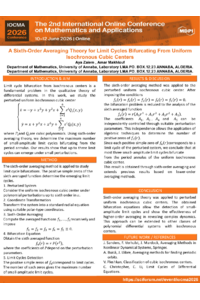
zaiem aya poster.pdf
One-Dimensional Modelling of Tidal Water Levels in Chilaw Lagoon, Sri Lanka.
Complex eigenvalues of the Schrödinger equation with a Gaussian barrier