Event submissions
Published
This submission belongs to the session S4. Applied Mathematics of the event The 2nd International Online Conference on Mathematics and Applications
Published date
05 Jun, 2026
Academic Editor
'%3e%3cpath%20d='M12.6657%2010.9104C12.4185%2010.325%2012.0599%209.79327%2011.6097%209.34482C11.1609%208.89508%2010.6293%208.5365%2010.0442%208.28888C10.0389%208.28626%2010.0337%208.28495%2010.0285%208.28233C10.8446%207.69279%2011.3752%206.73249%2011.3752%205.64904C11.3752%203.8542%209.92103%202.39999%208.1262%202.39999C6.33136%202.39999%204.87715%203.8542%204.87715%205.64904C4.87715%206.73249%205.40774%207.69279%206.22393%208.28364C6.21869%208.28626%206.21345%208.28757%206.20821%208.29019C5.62129%208.5378%205.09463%208.89284%204.64265%209.34613C4.1929%209.79493%203.83432%2010.3266%203.58671%2010.9117C3.34345%2011.4845%203.21226%2012.0987%203.20023%2012.7209C3.19988%2012.7349%203.20233%2012.7488%203.20744%2012.7619C3.21255%2012.7749%203.22022%2012.7867%203.22998%2012.7968C3.23975%2012.8068%203.25142%2012.8147%203.26431%2012.8202C3.2772%2012.8256%203.29105%2012.8284%203.30504%2012.8284H4.09109C4.14874%2012.8284%204.19459%2012.7825%204.1959%2012.7262C4.2221%2011.7148%204.62823%2010.7676%205.34617%2010.0497C6.08899%209.30683%207.0755%208.89808%208.1262%208.89808C9.17689%208.89808%2010.1634%209.30683%2010.9062%2010.0497C11.6242%2010.7676%2012.0303%2011.7148%2012.0565%2012.7262C12.0578%2012.7838%2012.1037%2012.8284%2012.1613%2012.8284H12.9474C12.9613%2012.8284%2012.9752%2012.8256%2012.9881%2012.8202C13.001%2012.8147%2013.0126%2012.8068%2013.0224%2012.7968C13.0322%2012.7867%2013.0398%2012.7749%2013.0449%2012.7619C13.0501%2012.7488%2013.0525%2012.7349%2013.0522%2012.7209C13.0391%2012.0947%2012.9094%2011.4855%2012.6657%2010.9104ZM8.1262%207.9024C7.52486%207.9024%206.9589%207.6679%206.53312%207.24211C6.10733%206.81633%205.87283%206.25037%205.87283%205.64904C5.87283%205.0477%206.10733%204.48174%206.53312%204.05596C6.9589%203.63018%207.52486%203.39567%208.1262%203.39567C8.72753%203.39567%209.29349%203.63018%209.71927%204.05596C10.1451%204.48174%2010.3796%205.0477%2010.3796%205.64904C10.3796%206.25037%2010.1451%206.81633%209.71927%207.24211C9.29349%207.6679%208.72753%207.9024%208.1262%207.9024Z'%20fill='%235D1EE1'/%3e%3c/g%3e%3c/svg%3e) Juan Torregrosa
Juan TorregrosaCitation
Sara Hiba Khemmoudj, Said Aoughellanet, Ilyes Ben Lemkherbeche, A Dimensionally Consistent Mathematical Framework for Optimal Frequency Selection in Pulse-Width Modulated Systems, in Proceedings of The 2nd International Online Conference on Mathematics and Applications, 10 June–12 June 2026, MDPI: Basel, Switzerland
Share
Email
Facebook
Twitter
LinkedIn
A Dimensionally Consistent Mathematical Framework for Optimal Frequency Selection in Pulse-Width Modulated Systems
'%3e%3cpath%20d='M12.6647%2010.9104C12.4176%2010.325%2012.0589%209.7933%2011.6088%209.34485C11.16%208.89511%2010.6283%208.53653%2010.0432%208.28891C10.038%208.28629%2010.0327%208.28498%2010.0275%208.28236C10.8437%207.69282%2011.3743%206.73252%2011.3743%205.64907C11.3743%203.85423%209.92005%202.40002%208.12522%202.40002C6.33038%202.40002%204.87618%203.85423%204.87618%205.64907C4.87618%206.73252%205.40677%207.69282%206.22296%208.28367C6.21772%208.28629%206.21248%208.2876%206.20724%208.29022C5.62031%208.53783%205.09365%208.89287%204.64167%209.34616C4.19192%209.79496%203.83334%2010.3266%203.58573%2010.9117C3.34247%2011.4846%203.21128%2012.0987%203.19925%2012.721C3.1989%2012.735%203.20135%2012.7489%203.20646%2012.7619C3.21157%2012.7749%203.21924%2012.7868%203.22901%2012.7968C3.23877%2012.8068%203.25045%2012.8148%203.26334%2012.8202C3.27623%2012.8256%203.29007%2012.8284%203.30406%2012.8284H4.09012C4.14776%2012.8284%204.19362%2012.7825%204.19493%2012.7262C4.22113%2011.7148%204.62726%2010.7676%205.34519%2010.0497C6.08802%209.30686%207.07452%208.89811%208.12522%208.89811C9.17592%208.89811%2010.1624%209.30686%2010.9052%2010.0497C11.6232%2010.7676%2012.0293%2011.7148%2012.0555%2012.7262C12.0568%2012.7839%2012.1027%2012.8284%2012.1603%2012.8284H12.9464C12.9604%2012.8284%2012.9742%2012.8256%2012.9871%2012.8202C13%2012.8148%2013.0117%2012.8068%2013.0214%2012.7968C13.0312%2012.7868%2013.0389%2012.7749%2013.044%2012.7619C13.0491%2012.7489%2013.0515%2012.735%2013.0512%2012.721C13.0381%2012.0947%2012.9084%2011.4856%2012.6647%2010.9104ZM8.12522%207.90243C7.52388%207.90243%206.95792%207.66793%206.53214%207.24215C6.10636%206.81636%205.87185%206.2504%205.87185%205.64907C5.87185%205.04773%206.10636%204.48177%206.53214%204.05599C6.95792%203.63021%207.52388%203.3957%208.12522%203.3957C8.72655%203.3957%209.29252%203.63021%209.7183%204.05599C10.1441%204.48177%2010.3786%205.04773%2010.3786%205.64907C10.3786%206.2504%2010.1441%206.81636%209.7183%207.24215C9.29252%207.66793%208.72655%207.90243%208.12522%207.90243Z'%20fill='%235D1EE1'/%3e%3c/g%3e%3c/svg%3e)
Sara Hiba Khemmoudj 1
Said Aoughellanet 1
Ilyes Ben Lemkherbeche 2
1. Department of Electronics, Faculty of Technology, University of Batna 2 – Mostefa Ben Boulaïd, Fesdis, Batna 05078, Algeria
2. Department of Electrical Engineering, Faculty of Technology, University of Batna 2 – Mostefa Ben Boulaïd, Fesdis, Batna, 05078, Algeria
Abstract
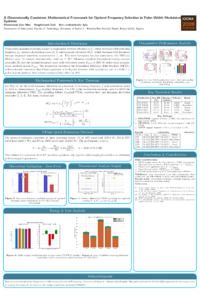
This work establishes a complete mathematical framework for determining the optimal switching frequency in pulse width modulated systems, resolving a longstanding dimensional inconsistency in the literature. Two competing objectives govern these systems: efficiency, which decreases with switching frequency due to switching losses, and harmonic distortion, which also decreases with frequency through improved waveform reconstruction. This monotonic conflict in a single independent variable forms the core mathematical challenge. Two key insights are introduced. First, dimensional analysis shows that the harmonic distortion coefficient has physical units of frequency raised to the power 0.65 rather than being dimensionless as commonly assumed. The correct formulation expresses it as a dimensionless constant multiplied by nominal frequency to the same exponent. Second, the optimal switching frequency scales with rated power of 2500 watts rather than instantaneous power because switching loss coefficients are defined at nominal conditions. These corrections yield a dimensionally consistent closed-form solution that satisfies the necessary optimality condition, and the associated fixed-point iteration is proven to converge geometrically with contraction rate 0.39. Validation across five pulse width modulation controllers, including Constant Frequency, Variable Frequency, Hysteresis Band, Optimal Normalized Efficiency Total Harmonic Distortion Product, and Dual Mode, shows zero theoretical error after calibrating a single dimensionless coefficient to 0.001. A secondary contribution, the Normalized Efficiency Total Harmonic Distortion Product, unifies both objectives into one scalar metric with a frequency-independent upper bound of 0.711. The infinite dimensional optimization reduces to evaluation at three load points at 10%, 50%, and 100%, reducing computations from 10000 to 3 while preserving rigorous error bounds.
Keywords
Pulse-width modulation
dimensional analysis
optimal control
variational optimization
contraction mapping
Pareto optimality
Poster
Conf_IOCMA_Sara.pdf
Optimal Vaccination Strategies for an SEIR Epidemic Model with Application to Influenza
Degenerate Mittag-Leffler Function via the Degenerate Pochhammer Symbol