Event submissions
Published
This submission belongs to the session S4. Applied Mathematics of the event The 2nd International Online Conference on Mathematics and Applications
Published date
05 Jun, 2026
Academic Editor
'%3e%3cpath%20d='M12.6657%2010.9104C12.4185%2010.325%2012.0599%209.79327%2011.6097%209.34482C11.1609%208.89508%2010.6293%208.5365%2010.0442%208.28888C10.0389%208.28626%2010.0337%208.28495%2010.0285%208.28233C10.8446%207.69279%2011.3752%206.73249%2011.3752%205.64904C11.3752%203.8542%209.92103%202.39999%208.1262%202.39999C6.33136%202.39999%204.87715%203.8542%204.87715%205.64904C4.87715%206.73249%205.40774%207.69279%206.22393%208.28364C6.21869%208.28626%206.21345%208.28757%206.20821%208.29019C5.62129%208.5378%205.09463%208.89284%204.64265%209.34613C4.1929%209.79493%203.83432%2010.3266%203.58671%2010.9117C3.34345%2011.4845%203.21226%2012.0987%203.20023%2012.7209C3.19988%2012.7349%203.20233%2012.7488%203.20744%2012.7619C3.21255%2012.7749%203.22022%2012.7867%203.22998%2012.7968C3.23975%2012.8068%203.25142%2012.8147%203.26431%2012.8202C3.2772%2012.8256%203.29105%2012.8284%203.30504%2012.8284H4.09109C4.14874%2012.8284%204.19459%2012.7825%204.1959%2012.7262C4.2221%2011.7148%204.62823%2010.7676%205.34617%2010.0497C6.08899%209.30683%207.0755%208.89808%208.1262%208.89808C9.17689%208.89808%2010.1634%209.30683%2010.9062%2010.0497C11.6242%2010.7676%2012.0303%2011.7148%2012.0565%2012.7262C12.0578%2012.7838%2012.1037%2012.8284%2012.1613%2012.8284H12.9474C12.9613%2012.8284%2012.9752%2012.8256%2012.9881%2012.8202C13.001%2012.8147%2013.0126%2012.8068%2013.0224%2012.7968C13.0322%2012.7867%2013.0398%2012.7749%2013.0449%2012.7619C13.0501%2012.7488%2013.0525%2012.7349%2013.0522%2012.7209C13.0391%2012.0947%2012.9094%2011.4855%2012.6657%2010.9104ZM8.1262%207.9024C7.52486%207.9024%206.9589%207.6679%206.53312%207.24211C6.10733%206.81633%205.87283%206.25037%205.87283%205.64904C5.87283%205.0477%206.10733%204.48174%206.53312%204.05596C6.9589%203.63018%207.52486%203.39567%208.1262%203.39567C8.72753%203.39567%209.29349%203.63018%209.71927%204.05596C10.1451%204.48174%2010.3796%205.0477%2010.3796%205.64904C10.3796%206.25037%2010.1451%206.81633%209.71927%207.24211C9.29349%207.6679%208.72753%207.9024%208.1262%207.9024Z'%20fill='%235D1EE1'/%3e%3c/g%3e%3c/svg%3e) Francisco Chiclana
Francisco ChiclanaCitation
Dimitrios Kostas, Stability estimates for discontinuous Galerkin in space Methods for the complex Ginzburg–Landau equation, in Proceedings of The 2nd International Online Conference on Mathematics and Applications, 10 June–12 June 2026, MDPI: Basel, Switzerland
Share
Email
Facebook
Twitter
LinkedIn
Stability estimates for discontinuous Galerkin in space Methods for the complex Ginzburg–Landau equation

Dimitrios Kostas 1
1. School of Electrical and Computer Engineering, National Technical University of Athens, Zografou Campus, 157 72 Athens, Greece
Abstract
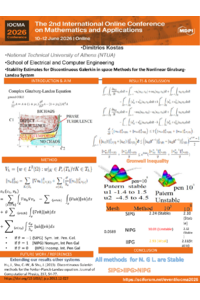
This study presents a rigorous stability analysis of Interior Penalty Discontinuous Galerkin (IP-DG) spatial discretizations for the complex Ginzburg–Landau equation (CGLE), a pivotal model governing nonlinear wave dynamics in optics, superconductivity, and fluid mechanics. The CGLE’s capacity to describe the evolution of slowly varying wave envelopes—characterized by intense nonlinearity and dissipative effects—is essential for modeling chaotic regimes and vortex-dominated systems. However, these dynamics pose significant numerical challenges; preserving physical properties such as amplitude boundedness and nonlinear stability is paramount for reliable long-term simulations.
We investigate a unified framework of IP-DG formulations, specifically comparing the Symmetric (SIPG), Non-symmetric (NIPG), and Incomplete (IIPG) methods. Our analysis establishes semi-discrete stability estimates and validates them through systematic numerical experiments. A central focus is placed on the role of the penalty parameter, where we demonstrate that its magnitude is the primary driver of numerical stability. We show that while the SIPG and IIPG schemes require a threshold penalty value to ensure coercivity and bound the solution norm, the NIPG scheme remains stable for a broader range of parameters, albeit with different convergence characteristics. Notably, the SIPG method exhibits the highest robustness in highly nonlinear settings, provided the penalty parameter is sufficiently tuned to suppress unphysical oscillations.
By clarifying the interplay between the penalty parameter, numerical dissipation, and nonlinear growth, this work offers a definitive guide for selecting DG discretizations tailored to specific physical regimes. These findings facilitate the development of high-fidelity computational tools for laser dynamics, turbulence modeling, and Bose–Einstein condensation research.
Keywords
Stability Space discontinuous Synmmetric Nonsymmetric Incomplete Interrior Penalty Galerkin
Poster
The 2nd IOCNAAM_.pdf
Logarithmic Traveling Wave Solutions of a Nonlinear Tzitzéica–Dodd–Bullough equation via the φ6-Expansion Method
Existence, Uniqueness, and Stability of distribution-dependent Stochastic Differential Equations Driven by G-Brownian Motion