Event submissions
Published
This submission belongs to the session S4. Applied Mathematics of the event The 2nd International Online Conference on Mathematics and Applications
Published date
05 Jun, 2026
Academic Editor
'%3e%3cpath%20d='M12.6657%2010.9104C12.4185%2010.325%2012.0599%209.79327%2011.6097%209.34482C11.1609%208.89508%2010.6293%208.5365%2010.0442%208.28888C10.0389%208.28626%2010.0337%208.28495%2010.0285%208.28233C10.8446%207.69279%2011.3752%206.73249%2011.3752%205.64904C11.3752%203.8542%209.92103%202.39999%208.1262%202.39999C6.33136%202.39999%204.87715%203.8542%204.87715%205.64904C4.87715%206.73249%205.40774%207.69279%206.22393%208.28364C6.21869%208.28626%206.21345%208.28757%206.20821%208.29019C5.62129%208.5378%205.09463%208.89284%204.64265%209.34613C4.1929%209.79493%203.83432%2010.3266%203.58671%2010.9117C3.34345%2011.4845%203.21226%2012.0987%203.20023%2012.7209C3.19988%2012.7349%203.20233%2012.7488%203.20744%2012.7619C3.21255%2012.7749%203.22022%2012.7867%203.22998%2012.7968C3.23975%2012.8068%203.25142%2012.8147%203.26431%2012.8202C3.2772%2012.8256%203.29105%2012.8284%203.30504%2012.8284H4.09109C4.14874%2012.8284%204.19459%2012.7825%204.1959%2012.7262C4.2221%2011.7148%204.62823%2010.7676%205.34617%2010.0497C6.08899%209.30683%207.0755%208.89808%208.1262%208.89808C9.17689%208.89808%2010.1634%209.30683%2010.9062%2010.0497C11.6242%2010.7676%2012.0303%2011.7148%2012.0565%2012.7262C12.0578%2012.7838%2012.1037%2012.8284%2012.1613%2012.8284H12.9474C12.9613%2012.8284%2012.9752%2012.8256%2012.9881%2012.8202C13.001%2012.8147%2013.0126%2012.8068%2013.0224%2012.7968C13.0322%2012.7867%2013.0398%2012.7749%2013.0449%2012.7619C13.0501%2012.7488%2013.0525%2012.7349%2013.0522%2012.7209C13.0391%2012.0947%2012.9094%2011.4855%2012.6657%2010.9104ZM8.1262%207.9024C7.52486%207.9024%206.9589%207.6679%206.53312%207.24211C6.10733%206.81633%205.87283%206.25037%205.87283%205.64904C5.87283%205.0477%206.10733%204.48174%206.53312%204.05596C6.9589%203.63018%207.52486%203.39567%208.1262%203.39567C8.72753%203.39567%209.29349%203.63018%209.71927%204.05596C10.1451%204.48174%2010.3796%205.0477%2010.3796%205.64904C10.3796%206.25037%2010.1451%206.81633%209.71927%207.24211C9.29349%207.6679%208.72753%207.9024%208.1262%207.9024Z'%20fill='%235D1EE1'/%3e%3c/g%3e%3c/svg%3e) Juan Torregrosa
Juan TorregrosaCitation
Spyridon C. Katsoudas, Panagiotis D. Linardopoulos, Anastasios A. Raptis, Konstantinos G. Moulakakis, John D. Kakisis, Konstantinos T. Spanos, Miltiadis I. Matsagkas, Athanasios D. Giannoukas, Christos G. Manopoulos, Efstratios E. Tzirtzilakis, Michalis A. Xenos, Mathematical Modeling and Surface-Based Quantification of Hemodynamics in Abdominal Aortic Aneurysms, in Proceedings of The 2nd International Online Conference on Mathematics and Applications, 10 June–12 June 2026, MDPI: Basel, Switzerland
Share
Email
Facebook
Twitter
LinkedIn
Mathematical Modeling and Surface-Based Quantification of Hemodynamics in Abdominal Aortic Aneurysms
'%3e%3cpath%20d='M12.6647%2010.9104C12.4176%2010.325%2012.0589%209.7933%2011.6088%209.34485C11.16%208.89511%2010.6283%208.53653%2010.0432%208.28891C10.038%208.28629%2010.0327%208.28498%2010.0275%208.28236C10.8437%207.69282%2011.3743%206.73252%2011.3743%205.64907C11.3743%203.85423%209.92005%202.40002%208.12522%202.40002C6.33038%202.40002%204.87618%203.85423%204.87618%205.64907C4.87618%206.73252%205.40677%207.69282%206.22296%208.28367C6.21772%208.28629%206.21248%208.2876%206.20724%208.29022C5.62031%208.53783%205.09365%208.89287%204.64167%209.34616C4.19192%209.79496%203.83334%2010.3266%203.58573%2010.9117C3.34247%2011.4846%203.21128%2012.0987%203.19925%2012.721C3.1989%2012.735%203.20135%2012.7489%203.20646%2012.7619C3.21157%2012.7749%203.21924%2012.7868%203.22901%2012.7968C3.23877%2012.8068%203.25045%2012.8148%203.26334%2012.8202C3.27623%2012.8256%203.29007%2012.8284%203.30406%2012.8284H4.09012C4.14776%2012.8284%204.19362%2012.7825%204.19493%2012.7262C4.22113%2011.7148%204.62726%2010.7676%205.34519%2010.0497C6.08802%209.30686%207.07452%208.89811%208.12522%208.89811C9.17592%208.89811%2010.1624%209.30686%2010.9052%2010.0497C11.6232%2010.7676%2012.0293%2011.7148%2012.0555%2012.7262C12.0568%2012.7839%2012.1027%2012.8284%2012.1603%2012.8284H12.9464C12.9604%2012.8284%2012.9742%2012.8256%2012.9871%2012.8202C13%2012.8148%2013.0117%2012.8068%2013.0214%2012.7968C13.0312%2012.7868%2013.0389%2012.7749%2013.044%2012.7619C13.0491%2012.7489%2013.0515%2012.735%2013.0512%2012.721C13.0381%2012.0947%2012.9084%2011.4856%2012.6647%2010.9104ZM8.12522%207.90243C7.52388%207.90243%206.95792%207.66793%206.53214%207.24215C6.10636%206.81636%205.87185%206.2504%205.87185%205.64907C5.87185%205.04773%206.10636%204.48177%206.53214%204.05599C6.95792%203.63021%207.52388%203.3957%208.12522%203.3957C8.72655%203.3957%209.29252%203.63021%209.7183%204.05599C10.1441%204.48177%2010.3786%205.04773%2010.3786%205.64907C10.3786%206.2504%2010.1441%206.81636%209.7183%207.24215C9.29252%207.66793%208.72655%207.90243%208.12522%207.90243Z'%20fill='%235D1EE1'/%3e%3c/g%3e%3c/svg%3e)
Spyridon C. Katsoudas 1
Panagiotis D. Linardopoulos 1
Anastasios A. Raptis 2
Konstantinos G. Moulakakis 3
John D. Kakisis 3
Konstantinos T. Spanos 4
Miltiadis I. Matsagkas 4
Athanasios D. Giannoukas 4

Christos G. Manopoulos 2

Efstratios E. Tzirtzilakis 5

Michalis A. Xenos 1
1. Department of Mathematics, University of Ioannina, Ioannina 45110, Greece
2. Laboratory of Biofluid Mechanics & Biomedical Technology, School of Mechanical Engineering, National Technical University of Athens, Zografou, Athens 15772, Greece
3. Department of Vascular Surgery, Attikon University Hospital, National and Kapodistrian University of Athens, Athens 10679, Greece
4. Department of Vascular Surgery, Faculty of Medicine, School of Health Sciences, University of Thessaly, Larissa 41334, Greece
5. Department of Civil Engineering, University of the Peloponnese, Patras 26334, Greece
Abstract
Introduction:
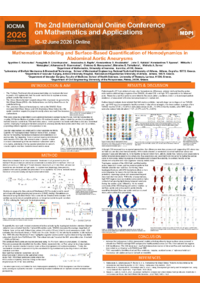
Abdominal aortic aneurysm (AAA) rupture risk is primarily assessed by maximum diameter, although biomechanical and hemodynamic mechanisms play a central role in wall degeneration and thrombus formation. From a fluid-mechanics standpoint, pathological remodeling is associated with low shear magnitude and oscillatory near-wall flow. This study formulates AAA evaluation as a patient-specific computational hemodynamics problem with spatial quantification of adverse shear environments.
Methods:
Fifteen AAA and ten healthy infrarenal aortic geometries were reconstructed and discretized using unstructured tetrahedral meshes with boundary layer refinement. Blood flow was modeled as an incompressible Newtonian fluid governed by the unsteady three-dimensional Navier–Stokes equations. Pulsatile inlet conditions were derived from a validated multiscale (0D–1D) cardiovascular model, and three-element Windkessel (RCR) boundary conditions were imposed at the iliac outlets. Hemodynamic indices were computed over the cardiac cycle: Time-Averaged Wall Shear Stress (TAWSS), Oscillatory Shear Index (OSI), and Relative Residence Time (RRT). The percentage of vessel surface exceeding pathological thresholds was quantified regionally.
Results:
AAA geometries exhibited significantly greater surface exposure to low TAWSS and elevated RRT compared with healthy controls (p < 0.001), indicating expanded regions of flow deceleration and prolonged near-wall residence. OSI showed weaker discriminatory capability in the infrarenal region. Disturbed flow patterns extended beyond the aneurysm sac into adjacent segments.
Conclusions:
Surface-based mathematical characterization of shear stress distributions enhances discrimination between healthy and aneurysmal aortas. The combined metrics TAWSS and RRT provide stronger predictive insight than oscillatory measures alone, supporting their integration into quantitative AAA risk modeling.
Keywords
Abdominal aortic aneurysm (AAA)
Computational fluid dynamics (CFD)
Time Averaged Wall shear stress (TAWSS)
Oscillatory shear index (OSI)
Relative Residence Time (RRT)
RCR boundary conditions
Poster
Poster.pdf
A DERIVATIVE-FREE OPTIMIZATION METHOD ON HADAMARD MANIFOLD FOR SOLVING NONLINEAR MONOTONE SYSTEMS WITH APPLICATION IN IMAGE DEBLURRING
Investigation of Third-Order Refinement Iterative Methods for Solving Linear Systems in Engineering Applications