Event submissions
Published
This submission belongs to the session S7. Novel Methods and Technologies for Research and Treatment of the event The 5th International Electronic Conference on Cancers
Published date
05 Jun, 2026
Academic Editor
'%3e%3cpath%20d='M12.6657%2010.9104C12.4185%2010.325%2012.0599%209.79327%2011.6097%209.34482C11.1609%208.89508%2010.6293%208.5365%2010.0442%208.28888C10.0389%208.28626%2010.0337%208.28495%2010.0285%208.28233C10.8446%207.69279%2011.3752%206.73249%2011.3752%205.64904C11.3752%203.8542%209.92103%202.39999%208.1262%202.39999C6.33136%202.39999%204.87715%203.8542%204.87715%205.64904C4.87715%206.73249%205.40774%207.69279%206.22393%208.28364C6.21869%208.28626%206.21345%208.28757%206.20821%208.29019C5.62129%208.5378%205.09463%208.89284%204.64265%209.34613C4.1929%209.79493%203.83432%2010.3266%203.58671%2010.9117C3.34345%2011.4845%203.21226%2012.0987%203.20023%2012.7209C3.19988%2012.7349%203.20233%2012.7488%203.20744%2012.7619C3.21255%2012.7749%203.22022%2012.7867%203.22998%2012.7968C3.23975%2012.8068%203.25142%2012.8147%203.26431%2012.8202C3.2772%2012.8256%203.29105%2012.8284%203.30504%2012.8284H4.09109C4.14874%2012.8284%204.19459%2012.7825%204.1959%2012.7262C4.2221%2011.7148%204.62823%2010.7676%205.34617%2010.0497C6.08899%209.30683%207.0755%208.89808%208.1262%208.89808C9.17689%208.89808%2010.1634%209.30683%2010.9062%2010.0497C11.6242%2010.7676%2012.0303%2011.7148%2012.0565%2012.7262C12.0578%2012.7838%2012.1037%2012.8284%2012.1613%2012.8284H12.9474C12.9613%2012.8284%2012.9752%2012.8256%2012.9881%2012.8202C13.001%2012.8147%2013.0126%2012.8068%2013.0224%2012.7968C13.0322%2012.7867%2013.0398%2012.7749%2013.0449%2012.7619C13.0501%2012.7488%2013.0525%2012.7349%2013.0522%2012.7209C13.0391%2012.0947%2012.9094%2011.4855%2012.6657%2010.9104ZM8.1262%207.9024C7.52486%207.9024%206.9589%207.6679%206.53312%207.24211C6.10733%206.81633%205.87283%206.25037%205.87283%205.64904C5.87283%205.0477%206.10733%204.48174%206.53312%204.05596C6.9589%203.63018%207.52486%203.39567%208.1262%203.39567C8.72753%203.39567%209.29349%203.63018%209.71927%204.05596C10.1451%204.48174%2010.3796%205.0477%2010.3796%205.64904C10.3796%206.25037%2010.1451%206.81633%209.71927%207.24211C9.29349%207.6679%208.72753%207.9024%208.1262%207.9024Z'%20fill='%235D1EE1'/%3e%3c/g%3e%3c/svg%3e) Guo-Min Li
Guo-Min LiCitation
Omar Hamad, Helen Naim Zarwi, Sarah Aldoseri, Moayed Al Abdul Wahed, Paul G. Murray, Digital Pathology Approach to Mapping Collagen VI Tumor Spatial Arrangement in COVID-19 Tissue Slides Using ImageJ, in Proceedings of The 5th International Electronic Conference on Cancers, 10 June–12 June 2026, MDPI: Basel, Switzerland
Share
Email
Facebook
Twitter
LinkedIn
Digital Pathology Approach to Mapping Collagen VI Tumor Spatial Arrangement in COVID-19 Tissue Slides Using ImageJ
'%3e%3cpath%20d='M12.6647%2010.9104C12.4176%2010.325%2012.0589%209.7933%2011.6088%209.34485C11.16%208.89511%2010.6283%208.53653%2010.0432%208.28891C10.038%208.28629%2010.0327%208.28498%2010.0275%208.28236C10.8437%207.69282%2011.3743%206.73252%2011.3743%205.64907C11.3743%203.85423%209.92005%202.40002%208.12522%202.40002C6.33038%202.40002%204.87618%203.85423%204.87618%205.64907C4.87618%206.73252%205.40677%207.69282%206.22296%208.28367C6.21772%208.28629%206.21248%208.2876%206.20724%208.29022C5.62031%208.53783%205.09365%208.89287%204.64167%209.34616C4.19192%209.79496%203.83334%2010.3266%203.58573%2010.9117C3.34247%2011.4846%203.21128%2012.0987%203.19925%2012.721C3.1989%2012.735%203.20135%2012.7489%203.20646%2012.7619C3.21157%2012.7749%203.21924%2012.7868%203.22901%2012.7968C3.23877%2012.8068%203.25045%2012.8148%203.26334%2012.8202C3.27623%2012.8256%203.29007%2012.8284%203.30406%2012.8284H4.09012C4.14776%2012.8284%204.19362%2012.7825%204.19493%2012.7262C4.22113%2011.7148%204.62726%2010.7676%205.34519%2010.0497C6.08802%209.30686%207.07452%208.89811%208.12522%208.89811C9.17592%208.89811%2010.1624%209.30686%2010.9052%2010.0497C11.6232%2010.7676%2012.0293%2011.7148%2012.0555%2012.7262C12.0568%2012.7839%2012.1027%2012.8284%2012.1603%2012.8284H12.9464C12.9604%2012.8284%2012.9742%2012.8256%2012.9871%2012.8202C13%2012.8148%2013.0117%2012.8068%2013.0214%2012.7968C13.0312%2012.7868%2013.0389%2012.7749%2013.044%2012.7619C13.0491%2012.7489%2013.0515%2012.735%2013.0512%2012.721C13.0381%2012.0947%2012.9084%2011.4856%2012.6647%2010.9104ZM8.12522%207.90243C7.52388%207.90243%206.95792%207.66793%206.53214%207.24215C6.10636%206.81636%205.87185%206.2504%205.87185%205.64907C5.87185%205.04773%206.10636%204.48177%206.53214%204.05599C6.95792%203.63021%207.52388%203.3957%208.12522%203.3957C8.72655%203.3957%209.29252%203.63021%209.7183%204.05599C10.1441%204.48177%2010.3786%205.04773%2010.3786%205.64907C10.3786%206.2504%2010.1441%206.81636%209.7183%207.24215C9.29252%207.66793%208.72655%207.90243%208.12522%207.90243Z'%20fill='%235D1EE1'/%3e%3c/g%3e%3c/svg%3e)
Omar Hamad 1
Helen Naim Zarwi 1
Sarah Aldoseri 1
Moayed Al Abdul Wahed 1
Paul G. Murray 1
1. School of Medicine, Royal College of Surgeons in Ireland-Medical University of Bahrain, Muharraq, Bahrain, Busaiteen 228, Bahrain
Abstract
Background:
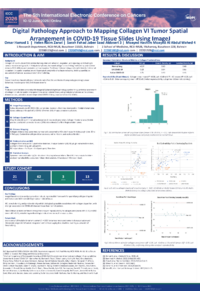
Collagen VI is a structural component of the extracellular matrix that regulates cellular processes, including adhesion, migration and signaling, that contribute to tumor growth and migration. In malignancies, such as Hodgkin lymphoma, changes in collagen deposition and its spatial arrangement are indicative of tumor-associated stromal remodeling. Traditional histopathology does not adequately capture the spatial organization of collagen networks. This study presents a reproducible digital pathology workflow using ImageJ to quantify collagen VI cellular spatial interactions in diseased tissue.
Aim: To develop and validate a digital pathology workflow using ImageJ for quantitative assessment of collagen VI-cellular spatial arrangements in cancer-related tissue remodeling.
Methods:
A Hodgkin lymphoma tissue image was used to establish workflow, which was subsequently applied to a COVID-19 lung tissue cohort. Structural elements were binarized and skeletonized; branching-related topological parameters were quantified. Architectural complexity was summarized using a composite Branching Complexity Index (BCI), alongside density-based metrics including branch and junction densities. Collagen fractional area was quantified using color thresholding. Distributional analyses and Spearman’s rank correlation assessed metric robustness and associations with collagen deposition. Reproducibility was evaluated using Bland–Altman and Spearman correlation analyses.
Results:
Branching-derived metrics were extracted and showed broad distributions with stable variability. BCI showed no meaningful association with collagen fractional area in normal lung tissue, whereas COVID-19 lung tissue demonstrated a positive association between BCI and collagen deposition, supporting the biological plausibility of the framework. Density-based metrics showed cohort-specific relationships with collagen fractional area, suggesting that branching abundance and network connectivity capture aspects of architectural remodeling. Bland-Altman analysis confirmed reproducibility for distance measurements.
Conclusion:
Skeleton-based branching analysis provides an approach for quantifying lung architectural remodeling in cancer. Branching metrics show associations with collagen deposition while extending beyond conventional area-based measures. This framework supports future integration with clinical data and application inother diseases involving tissue remodeling.
Acknowledgement:
We acknowledge the work done on the study titled "Multi-omic spatial profiling reveals the unique SARS-CoV-2 lung microenvironment and collagen VI as a predictive biomarker in severe COVID-19" to be the background of this study.
Keywords
COVID-19
Lung pathology
Branching complexity
Skeleton-based analysis
Collagen deposition
Quantitative histopathology
Poster
IECC2026_Poster_Hamad_Zarwi_Aldoseri_Abdul Wahed Poster 1 cancer conference.pdf
Emerging Strategies in Cancer Detection and Treatment: A Systematic Review of Immunotherapy, Gene Editing, and Artificial Intelligence
Liver Tumor Prediction: A Lifestyle-Based Risk Assessment