Event submissions
Published
This submission belongs to the session S4. Cancer Survivorship and Quality of Life of the event The 5th International Electronic Conference on Cancers
Published date
05 Jun, 2026
Academic Editor
'%3e%3cpath%20d='M12.6657%2010.9104C12.4185%2010.325%2012.0599%209.79327%2011.6097%209.34482C11.1609%208.89508%2010.6293%208.5365%2010.0442%208.28888C10.0389%208.28626%2010.0337%208.28495%2010.0285%208.28233C10.8446%207.69279%2011.3752%206.73249%2011.3752%205.64904C11.3752%203.8542%209.92103%202.39999%208.1262%202.39999C6.33136%202.39999%204.87715%203.8542%204.87715%205.64904C4.87715%206.73249%205.40774%207.69279%206.22393%208.28364C6.21869%208.28626%206.21345%208.28757%206.20821%208.29019C5.62129%208.5378%205.09463%208.89284%204.64265%209.34613C4.1929%209.79493%203.83432%2010.3266%203.58671%2010.9117C3.34345%2011.4845%203.21226%2012.0987%203.20023%2012.7209C3.19988%2012.7349%203.20233%2012.7488%203.20744%2012.7619C3.21255%2012.7749%203.22022%2012.7867%203.22998%2012.7968C3.23975%2012.8068%203.25142%2012.8147%203.26431%2012.8202C3.2772%2012.8256%203.29105%2012.8284%203.30504%2012.8284H4.09109C4.14874%2012.8284%204.19459%2012.7825%204.1959%2012.7262C4.2221%2011.7148%204.62823%2010.7676%205.34617%2010.0497C6.08899%209.30683%207.0755%208.89808%208.1262%208.89808C9.17689%208.89808%2010.1634%209.30683%2010.9062%2010.0497C11.6242%2010.7676%2012.0303%2011.7148%2012.0565%2012.7262C12.0578%2012.7838%2012.1037%2012.8284%2012.1613%2012.8284H12.9474C12.9613%2012.8284%2012.9752%2012.8256%2012.9881%2012.8202C13.001%2012.8147%2013.0126%2012.8068%2013.0224%2012.7968C13.0322%2012.7867%2013.0398%2012.7749%2013.0449%2012.7619C13.0501%2012.7488%2013.0525%2012.7349%2013.0522%2012.7209C13.0391%2012.0947%2012.9094%2011.4855%2012.6657%2010.9104ZM8.1262%207.9024C7.52486%207.9024%206.9589%207.6679%206.53312%207.24211C6.10733%206.81633%205.87283%206.25037%205.87283%205.64904C5.87283%205.0477%206.10733%204.48174%206.53312%204.05596C6.9589%203.63018%207.52486%203.39567%208.1262%203.39567C8.72753%203.39567%209.29349%203.63018%209.71927%204.05596C10.1451%204.48174%2010.3796%205.0477%2010.3796%205.64904C10.3796%206.25037%2010.1451%206.81633%209.71927%207.24211C9.29349%207.6679%208.72753%207.9024%208.1262%207.9024Z'%20fill='%235D1EE1'/%3e%3c/g%3e%3c/svg%3e) Sebastiano Mercadante
Sebastiano MercadanteCitation
Ioannis Adamopoulos, Aida Vafae Eslahi, Niki Syrou, George Mpourazanis, Panagiotis Tsirkas, Moustafa Younis, Survival impact of surgery and radiotherapy in malignant phyllodes tumors: Meta-Analysis of cohort studies, in Proceedings of The 5th International Electronic Conference on Cancers, 10 June–12 June 2026, MDPI: Basel, Switzerland
Share
Email
Facebook
Twitter
LinkedIn
Survival impact of surgery and radiotherapy in malignant phyllodes tumors: Meta-Analysis of cohort studies

Ioannis Adamopoulos 1

Aida Vafae Eslahi 2

Niki Syrou 3
'%3e%3cpath%20d='M12.6647%2010.9104C12.4176%2010.325%2012.0589%209.7933%2011.6088%209.34485C11.16%208.89511%2010.6283%208.53653%2010.0432%208.28891C10.038%208.28629%2010.0327%208.28498%2010.0275%208.28236C10.8437%207.69282%2011.3743%206.73252%2011.3743%205.64907C11.3743%203.85423%209.92005%202.40002%208.12522%202.40002C6.33038%202.40002%204.87618%203.85423%204.87618%205.64907C4.87618%206.73252%205.40677%207.69282%206.22296%208.28367C6.21772%208.28629%206.21248%208.2876%206.20724%208.29022C5.62031%208.53783%205.09365%208.89287%204.64167%209.34616C4.19192%209.79496%203.83334%2010.3266%203.58573%2010.9117C3.34247%2011.4846%203.21128%2012.0987%203.19925%2012.721C3.1989%2012.735%203.20135%2012.7489%203.20646%2012.7619C3.21157%2012.7749%203.21924%2012.7868%203.22901%2012.7968C3.23877%2012.8068%203.25045%2012.8148%203.26334%2012.8202C3.27623%2012.8256%203.29007%2012.8284%203.30406%2012.8284H4.09012C4.14776%2012.8284%204.19362%2012.7825%204.19493%2012.7262C4.22113%2011.7148%204.62726%2010.7676%205.34519%2010.0497C6.08802%209.30686%207.07452%208.89811%208.12522%208.89811C9.17592%208.89811%2010.1624%209.30686%2010.9052%2010.0497C11.6232%2010.7676%2012.0293%2011.7148%2012.0555%2012.7262C12.0568%2012.7839%2012.1027%2012.8284%2012.1603%2012.8284H12.9464C12.9604%2012.8284%2012.9742%2012.8256%2012.9871%2012.8202C13%2012.8148%2013.0117%2012.8068%2013.0214%2012.7968C13.0312%2012.7868%2013.0389%2012.7749%2013.044%2012.7619C13.0491%2012.7489%2013.0515%2012.735%2013.0512%2012.721C13.0381%2012.0947%2012.9084%2011.4856%2012.6647%2010.9104ZM8.12522%207.90243C7.52388%207.90243%206.95792%207.66793%206.53214%207.24215C6.10636%206.81636%205.87185%206.2504%205.87185%205.64907C5.87185%205.04773%206.10636%204.48177%206.53214%204.05599C6.95792%203.63021%207.52388%203.3957%208.12522%203.3957C8.72655%203.3957%209.29252%203.63021%209.7183%204.05599C10.1441%204.48177%2010.3786%205.04773%2010.3786%205.64907C10.3786%206.2504%2010.1441%206.81636%209.7183%207.24215C9.29252%207.66793%208.72655%207.90243%208.12522%207.90243Z'%20fill='%235D1EE1'/%3e%3c/g%3e%3c/svg%3e)
George Mpourazanis 4
Panagiotis Tsirkas 4

Moustafa Younis 5
1. Department of Public Health Policy, Sector of Occupational & Environmental Health, School of Public Health, University of West Attica, Athens, Greece
2. Medical Microbiology Research Center, Qazvin University of Medical Sciences, Qazvin, Iran
3. Department of Physical Education and Sport Science, University of Thessaly, Karies, Trikala, Greece
4. Department of Obstetrics and Gynecology, General Hospital “G. Hatzikosta" Ioannina, Ioannina, Greece
5. Department of health Policy & Management Jackson State University, Jackson, Mississippi, United States
Abstract
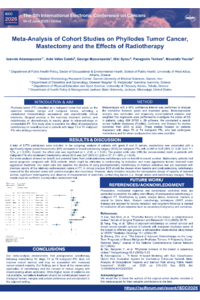
Background: Phyllodes tumors of the breast (PTs) are uncommon fibroepithelial lesions exhibiting tremendous biologic diversity, ranging from benign to highly aggressive malignant neoplasms. Surgical excision is the mainstay of treatment; however, the comparative survival benefit of mastectomy versus breast-conserving surgery (BCS) and the role of adjuvant postoperative radiotherapy (RT) in malignant PTs remain controversial. Existing evidence is fragmented, and clinical decision-making is largely extrapolated from retrospective series.
Methods: We conducted a PRISMA-compliant systematic review and meta-analysis of cohort studies evaluating survival outcomes in patients with primary malignant PTs treated with mastectomy or BCS, with or without postoperative RT. PubMed, Scopus, Cochrane Library, and PROSPERO databases were searched for eligible studies published between 2005 and 2025. Pooled hazard ratios (HRs) for overall survival and odds ratios (ORs) for cancer-related mortality were estimated using random-effects models in R software v.4.5.2. Meta-regression and propensity score-adjusted analyses were applied to account for tumor grade, surgical margins, and clinicopathologic confounders. In total, 8,779 patients with malignant PTs and available postoperative follow-up were included.
Results: Mastectomy, compared with breast-conserving surgery, was associated with significantly improved overall survival among patients with grade II–III malignant PTs (pooled HR=0.29, 95% CI=0.20–0.42; I²=72%, p=0.001). Postoperative radiotherapy did not confer a survival benefit and was associated with a higher risk of cancer-related mortality (pooled OR=3.27, 95% CI=2.55–4.17; I²=38%). These findings remained consistent across sensitivity and subgroup analyses adjusted for tumor grade and margin status.
Conclusions: Complete surgical resection remains the most critical determinant of survival in malignant phyllodes tumors. Our findings do not support the routine use of postoperative radiotherapy and suggest that RT should be reserved for carefully selected cases on an individualized basis. Overtreatment minimization, surgical treatment decisions, and future prospective trial designs, in a clinically significant manner, impact survivorship-focused cancer treatment and health care policy.
Keywords
Phyllodes tumor
Mastectomy
Radiotherapy
Meta-analysis
Survival outcomes
Poster
sciforum_158108_S4_slides_Adamopoulos_Vafae_Eslahi_Int_Cancer_Conference_MDPI_14_05_2026.pdf
The hypertrophic adipocyte niche fuels metabolic plasticity and invasive signaling in colorectal cancer
Breast Cancer in South India: Clinical Patterns and Lifestyle Associations in the Tiruchirappalli district