Event submissions
Published
This submission belongs to the session S4. Cancer Survivorship and Quality of Life of the event The 5th International Electronic Conference on Cancers
Published date
05 Jun, 2026
Academic Editor
'%3e%3cpath%20d='M12.6657%2010.9104C12.4185%2010.325%2012.0599%209.79327%2011.6097%209.34482C11.1609%208.89508%2010.6293%208.5365%2010.0442%208.28888C10.0389%208.28626%2010.0337%208.28495%2010.0285%208.28233C10.8446%207.69279%2011.3752%206.73249%2011.3752%205.64904C11.3752%203.8542%209.92103%202.39999%208.1262%202.39999C6.33136%202.39999%204.87715%203.8542%204.87715%205.64904C4.87715%206.73249%205.40774%207.69279%206.22393%208.28364C6.21869%208.28626%206.21345%208.28757%206.20821%208.29019C5.62129%208.5378%205.09463%208.89284%204.64265%209.34613C4.1929%209.79493%203.83432%2010.3266%203.58671%2010.9117C3.34345%2011.4845%203.21226%2012.0987%203.20023%2012.7209C3.19988%2012.7349%203.20233%2012.7488%203.20744%2012.7619C3.21255%2012.7749%203.22022%2012.7867%203.22998%2012.7968C3.23975%2012.8068%203.25142%2012.8147%203.26431%2012.8202C3.2772%2012.8256%203.29105%2012.8284%203.30504%2012.8284H4.09109C4.14874%2012.8284%204.19459%2012.7825%204.1959%2012.7262C4.2221%2011.7148%204.62823%2010.7676%205.34617%2010.0497C6.08899%209.30683%207.0755%208.89808%208.1262%208.89808C9.17689%208.89808%2010.1634%209.30683%2010.9062%2010.0497C11.6242%2010.7676%2012.0303%2011.7148%2012.0565%2012.7262C12.0578%2012.7838%2012.1037%2012.8284%2012.1613%2012.8284H12.9474C12.9613%2012.8284%2012.9752%2012.8256%2012.9881%2012.8202C13.001%2012.8147%2013.0126%2012.8068%2013.0224%2012.7968C13.0322%2012.7867%2013.0398%2012.7749%2013.0449%2012.7619C13.0501%2012.7488%2013.0525%2012.7349%2013.0522%2012.7209C13.0391%2012.0947%2012.9094%2011.4855%2012.6657%2010.9104ZM8.1262%207.9024C7.52486%207.9024%206.9589%207.6679%206.53312%207.24211C6.10733%206.81633%205.87283%206.25037%205.87283%205.64904C5.87283%205.0477%206.10733%204.48174%206.53312%204.05596C6.9589%203.63018%207.52486%203.39567%208.1262%203.39567C8.72753%203.39567%209.29349%203.63018%209.71927%204.05596C10.1451%204.48174%2010.3796%205.0477%2010.3796%205.64904C10.3796%206.25037%2010.1451%206.81633%209.71927%207.24211C9.29349%207.6679%208.72753%207.9024%208.1262%207.9024Z'%20fill='%235D1EE1'/%3e%3c/g%3e%3c/svg%3e) Sebastiano Mercadante
Sebastiano MercadanteCitation
Rajaram Vishnupriya, Janu P, Anandha Jothi S, Sara Ayisha Imthiaz Pasha, Arun Dharmarajan, Breast Cancer in South India: Clinical Patterns and Lifestyle Associations in the Tiruchirappalli district, in Proceedings of The 5th International Electronic Conference on Cancers, 10 June–12 June 2026, MDPI: Basel, Switzerland
Share
Email
Facebook
Twitter
LinkedIn
Breast Cancer in South India: Clinical Patterns and Lifestyle Associations in the Tiruchirappalli district
'%3e%3cpath%20d='M12.6647%2010.9104C12.4176%2010.325%2012.0589%209.7933%2011.6088%209.34485C11.16%208.89511%2010.6283%208.53653%2010.0432%208.28891C10.038%208.28629%2010.0327%208.28498%2010.0275%208.28236C10.8437%207.69282%2011.3743%206.73252%2011.3743%205.64907C11.3743%203.85423%209.92005%202.40002%208.12522%202.40002C6.33038%202.40002%204.87618%203.85423%204.87618%205.64907C4.87618%206.73252%205.40677%207.69282%206.22296%208.28367C6.21772%208.28629%206.21248%208.2876%206.20724%208.29022C5.62031%208.53783%205.09365%208.89287%204.64167%209.34616C4.19192%209.79496%203.83334%2010.3266%203.58573%2010.9117C3.34247%2011.4846%203.21128%2012.0987%203.19925%2012.721C3.1989%2012.735%203.20135%2012.7489%203.20646%2012.7619C3.21157%2012.7749%203.21924%2012.7868%203.22901%2012.7968C3.23877%2012.8068%203.25045%2012.8148%203.26334%2012.8202C3.27623%2012.8256%203.29007%2012.8284%203.30406%2012.8284H4.09012C4.14776%2012.8284%204.19362%2012.7825%204.19493%2012.7262C4.22113%2011.7148%204.62726%2010.7676%205.34519%2010.0497C6.08802%209.30686%207.07452%208.89811%208.12522%208.89811C9.17592%208.89811%2010.1624%209.30686%2010.9052%2010.0497C11.6232%2010.7676%2012.0293%2011.7148%2012.0555%2012.7262C12.0568%2012.7839%2012.1027%2012.8284%2012.1603%2012.8284H12.9464C12.9604%2012.8284%2012.9742%2012.8256%2012.9871%2012.8202C13%2012.8148%2013.0117%2012.8068%2013.0214%2012.7968C13.0312%2012.7868%2013.0389%2012.7749%2013.044%2012.7619C13.0491%2012.7489%2013.0515%2012.735%2013.0512%2012.721C13.0381%2012.0947%2012.9084%2011.4856%2012.6647%2010.9104ZM8.12522%207.90243C7.52388%207.90243%206.95792%207.66793%206.53214%207.24215C6.10636%206.81636%205.87185%206.2504%205.87185%205.64907C5.87185%205.04773%206.10636%204.48177%206.53214%204.05599C6.95792%203.63021%207.52388%203.3957%208.12522%203.3957C8.72655%203.3957%209.29252%203.63021%209.7183%204.05599C10.1441%204.48177%2010.3786%205.04773%2010.3786%205.64907C10.3786%206.2504%2010.1441%206.81636%209.7183%207.24215C9.29252%207.66793%208.72655%207.90243%208.12522%207.90243Z'%20fill='%235D1EE1'/%3e%3c/g%3e%3c/svg%3e)
Rajaram Vishnupriya 1
Janu P 1
Anandha Jothi S 1
Sara Ayisha Imthiaz Pasha 1

Arun Dharmarajan 2,3,4
1. Department of Biotechnology, School of Biosciences and Technology, Faculty of Engineering and Technology, SRM Institute of Science and Technology, Chennai 603203, india
2. SRM, Medical College Hospital and Research Centre, SRM Nagar, Irungalur, Trichy, 621105, India
3. Curtin Medical School, Curtin Health Innovation Research Institute, Curtin University, Perth, WA 6102, Australia.
4. School of Human Sciences, The University of Western Australia, Perth, WA 6009, Australia.
Abstract
Background:
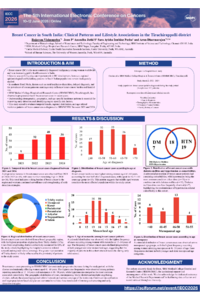
Breast cancer (BC) is the most frequently diagnosed malignancy among women globally and represents a significant and rising public health burden in India. Despite the role of genetic susceptibility, the epidemiological and hereditary patterns of breast cancer in South Indian populations, particularly in southern Tamil Nadu, remain poorly understood. SRM Medical College Hospital and Research Centre (SRMMCHRC), Tiruchirappalli, has reported increasing breast cancer cases, especially among women from rural backgrounds where consanguinity is prevalent.
Methods:
A retrospective study was conducted using anonymized clinical records of breast cancer patients diagnosed at SRMMCHRC between 2021 and 2024. Data on age, demographic characteristics, family history, consanguinity, tumor features, and geographic origin were systematically collected. Descriptive statistical analyses were performed to evaluate temporal trends, regional distribution, and age-specific incidence patterns.
Results:
Breast cancer cases increased steadily from 2021 to 2023, peaking in 2023, followed by minor fluctuations in 2024. Geographical analysis showed higher case concentrations in Trichy and “Other districts,” indicating regional disparities. Age-wise distribution revealed that the majority of cases occurred in women aged 45–65 years, with the highest incidence in the 55–60 age group, while younger and older populations contributed fewer cases.
Conclusion:
The findings highlight a rising burden of breast cancer with notable regional and age-related patterns. Hereditary factors, including consanguinity, along with lifestyle-related conditions, may contribute to disease risk. These results underscore the need for targeted screening, early detection, and improved risk stratification to enhance breast cancer management in this population.
Keywords
breast cancer
age-related patterns
diabetes
hypertension
Poster
sciforum_178005_S4_slides_Poster_Vishnu.pdf
Survival impact of surgery and radiotherapy in malignant phyllodes tumors: Meta-Analysis of cohort studies
Quantum Entanglement as a Physical Determinant of Genomic Instability in TP53