Event submissions
Published
This submission belongs to the session S4. Cancer Survivorship and Quality of Life of the event The 5th International Electronic Conference on Cancers
Published date
05 Jun, 2026
Academic Editor
'%3e%3cpath%20d='M12.6657%2010.9104C12.4185%2010.325%2012.0599%209.79327%2011.6097%209.34482C11.1609%208.89508%2010.6293%208.5365%2010.0442%208.28888C10.0389%208.28626%2010.0337%208.28495%2010.0285%208.28233C10.8446%207.69279%2011.3752%206.73249%2011.3752%205.64904C11.3752%203.8542%209.92103%202.39999%208.1262%202.39999C6.33136%202.39999%204.87715%203.8542%204.87715%205.64904C4.87715%206.73249%205.40774%207.69279%206.22393%208.28364C6.21869%208.28626%206.21345%208.28757%206.20821%208.29019C5.62129%208.5378%205.09463%208.89284%204.64265%209.34613C4.1929%209.79493%203.83432%2010.3266%203.58671%2010.9117C3.34345%2011.4845%203.21226%2012.0987%203.20023%2012.7209C3.19988%2012.7349%203.20233%2012.7488%203.20744%2012.7619C3.21255%2012.7749%203.22022%2012.7867%203.22998%2012.7968C3.23975%2012.8068%203.25142%2012.8147%203.26431%2012.8202C3.2772%2012.8256%203.29105%2012.8284%203.30504%2012.8284H4.09109C4.14874%2012.8284%204.19459%2012.7825%204.1959%2012.7262C4.2221%2011.7148%204.62823%2010.7676%205.34617%2010.0497C6.08899%209.30683%207.0755%208.89808%208.1262%208.89808C9.17689%208.89808%2010.1634%209.30683%2010.9062%2010.0497C11.6242%2010.7676%2012.0303%2011.7148%2012.0565%2012.7262C12.0578%2012.7838%2012.1037%2012.8284%2012.1613%2012.8284H12.9474C12.9613%2012.8284%2012.9752%2012.8256%2012.9881%2012.8202C13.001%2012.8147%2013.0126%2012.8068%2013.0224%2012.7968C13.0322%2012.7867%2013.0398%2012.7749%2013.0449%2012.7619C13.0501%2012.7488%2013.0525%2012.7349%2013.0522%2012.7209C13.0391%2012.0947%2012.9094%2011.4855%2012.6657%2010.9104ZM8.1262%207.9024C7.52486%207.9024%206.9589%207.6679%206.53312%207.24211C6.10733%206.81633%205.87283%206.25037%205.87283%205.64904C5.87283%205.0477%206.10733%204.48174%206.53312%204.05596C6.9589%203.63018%207.52486%203.39567%208.1262%203.39567C8.72753%203.39567%209.29349%203.63018%209.71927%204.05596C10.1451%204.48174%2010.3796%205.0477%2010.3796%205.64904C10.3796%206.25037%2010.1451%206.81633%209.71927%207.24211C9.29349%207.6679%208.72753%207.9024%208.1262%207.9024Z'%20fill='%235D1EE1'/%3e%3c/g%3e%3c/svg%3e) Sebastiano Mercadante
Sebastiano MercadanteCitation
Elsa Vitale, Influence of Heath Literacy on Quality of Life in oncology patients, in Proceedings of The 5th International Electronic Conference on Cancers, 10 June–12 June 2026, MDPI: Basel, Switzerland
Share
Email
Facebook
Twitter
LinkedIn
Influence of Heath Literacy on Quality of Life in oncology patients

Elsa Vitale 1
1. Healthcare Directions, ASL Bari, Bari 70123, Italy
Abstract
Background
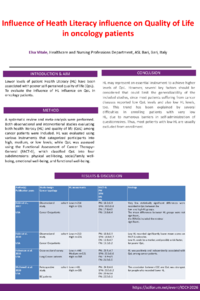
Lower levels of patient health literacy (HL) have been associated with poorer self-perceived quality of life (QoL).
Aim
We aimed to evaluate the influence of HL on QoL in oncology patients.
Methodology
A systematic review and meta-analysis were performed. Both observational and interventional studies evaluating both health literacy (HL) and quality of life (QoL) among cancer patients were included. HL was evaluated using various instruments that categorized participants into high, medium, or low levels; QoL was assessed using the Functional Assessment of Cancer Therapy–General (FACT-G), which classified QoL into four subdimensions: physical well-being, social/family well-being, emotional well-being, and functional well-being.
Results
We gathered data from four records and conducted additional analyses for each screened study based on the FACT-G sub-dimensions. Overall, our findings suggested substantial heterogeneity in the fields of physical, emotional, and functional well-being. Nevertheless, the Forest Plot revealed a clear trend toward poorer outcomes in low HL groups, and also revealed that patients with lower HL also reported lower QoL. This pattern was further supported in the social/family well-being subdimension.
Conclusions
HL may represent an essential instrument to achieve higher levels of QoL. However, several key factors should be considered that could limit the generalizability of the included studies, since most patients suffering from cancer diseases reported low QoL levels and low HL levels, too. This trend has been explained by several difficulties in enrolling patients with very low HL due to numerous barriers in self-administration of questionnaires. Thus, most patients with low HL are usually excluded from enrollment.
Keywords
Heath Literacy
Quality of Life
Nursing
Oncology
Poster
sciforum_163628_S4_powerpoint_Vitale.pdf
Cold Atmospheric Plasma–Mediated Disruption of Cell Adhesion Protein Interactions in Inflammatory Breast Cancer
A comprehensive study of HMG-CoA reductase in Uterine cancer with an in silico perspective