Event submissions
Published
This submission belongs to the session S3. Drug Resistance and Anti-cancer Drug Development and Screening of the event The 5th International Electronic Conference on Cancers
Published date
05 Jun, 2026
Academic Editor
'%3e%3cpath%20d='M12.6657%2010.9104C12.4185%2010.325%2012.0599%209.79327%2011.6097%209.34482C11.1609%208.89508%2010.6293%208.5365%2010.0442%208.28888C10.0389%208.28626%2010.0337%208.28495%2010.0285%208.28233C10.8446%207.69279%2011.3752%206.73249%2011.3752%205.64904C11.3752%203.8542%209.92103%202.39999%208.1262%202.39999C6.33136%202.39999%204.87715%203.8542%204.87715%205.64904C4.87715%206.73249%205.40774%207.69279%206.22393%208.28364C6.21869%208.28626%206.21345%208.28757%206.20821%208.29019C5.62129%208.5378%205.09463%208.89284%204.64265%209.34613C4.1929%209.79493%203.83432%2010.3266%203.58671%2010.9117C3.34345%2011.4845%203.21226%2012.0987%203.20023%2012.7209C3.19988%2012.7349%203.20233%2012.7488%203.20744%2012.7619C3.21255%2012.7749%203.22022%2012.7867%203.22998%2012.7968C3.23975%2012.8068%203.25142%2012.8147%203.26431%2012.8202C3.2772%2012.8256%203.29105%2012.8284%203.30504%2012.8284H4.09109C4.14874%2012.8284%204.19459%2012.7825%204.1959%2012.7262C4.2221%2011.7148%204.62823%2010.7676%205.34617%2010.0497C6.08899%209.30683%207.0755%208.89808%208.1262%208.89808C9.17689%208.89808%2010.1634%209.30683%2010.9062%2010.0497C11.6242%2010.7676%2012.0303%2011.7148%2012.0565%2012.7262C12.0578%2012.7838%2012.1037%2012.8284%2012.1613%2012.8284H12.9474C12.9613%2012.8284%2012.9752%2012.8256%2012.9881%2012.8202C13.001%2012.8147%2013.0126%2012.8068%2013.0224%2012.7968C13.0322%2012.7867%2013.0398%2012.7749%2013.0449%2012.7619C13.0501%2012.7488%2013.0525%2012.7349%2013.0522%2012.7209C13.0391%2012.0947%2012.9094%2011.4855%2012.6657%2010.9104ZM8.1262%207.9024C7.52486%207.9024%206.9589%207.6679%206.53312%207.24211C6.10733%206.81633%205.87283%206.25037%205.87283%205.64904C5.87283%205.0477%206.10733%204.48174%206.53312%204.05596C6.9589%203.63018%207.52486%203.39567%208.1262%203.39567C8.72753%203.39567%209.29349%203.63018%209.71927%204.05596C10.1451%204.48174%2010.3796%205.0477%2010.3796%205.64904C10.3796%206.25037%2010.1451%206.81633%209.71927%207.24211C9.29349%207.6679%208.72753%207.9024%208.1262%207.9024Z'%20fill='%235D1EE1'/%3e%3c/g%3e%3c/svg%3e) Farrukh Aqil
Farrukh AqilCitation
Maria Fernanda Barrientos Nava, Fabiola Estefanía Tristán-Flores, Guillermo Antonio Silva-Martínez, Molecular Docking and Molecular Dynamics Approaches to Evaluate the Specificity of the AS1411–Lapatinib Aptamer Complex in HER2-Positive Breast Cancer, in Proceedings of The 5th International Electronic Conference on Cancers, 10 June–12 June 2026, MDPI: Basel, Switzerland
Share
Email
Facebook
Twitter
LinkedIn
Molecular Docking and Molecular Dynamics Approaches to Evaluate the Specificity of the AS1411–Lapatinib Aptamer Complex in HER2-Positive Breast Cancer
'%3e%3cpath%20d='M12.6647%2010.9104C12.4176%2010.325%2012.0589%209.7933%2011.6088%209.34485C11.16%208.89511%2010.6283%208.53653%2010.0432%208.28891C10.038%208.28629%2010.0327%208.28498%2010.0275%208.28236C10.8437%207.69282%2011.3743%206.73252%2011.3743%205.64907C11.3743%203.85423%209.92005%202.40002%208.12522%202.40002C6.33038%202.40002%204.87618%203.85423%204.87618%205.64907C4.87618%206.73252%205.40677%207.69282%206.22296%208.28367C6.21772%208.28629%206.21248%208.2876%206.20724%208.29022C5.62031%208.53783%205.09365%208.89287%204.64167%209.34616C4.19192%209.79496%203.83334%2010.3266%203.58573%2010.9117C3.34247%2011.4846%203.21128%2012.0987%203.19925%2012.721C3.1989%2012.735%203.20135%2012.7489%203.20646%2012.7619C3.21157%2012.7749%203.21924%2012.7868%203.22901%2012.7968C3.23877%2012.8068%203.25045%2012.8148%203.26334%2012.8202C3.27623%2012.8256%203.29007%2012.8284%203.30406%2012.8284H4.09012C4.14776%2012.8284%204.19362%2012.7825%204.19493%2012.7262C4.22113%2011.7148%204.62726%2010.7676%205.34519%2010.0497C6.08802%209.30686%207.07452%208.89811%208.12522%208.89811C9.17592%208.89811%2010.1624%209.30686%2010.9052%2010.0497C11.6232%2010.7676%2012.0293%2011.7148%2012.0555%2012.7262C12.0568%2012.7839%2012.1027%2012.8284%2012.1603%2012.8284H12.9464C12.9604%2012.8284%2012.9742%2012.8256%2012.9871%2012.8202C13%2012.8148%2013.0117%2012.8068%2013.0214%2012.7968C13.0312%2012.7868%2013.0389%2012.7749%2013.044%2012.7619C13.0491%2012.7489%2013.0515%2012.735%2013.0512%2012.721C13.0381%2012.0947%2012.9084%2011.4856%2012.6647%2010.9104ZM8.12522%207.90243C7.52388%207.90243%206.95792%207.66793%206.53214%207.24215C6.10636%206.81636%205.87185%206.2504%205.87185%205.64907C5.87185%205.04773%206.10636%204.48177%206.53214%204.05599C6.95792%203.63021%207.52388%203.3957%208.12522%203.3957C8.72655%203.3957%209.29252%203.63021%209.7183%204.05599C10.1441%204.48177%2010.3786%205.04773%2010.3786%205.64907C10.3786%206.2504%2010.1441%206.81636%209.7183%207.24215C9.29252%207.66793%208.72655%207.90243%208.12522%207.90243Z'%20fill='%235D1EE1'/%3e%3c/g%3e%3c/svg%3e)
Maria Fernanda Barrientos Nava 1
Fabiola Estefanía Tristán-Flores 1,2

Guillermo Antonio Silva-Martínez 1,3,4
1. Graduate Program in Biochemical Engineering, Tecnológico Nacional de México / Instituto Tecnológico de Celaya, Celaya 38010, Mexico
2. Department of Basic Sciences, Tecnológico Nacional de México / Instituto Tecnológico de Celaya, Celaya 38010, Mexico
3. Department of Biochemical and Environmental Engineering, Tecnológico Nacional de México / Instituto Tecnológico de Celaya, Celaya 38010, Mexico
4. Secretariat of Science, Humanities, Technology and Innovation (SECIHTI), Mexico City 03940, Mexico
Abstract
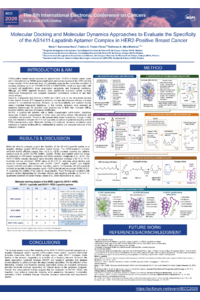
HER2-positive breast cancer is an aggressive subtype characterized by the overexpression of the HER2 tyrosine kinase receptor, which promotes uncontrolled cell proliferation and tumor progression. Lapatinib is a dual EGFR/HER2 inhibitor widely used in targeted therapies; however, its limited bioavailability and adverse effects associated with systemic distribution highlight the need for more selective molecular targeting strategies. In this context, DNA aptamers have emerged as promising platforms for specific molecular recognition and the development of targeted drug delivery systems.
The AS1411 aptamer, which is rich in guanine regions and capable of adopting stable conformational structures, represents a potential candidate for the selective transport of therapeutic agents. As an initial step in the structural design of the aptamer–drug complex, multiple conformations of the ligand Lapatinib were generated in order to represent its molecular flexibility and obtain energetically favorable geometries for subsequent interaction studies.
Additionally, potential binding cavities were identified using structural site detection algorithms. The analysis revealed seven possible interaction sites, with Site 1 identified as the main cavity, showing a size of 78, a PLB value of 1.54, and 10 hydrophobic features, associated with 62 nucleotide residues, including DG9, DT10, DT11, DG12, DT13, DG15, DT16, DG17, DG18, DG26, DG27, and DT28. These characteristics suggest a structurally favorable region for interactions with aromatic ligands.
The results obtained establish a structural basis for subsequent molecular docking studies and molecular dynamics simulations aimed at evaluating the stability of the AS1411–Lapatinib complex and its potential application in targeted delivery strategies for HER2-positive breast cancer.
Keywords
HER2-positive breast cancer
AS1411 aptamer
Lapatinib
molecular docking
molecular dynamics
Poster
poster.pdf
Transcription factor NR5A1 enhances wild-type p53 transactivation
Functional reactivation of p53 as a promising therapeutic strategy in the treatment of ovarian cancer