Event submissions
Published
This submission belongs to the session S2. Tumor Heterogeneity of the event The 5th International Electronic Conference on Cancers
Published date
05 Jun, 2026
Academic Editor
'%3e%3cpath%20d='M12.6657%2010.9104C12.4185%2010.325%2012.0599%209.79327%2011.6097%209.34482C11.1609%208.89508%2010.6293%208.5365%2010.0442%208.28888C10.0389%208.28626%2010.0337%208.28495%2010.0285%208.28233C10.8446%207.69279%2011.3752%206.73249%2011.3752%205.64904C11.3752%203.8542%209.92103%202.39999%208.1262%202.39999C6.33136%202.39999%204.87715%203.8542%204.87715%205.64904C4.87715%206.73249%205.40774%207.69279%206.22393%208.28364C6.21869%208.28626%206.21345%208.28757%206.20821%208.29019C5.62129%208.5378%205.09463%208.89284%204.64265%209.34613C4.1929%209.79493%203.83432%2010.3266%203.58671%2010.9117C3.34345%2011.4845%203.21226%2012.0987%203.20023%2012.7209C3.19988%2012.7349%203.20233%2012.7488%203.20744%2012.7619C3.21255%2012.7749%203.22022%2012.7867%203.22998%2012.7968C3.23975%2012.8068%203.25142%2012.8147%203.26431%2012.8202C3.2772%2012.8256%203.29105%2012.8284%203.30504%2012.8284H4.09109C4.14874%2012.8284%204.19459%2012.7825%204.1959%2012.7262C4.2221%2011.7148%204.62823%2010.7676%205.34617%2010.0497C6.08899%209.30683%207.0755%208.89808%208.1262%208.89808C9.17689%208.89808%2010.1634%209.30683%2010.9062%2010.0497C11.6242%2010.7676%2012.0303%2011.7148%2012.0565%2012.7262C12.0578%2012.7838%2012.1037%2012.8284%2012.1613%2012.8284H12.9474C12.9613%2012.8284%2012.9752%2012.8256%2012.9881%2012.8202C13.001%2012.8147%2013.0126%2012.8068%2013.0224%2012.7968C13.0322%2012.7867%2013.0398%2012.7749%2013.0449%2012.7619C13.0501%2012.7488%2013.0525%2012.7349%2013.0522%2012.7209C13.0391%2012.0947%2012.9094%2011.4855%2012.6657%2010.9104ZM8.1262%207.9024C7.52486%207.9024%206.9589%207.6679%206.53312%207.24211C6.10733%206.81633%205.87283%206.25037%205.87283%205.64904C5.87283%205.0477%206.10733%204.48174%206.53312%204.05596C6.9589%203.63018%207.52486%203.39567%208.1262%203.39567C8.72753%203.39567%209.29349%203.63018%209.71927%204.05596C10.1451%204.48174%2010.3796%205.0477%2010.3796%205.64904C10.3796%206.25037%2010.1451%206.81633%209.71927%207.24211C9.29349%207.6679%208.72753%207.9024%208.1262%207.9024Z'%20fill='%235D1EE1'/%3e%3c/g%3e%3c/svg%3e) Masaharu Seno
Masaharu SenoCitation
Mahmoud Aberkane, Anass Haloui, Chaimae Daoudi, Manal Derkaoui, Nassira Karich, Amal Bennani, Rare Palatal Cribriform Adenocarcinoma of the Salivary Glands: a Case Report, in Proceedings of The 5th International Electronic Conference on Cancers, 10 June–12 June 2026, MDPI: Basel, Switzerland
Share
Email
Facebook
Twitter
LinkedIn
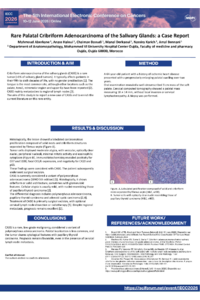
Rare Palatal Cribriform Adenocarcinoma of the Salivary Glands: a Case Report
'%3e%3cpath%20d='M12.6647%2010.9104C12.4176%2010.325%2012.0589%209.7933%2011.6088%209.34485C11.16%208.89511%2010.6283%208.53653%2010.0432%208.28891C10.038%208.28629%2010.0327%208.28498%2010.0275%208.28236C10.8437%207.69282%2011.3743%206.73252%2011.3743%205.64907C11.3743%203.85423%209.92005%202.40002%208.12522%202.40002C6.33038%202.40002%204.87618%203.85423%204.87618%205.64907C4.87618%206.73252%205.40677%207.69282%206.22296%208.28367C6.21772%208.28629%206.21248%208.2876%206.20724%208.29022C5.62031%208.53783%205.09365%208.89287%204.64167%209.34616C4.19192%209.79496%203.83334%2010.3266%203.58573%2010.9117C3.34247%2011.4846%203.21128%2012.0987%203.19925%2012.721C3.1989%2012.735%203.20135%2012.7489%203.20646%2012.7619C3.21157%2012.7749%203.21924%2012.7868%203.22901%2012.7968C3.23877%2012.8068%203.25045%2012.8148%203.26334%2012.8202C3.27623%2012.8256%203.29007%2012.8284%203.30406%2012.8284H4.09012C4.14776%2012.8284%204.19362%2012.7825%204.19493%2012.7262C4.22113%2011.7148%204.62726%2010.7676%205.34519%2010.0497C6.08802%209.30686%207.07452%208.89811%208.12522%208.89811C9.17592%208.89811%2010.1624%209.30686%2010.9052%2010.0497C11.6232%2010.7676%2012.0293%2011.7148%2012.0555%2012.7262C12.0568%2012.7839%2012.1027%2012.8284%2012.1603%2012.8284H12.9464C12.9604%2012.8284%2012.9742%2012.8256%2012.9871%2012.8202C13%2012.8148%2013.0117%2012.8068%2013.0214%2012.7968C13.0312%2012.7868%2013.0389%2012.7749%2013.044%2012.7619C13.0491%2012.7489%2013.0515%2012.735%2013.0512%2012.721C13.0381%2012.0947%2012.9084%2011.4856%2012.6647%2010.9104ZM8.12522%207.90243C7.52388%207.90243%206.95792%207.66793%206.53214%207.24215C6.10636%206.81636%205.87185%206.2504%205.87185%205.64907C5.87185%205.04773%206.10636%204.48177%206.53214%204.05599C6.95792%203.63021%207.52388%203.3957%208.12522%203.3957C8.72655%203.3957%209.29252%203.63021%209.7183%204.05599C10.1441%204.48177%2010.3786%205.04773%2010.3786%205.64907C10.3786%206.2504%2010.1441%206.81636%209.7183%207.24215C9.29252%207.66793%208.72655%207.90243%208.12522%207.90243Z'%20fill='%235D1EE1'/%3e%3c/g%3e%3c/svg%3e)
Mahmoud Aberkane 1
Anass Haloui 1
Chaimae Daoudi 1
Manal Derkaoui 1
Nassira Karich 1
Amal Bennani 1
1. Department of Anatomopathology, Mohammed VI University Hospital Center Oujda, Faculty of medicine and pharmacy Oujda, Oujda 60000, Morocco
Abstract
Introduction:
Cribriform adenocarcinoma of the salivary glands (CASG) is a rare tumor (<1% of salivary gland tumors). It typically affects patients in their fifth to sixth decades of life, with no gender predilection. The tongue is the most common site, although other locations such as the palate, tonsil, retromolar region and upper lip have been reported. CASG mainly metastasizes to regional lymph nodes.
Case report:
A 64-year-old patient with a history of ischemic heart disease presented with a progressively enlarging palatal swelling over two years.
Oral examination revealed a well-circumscribed 3 cm mass of the soft palate. Cervical computed tomography showed a palatal mass measuring 18 × 14 mm, without local invasion or cervical lymphadenopathy. A biopsy was performed.
Results:
Histologically, the lesion showed a lobulated carcinomatous proliferation composed of solid nests and cribriform structures separated by fibrous septa.
Tumor cells displayed moderate atypia, with vesicular, optically clear nuclei, peripheral nucleoli, minimal mitotic activity and eosinophilic cytoplasm. Immunohistochemistry revealed positivity for CK7 and S100, focal CK5/6 expression, and negativity for CK20 and p63.
These findings were consistent with CASG. The patient subsequently underwent surgical excision.
Discussion:
CASG is currently considered a variant of polymorphous adenocarcinoma (WHO 5th edition). Histologically, it shows cribriform or solid architecture, sometimes with glomeruloid features. Cellular atypia is usually mild, with nuclei resembling those of papillary thyroid carcinoma.
The differential diagnosis includes polymorphous adenocarcinoma, papillary thyroid carcinoma and adenoid cystic carcinoma.
Treatment of CASG is primarily surgical excision, with optional cervical lymph node dissection or radiotherapy. Despite regional metastasis, prognosis remains excellent.
Conclusion:
CASG is a rare, low-grade malignancy, considered a variant of polymorphous adenocarcinoma. Palatal localization is less common, and the tumor shares cytological features with papillary thyroid carcinoma. Prognosis remains favorable, even in the presence of cervical lymph node metastasis.
Keywords
Cribriform adenocarcinoma
salivary glands
palate
polymorphous adenocarcinoma
Poster
sciforum_178371_S2_slides_Rare_Palatal_Cribriform_Adenocarcinoma_of_the_Salivary_Glands_Aberkane_mahmoud.pdf
Deuterated α-Aminoisobutyric Acid (AIBA-d6) as a Novel Contrast Agent for Deuterium Magnetic Resonance Spectroscopy (DMRS)
Impact of AgNPs on LLC cells