Event submissions
Published
This submission belongs to the session S3. Drug Resistance and Anti-cancer Drug Development and Screening of the event The 5th International Electronic Conference on Cancers
Published date
05 Jun, 2026
Academic Editor
'%3e%3cpath%20d='M12.6657%2010.9104C12.4185%2010.325%2012.0599%209.79327%2011.6097%209.34482C11.1609%208.89508%2010.6293%208.5365%2010.0442%208.28888C10.0389%208.28626%2010.0337%208.28495%2010.0285%208.28233C10.8446%207.69279%2011.3752%206.73249%2011.3752%205.64904C11.3752%203.8542%209.92103%202.39999%208.1262%202.39999C6.33136%202.39999%204.87715%203.8542%204.87715%205.64904C4.87715%206.73249%205.40774%207.69279%206.22393%208.28364C6.21869%208.28626%206.21345%208.28757%206.20821%208.29019C5.62129%208.5378%205.09463%208.89284%204.64265%209.34613C4.1929%209.79493%203.83432%2010.3266%203.58671%2010.9117C3.34345%2011.4845%203.21226%2012.0987%203.20023%2012.7209C3.19988%2012.7349%203.20233%2012.7488%203.20744%2012.7619C3.21255%2012.7749%203.22022%2012.7867%203.22998%2012.7968C3.23975%2012.8068%203.25142%2012.8147%203.26431%2012.8202C3.2772%2012.8256%203.29105%2012.8284%203.30504%2012.8284H4.09109C4.14874%2012.8284%204.19459%2012.7825%204.1959%2012.7262C4.2221%2011.7148%204.62823%2010.7676%205.34617%2010.0497C6.08899%209.30683%207.0755%208.89808%208.1262%208.89808C9.17689%208.89808%2010.1634%209.30683%2010.9062%2010.0497C11.6242%2010.7676%2012.0303%2011.7148%2012.0565%2012.7262C12.0578%2012.7838%2012.1037%2012.8284%2012.1613%2012.8284H12.9474C12.9613%2012.8284%2012.9752%2012.8256%2012.9881%2012.8202C13.001%2012.8147%2013.0126%2012.8068%2013.0224%2012.7968C13.0322%2012.7867%2013.0398%2012.7749%2013.0449%2012.7619C13.0501%2012.7488%2013.0525%2012.7349%2013.0522%2012.7209C13.0391%2012.0947%2012.9094%2011.4855%2012.6657%2010.9104ZM8.1262%207.9024C7.52486%207.9024%206.9589%207.6679%206.53312%207.24211C6.10733%206.81633%205.87283%206.25037%205.87283%205.64904C5.87283%205.0477%206.10733%204.48174%206.53312%204.05596C6.9589%203.63018%207.52486%203.39567%208.1262%203.39567C8.72753%203.39567%209.29349%203.63018%209.71927%204.05596C10.1451%204.48174%2010.3796%205.0477%2010.3796%205.64904C10.3796%206.25037%2010.1451%206.81633%209.71927%207.24211C9.29349%207.6679%208.72753%207.9024%208.1262%207.9024Z'%20fill='%235D1EE1'/%3e%3c/g%3e%3c/svg%3e) Farrukh Aqil
Farrukh AqilCitation
Charu Verma, Praveen Kumar Verma, IN SILICO PHARMACOKINETIC PROFILING AND MOLECULAR DOCKING OF MARGOLONONE AGAINST THE ONCOGENIC IDH1-R132H MUTANT, in Proceedings of The 5th International Electronic Conference on Cancers, 10 June–12 June 2026, MDPI: Basel, Switzerland
Share
Email
Facebook
Twitter
LinkedIn
IN SILICO PHARMACOKINETIC PROFILING AND MOLECULAR DOCKING OF MARGOLONONE AGAINST THE ONCOGENIC IDH1-R132H MUTANT

Charu Verma 1
'%3e%3cpath%20d='M12.6647%2010.9104C12.4176%2010.325%2012.0589%209.7933%2011.6088%209.34485C11.16%208.89511%2010.6283%208.53653%2010.0432%208.28891C10.038%208.28629%2010.0327%208.28498%2010.0275%208.28236C10.8437%207.69282%2011.3743%206.73252%2011.3743%205.64907C11.3743%203.85423%209.92005%202.40002%208.12522%202.40002C6.33038%202.40002%204.87618%203.85423%204.87618%205.64907C4.87618%206.73252%205.40677%207.69282%206.22296%208.28367C6.21772%208.28629%206.21248%208.2876%206.20724%208.29022C5.62031%208.53783%205.09365%208.89287%204.64167%209.34616C4.19192%209.79496%203.83334%2010.3266%203.58573%2010.9117C3.34247%2011.4846%203.21128%2012.0987%203.19925%2012.721C3.1989%2012.735%203.20135%2012.7489%203.20646%2012.7619C3.21157%2012.7749%203.21924%2012.7868%203.22901%2012.7968C3.23877%2012.8068%203.25045%2012.8148%203.26334%2012.8202C3.27623%2012.8256%203.29007%2012.8284%203.30406%2012.8284H4.09012C4.14776%2012.8284%204.19362%2012.7825%204.19493%2012.7262C4.22113%2011.7148%204.62726%2010.7676%205.34519%2010.0497C6.08802%209.30686%207.07452%208.89811%208.12522%208.89811C9.17592%208.89811%2010.1624%209.30686%2010.9052%2010.0497C11.6232%2010.7676%2012.0293%2011.7148%2012.0555%2012.7262C12.0568%2012.7839%2012.1027%2012.8284%2012.1603%2012.8284H12.9464C12.9604%2012.8284%2012.9742%2012.8256%2012.9871%2012.8202C13%2012.8148%2013.0117%2012.8068%2013.0214%2012.7968C13.0312%2012.7868%2013.0389%2012.7749%2013.044%2012.7619C13.0491%2012.7489%2013.0515%2012.735%2013.0512%2012.721C13.0381%2012.0947%2012.9084%2011.4856%2012.6647%2010.9104ZM8.12522%207.90243C7.52388%207.90243%206.95792%207.66793%206.53214%207.24215C6.10636%206.81636%205.87185%206.2504%205.87185%205.64907C5.87185%205.04773%206.10636%204.48177%206.53214%204.05599C6.95792%203.63021%207.52388%203.3957%208.12522%203.3957C8.72655%203.3957%209.29252%203.63021%209.7183%204.05599C10.1441%204.48177%2010.3786%205.04773%2010.3786%205.64907C10.3786%206.2504%2010.1441%206.81636%209.7183%207.24215C9.29252%207.66793%208.72655%207.90243%208.12522%207.90243Z'%20fill='%235D1EE1'/%3e%3c/g%3e%3c/svg%3e)
Praveen Kumar Verma 2
1. Centre for Interdisciplinary Research in Basic Sciences, Jamia Millia Islamia, New Delhi, 110025, India.
2. Rajiv Gandhi Regional Museum of Natural History, Sawai Madhopur, Rajasthan, India
Abstract
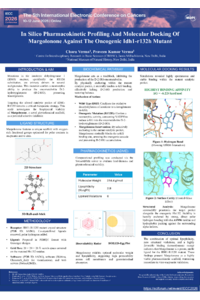
Mutations in the isocitrate dehydrogenase 1 (IDH1) enzyme, particularly the R132H substitution, are key drivers of several malignancies, owing to the neomorphic production of the oncometabolite D-2-hydroxyglutarate. Targeting the different catalytic pocket of IDH1-R132H remains a critical therapeutic blueprint. This research mainly examines the biophysical viability and binding effectiveness of Margolonone, a novel bioactive compound, as a potential selective inhibitor of the IDH1 mutant. Computational pharmacokinetic profiling was executed using SwissADME to assess lead-likeness and physicochemical stability. To determine binding effectiveness, molecular docking simulations were performed using AutoDock Vina via the Webina framework. The structural model of the IDH1-R132H mutant (PDB ID: 6ADG) was utilised as the receptor. A highly specific (20 X 20 X 20) Å search space was centred around the mutated His132 residue to evaluate allosteric and competitive binding modes. Pharmacokinetic evaluation revealed that Margolonone exhibits excellent biophysical parameters, strictly bound to Lipinski’s Rule of Five with zero violations. The compound demonstrated an ideal molecular weight of 314.4 g/mol and a favourable lipophilicity profile (XLogP3 = 2.9), suggesting high cell membrane permeability and gastrointestinal absorption. Molecular docking simulations corroborated these favourable properties, yielding a strong, spontaneous binding affinity of -6.607 kcal/mol within the IDH1-R132H active site, driven by specific non-covalent interactions within the target pocket, notably strong hydrogen bonding with the ASN96 residue. The combination of optimal lipophilicity, no structural violations, and a highly favourable binding thermodynamic energy indicates that Margolonone acts as a potent, stable ligand for the IDH1-R132H mutant. These in silico findings present Margolonone as a highly executable pharmacokinetic scaffold, warranting immediate in vitro validation for targeted oncological interventions.
Keywords
Margolonone
IDH1-R132H Mutant
Molecular Docking
In Silico Pharmacokinetics
Oncometabolite
Targeted Cancer Therapy
AutoDock Vina
Drug Discovery
Webina framework
Poster
Sciforum Presentation Electronic Conference on Cancers.pdf
Bioinformatic Identification of ACTN4 as a Candidate Master Regulator of Local Invasion in Glioblastoma
Enhancing Analytical Rigor: A pathologist-guided Framework for Multiplex Immunofluorescence Profiling of the NSCLC Tumor Microenvironment