Event submissions
Published
This submission belongs to the session S3. Drug Resistance and Anti-cancer Drug Development and Screening of the event The 5th International Electronic Conference on Cancers
Published date
05 Jun, 2026
Academic Editor
'%3e%3cpath%20d='M12.6657%2010.9104C12.4185%2010.325%2012.0599%209.79327%2011.6097%209.34482C11.1609%208.89508%2010.6293%208.5365%2010.0442%208.28888C10.0389%208.28626%2010.0337%208.28495%2010.0285%208.28233C10.8446%207.69279%2011.3752%206.73249%2011.3752%205.64904C11.3752%203.8542%209.92103%202.39999%208.1262%202.39999C6.33136%202.39999%204.87715%203.8542%204.87715%205.64904C4.87715%206.73249%205.40774%207.69279%206.22393%208.28364C6.21869%208.28626%206.21345%208.28757%206.20821%208.29019C5.62129%208.5378%205.09463%208.89284%204.64265%209.34613C4.1929%209.79493%203.83432%2010.3266%203.58671%2010.9117C3.34345%2011.4845%203.21226%2012.0987%203.20023%2012.7209C3.19988%2012.7349%203.20233%2012.7488%203.20744%2012.7619C3.21255%2012.7749%203.22022%2012.7867%203.22998%2012.7968C3.23975%2012.8068%203.25142%2012.8147%203.26431%2012.8202C3.2772%2012.8256%203.29105%2012.8284%203.30504%2012.8284H4.09109C4.14874%2012.8284%204.19459%2012.7825%204.1959%2012.7262C4.2221%2011.7148%204.62823%2010.7676%205.34617%2010.0497C6.08899%209.30683%207.0755%208.89808%208.1262%208.89808C9.17689%208.89808%2010.1634%209.30683%2010.9062%2010.0497C11.6242%2010.7676%2012.0303%2011.7148%2012.0565%2012.7262C12.0578%2012.7838%2012.1037%2012.8284%2012.1613%2012.8284H12.9474C12.9613%2012.8284%2012.9752%2012.8256%2012.9881%2012.8202C13.001%2012.8147%2013.0126%2012.8068%2013.0224%2012.7968C13.0322%2012.7867%2013.0398%2012.7749%2013.0449%2012.7619C13.0501%2012.7488%2013.0525%2012.7349%2013.0522%2012.7209C13.0391%2012.0947%2012.9094%2011.4855%2012.6657%2010.9104ZM8.1262%207.9024C7.52486%207.9024%206.9589%207.6679%206.53312%207.24211C6.10733%206.81633%205.87283%206.25037%205.87283%205.64904C5.87283%205.0477%206.10733%204.48174%206.53312%204.05596C6.9589%203.63018%207.52486%203.39567%208.1262%203.39567C8.72753%203.39567%209.29349%203.63018%209.71927%204.05596C10.1451%204.48174%2010.3796%205.0477%2010.3796%205.64904C10.3796%206.25037%2010.1451%206.81633%209.71927%207.24211C9.29349%207.6679%208.72753%207.9024%208.1262%207.9024Z'%20fill='%235D1EE1'/%3e%3c/g%3e%3c/svg%3e) Farrukh Aqil
Farrukh AqilCitation
Asmat Ullah, Somia Shehzadi, Evodiamine Illuminating New Horizons in Colorectal Cancer Therapy by Disrupting Hypoxia-Driven Angiogenesis via the HIF-1α/VEGF Axis, in Proceedings of The 5th International Electronic Conference on Cancers, 10 June–12 June 2026, MDPI: Basel, Switzerland
Share
Email
Facebook
Twitter
LinkedIn
Evodiamine Illuminating New Horizons in Colorectal Cancer Therapy by Disrupting Hypoxia-Driven Angiogenesis via the HIF-1α/VEGF Axis

Asmat Ullah 1
'%3e%3cpath%20d='M12.6647%2010.9104C12.4176%2010.325%2012.0589%209.7933%2011.6088%209.34485C11.16%208.89511%2010.6283%208.53653%2010.0432%208.28891C10.038%208.28629%2010.0327%208.28498%2010.0275%208.28236C10.8437%207.69282%2011.3743%206.73252%2011.3743%205.64907C11.3743%203.85423%209.92005%202.40002%208.12522%202.40002C6.33038%202.40002%204.87618%203.85423%204.87618%205.64907C4.87618%206.73252%205.40677%207.69282%206.22296%208.28367C6.21772%208.28629%206.21248%208.2876%206.20724%208.29022C5.62031%208.53783%205.09365%208.89287%204.64167%209.34616C4.19192%209.79496%203.83334%2010.3266%203.58573%2010.9117C3.34247%2011.4846%203.21128%2012.0987%203.19925%2012.721C3.1989%2012.735%203.20135%2012.7489%203.20646%2012.7619C3.21157%2012.7749%203.21924%2012.7868%203.22901%2012.7968C3.23877%2012.8068%203.25045%2012.8148%203.26334%2012.8202C3.27623%2012.8256%203.29007%2012.8284%203.30406%2012.8284H4.09012C4.14776%2012.8284%204.19362%2012.7825%204.19493%2012.7262C4.22113%2011.7148%204.62726%2010.7676%205.34519%2010.0497C6.08802%209.30686%207.07452%208.89811%208.12522%208.89811C9.17592%208.89811%2010.1624%209.30686%2010.9052%2010.0497C11.6232%2010.7676%2012.0293%2011.7148%2012.0555%2012.7262C12.0568%2012.7839%2012.1027%2012.8284%2012.1603%2012.8284H12.9464C12.9604%2012.8284%2012.9742%2012.8256%2012.9871%2012.8202C13%2012.8148%2013.0117%2012.8068%2013.0214%2012.7968C13.0312%2012.7868%2013.0389%2012.7749%2013.044%2012.7619C13.0491%2012.7489%2013.0515%2012.735%2013.0512%2012.721C13.0381%2012.0947%2012.9084%2011.4856%2012.6647%2010.9104ZM8.12522%207.90243C7.52388%207.90243%206.95792%207.66793%206.53214%207.24215C6.10636%206.81636%205.87185%206.2504%205.87185%205.64907C5.87185%205.04773%206.10636%204.48177%206.53214%204.05599C6.95792%203.63021%207.52388%203.3957%208.12522%203.3957C8.72655%203.3957%209.29252%203.63021%209.7183%204.05599C10.1441%204.48177%2010.3786%205.04773%2010.3786%205.64907C10.3786%206.2504%2010.1441%206.81636%209.7183%207.24215C9.29252%207.66793%208.72655%207.90243%208.12522%207.90243Z'%20fill='%235D1EE1'/%3e%3c/g%3e%3c/svg%3e)
Somia Shehzadi 2
1. College of Pharmaceutical Sciences, Zhejiang University of Technology, Hangzhou 310012, China.
2. University Institute of Medical Laboratory Technology (UIMLT), University of Lahore, Pakistan
Abstract
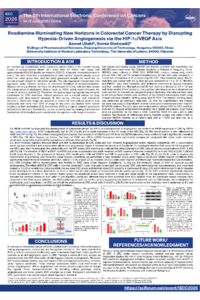
Introduction: Colorectal cancer (CRC) remains the second leading cause of cancer-related deaths worldwide, with over 1.9 million new cases and 900,000 deaths reported in 2020. Tumor hypoxia, a hallmark of solid tumors, promotes angiogenesis, metastasis, and therapeutic resistance by upregulating angiogenic factors such as VEGF and HIF-1α. Targeting hypoxia presents a promising strategy for CRC treatment. Natural products, known for their safety and efficacy, offer valuable leads for drug development. Evodiamine (EVD), an alkaloid derived from Evodiae fructus, has demonstrated anti-cancer potential across various malignancies.
Methods: SW480 and HUVEC cells were cultured under hypoxic conditions to evaluate EVD’s effects. Cell viability was assessed using MTT assays, while tube formation assays evaluated angiogenesis. Western blotting and RT-qPCR analyzed VEGF and HIF-1α expression. In vivo studies involved xenograft models in nude mice, with tumor growth and molecular responses monitored following EVD treatment. Statistical analysis was performed using GraphPad Prism 5.0, with significance determined by one-way ANOVA and Tukey’s test (p < 0.05).
Results: EVD significantly inhibited CRC cell proliferation (IC50: 8.342 µM) and reduced hypoxia-induced VEGF and HIF-1α expression in a dose-dependent manner. Under hypoxic conditions, EVD suppressed tube formation in HUVECs (p > 0.05) and impeded tumor growth in xenograft models without inducing toxicity. In vivo, EVD administration reduced tumor volume and weight, confirming its anti-tumor efficacy. Molecular analyses revealed EVD’s potential to disrupt HIF-1α accumulation and activity, highlighting its dual mechanism of action.
Conclusion: EVD emerges as a potent anti-angiogenic and anti-tumor agent for CRC, particularly in hypoxic microenvironments. By targeting HIF-1α degradation and transcriptional suppression, EVD disrupts critical pathways driving tumor progression. These findings position EVD as a novel therapeutic candidate for advanced CRC, warranting further exploration of its clinical potential and structural optimization.
Keywords
Colorectal cancer
Hypoxia
Evodiamine
Angiogenesis
HIF-1α
Poster
sciforum_178266_S3_powerpoint_The_5th_International_Electronic_Conference_on_Cancers.pdf
Serum levels of adipokines in women with cervical cancer
Beyond the Cytosol: Extracellular Targeted Protein Degradation for Remodeling the Tumor Immune Microenvironment