Event submissions
Published
This submission belongs to the session S5. Causes, Diagnosis and Treatment of Cancer of the event The 5th International Electronic Conference on Cancers
Published date
05 Jun, 2026
Academic Editor
'%3e%3cpath%20d='M12.6657%2010.9104C12.4185%2010.325%2012.0599%209.79327%2011.6097%209.34482C11.1609%208.89508%2010.6293%208.5365%2010.0442%208.28888C10.0389%208.28626%2010.0337%208.28495%2010.0285%208.28233C10.8446%207.69279%2011.3752%206.73249%2011.3752%205.64904C11.3752%203.8542%209.92103%202.39999%208.1262%202.39999C6.33136%202.39999%204.87715%203.8542%204.87715%205.64904C4.87715%206.73249%205.40774%207.69279%206.22393%208.28364C6.21869%208.28626%206.21345%208.28757%206.20821%208.29019C5.62129%208.5378%205.09463%208.89284%204.64265%209.34613C4.1929%209.79493%203.83432%2010.3266%203.58671%2010.9117C3.34345%2011.4845%203.21226%2012.0987%203.20023%2012.7209C3.19988%2012.7349%203.20233%2012.7488%203.20744%2012.7619C3.21255%2012.7749%203.22022%2012.7867%203.22998%2012.7968C3.23975%2012.8068%203.25142%2012.8147%203.26431%2012.8202C3.2772%2012.8256%203.29105%2012.8284%203.30504%2012.8284H4.09109C4.14874%2012.8284%204.19459%2012.7825%204.1959%2012.7262C4.2221%2011.7148%204.62823%2010.7676%205.34617%2010.0497C6.08899%209.30683%207.0755%208.89808%208.1262%208.89808C9.17689%208.89808%2010.1634%209.30683%2010.9062%2010.0497C11.6242%2010.7676%2012.0303%2011.7148%2012.0565%2012.7262C12.0578%2012.7838%2012.1037%2012.8284%2012.1613%2012.8284H12.9474C12.9613%2012.8284%2012.9752%2012.8256%2012.9881%2012.8202C13.001%2012.8147%2013.0126%2012.8068%2013.0224%2012.7968C13.0322%2012.7867%2013.0398%2012.7749%2013.0449%2012.7619C13.0501%2012.7488%2013.0525%2012.7349%2013.0522%2012.7209C13.0391%2012.0947%2012.9094%2011.4855%2012.6657%2010.9104ZM8.1262%207.9024C7.52486%207.9024%206.9589%207.6679%206.53312%207.24211C6.10733%206.81633%205.87283%206.25037%205.87283%205.64904C5.87283%205.0477%206.10733%204.48174%206.53312%204.05596C6.9589%203.63018%207.52486%203.39567%208.1262%203.39567C8.72753%203.39567%209.29349%203.63018%209.71927%204.05596C10.1451%204.48174%2010.3796%205.0477%2010.3796%205.64904C10.3796%206.25037%2010.1451%206.81633%209.71927%207.24211C9.29349%207.6679%208.72753%207.9024%208.1262%207.9024Z'%20fill='%235D1EE1'/%3e%3c/g%3e%3c/svg%3e) Masaharu Seno
Masaharu SenoCitation
Ionela Codruta Bubuianu, Giulia Canarutto, Simona Arena, Luca Triboli, Lucia Bertuccini, Silvano Piazza, Isabella Parolini, Giulia Antoniali, Decoding Therapy-induced Senescence EVs: Proteomic and miRNomic Clues to NSCLC Chemoresistance, in Proceedings of The 5th International Electronic Conference on Cancers, 10 June–12 June 2026, MDPI: Basel, Switzerland
Share
Email
Facebook
Twitter
LinkedIn
Decoding Therapy-induced Senescence EVs: Proteomic and miRNomic Clues to NSCLC Chemoresistance
'%3e%3cpath%20d='M12.6647%2010.9104C12.4176%2010.325%2012.0589%209.7933%2011.6088%209.34485C11.16%208.89511%2010.6283%208.53653%2010.0432%208.28891C10.038%208.28629%2010.0327%208.28498%2010.0275%208.28236C10.8437%207.69282%2011.3743%206.73252%2011.3743%205.64907C11.3743%203.85423%209.92005%202.40002%208.12522%202.40002C6.33038%202.40002%204.87618%203.85423%204.87618%205.64907C4.87618%206.73252%205.40677%207.69282%206.22296%208.28367C6.21772%208.28629%206.21248%208.2876%206.20724%208.29022C5.62031%208.53783%205.09365%208.89287%204.64167%209.34616C4.19192%209.79496%203.83334%2010.3266%203.58573%2010.9117C3.34247%2011.4846%203.21128%2012.0987%203.19925%2012.721C3.1989%2012.735%203.20135%2012.7489%203.20646%2012.7619C3.21157%2012.7749%203.21924%2012.7868%203.22901%2012.7968C3.23877%2012.8068%203.25045%2012.8148%203.26334%2012.8202C3.27623%2012.8256%203.29007%2012.8284%203.30406%2012.8284H4.09012C4.14776%2012.8284%204.19362%2012.7825%204.19493%2012.7262C4.22113%2011.7148%204.62726%2010.7676%205.34519%2010.0497C6.08802%209.30686%207.07452%208.89811%208.12522%208.89811C9.17592%208.89811%2010.1624%209.30686%2010.9052%2010.0497C11.6232%2010.7676%2012.0293%2011.7148%2012.0555%2012.7262C12.0568%2012.7839%2012.1027%2012.8284%2012.1603%2012.8284H12.9464C12.9604%2012.8284%2012.9742%2012.8256%2012.9871%2012.8202C13%2012.8148%2013.0117%2012.8068%2013.0214%2012.7968C13.0312%2012.7868%2013.0389%2012.7749%2013.044%2012.7619C13.0491%2012.7489%2013.0515%2012.735%2013.0512%2012.721C13.0381%2012.0947%2012.9084%2011.4856%2012.6647%2010.9104ZM8.12522%207.90243C7.52388%207.90243%206.95792%207.66793%206.53214%207.24215C6.10636%206.81636%205.87185%206.2504%205.87185%205.64907C5.87185%205.04773%206.10636%204.48177%206.53214%204.05599C6.95792%203.63021%207.52388%203.3957%208.12522%203.3957C8.72655%203.3957%209.29252%203.63021%209.7183%204.05599C10.1441%204.48177%2010.3786%205.04773%2010.3786%205.64907C10.3786%206.2504%2010.1441%206.81636%209.7183%207.24215C9.29252%207.66793%208.72655%207.90243%208.12522%207.90243Z'%20fill='%235D1EE1'/%3e%3c/g%3e%3c/svg%3e)
Ionela Codruta Bubuianu 1
Giulia Canarutto 2
Simona Arena 3
Luca Triboli 1
Lucia Bertuccini 4
Silvano Piazza 2
Isabella Parolini 1,5

Giulia Antoniali 1
1. Department of Medicine, University of Udine, Udine, Italy
2. Computational Biology Group, International Centre for Genetic Engineering and Biotechnology (ICGEB), Trieste, Italy
3. Institute for Animal Production Systems in the Mediterranean Environment (ISPAAM), National Research Council
(CNR), Naples, Italy
4. Microscopy Area - Electron Microscopy , Core Facilities (FAST), Istituto Superiore di Sanità, Rome, Italy.
5. Department of Oncology and Molecular Medicine, Istituto Superiore Di Sanità, Rome, Italy.
Abstract
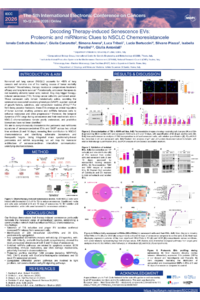
Non-small cell lung cancer (NSCLC) remains one of the leading causes of cancer mortality, driven by molecular heterogeneity and therapy resistance. Standard treatments like chemotherapy and radiotherapy often fail to eradicate all tumour cells and instead trigger therapy-induced senescence (TIS), a state of permanent growth arrest with persistent metabolic activity. TIS cells undergo profound changes and secrete a complex senescence-associated secretory phenotype (SASP). SASP exerts dual effects: initially recruiting immune surveillance, later promoting tumour progression through matrix remodelling and growth factor release. Among SASP components, extracellular vesicles (EVs) are emerging as key intercellular messengers, capable of
transferring functional cargo that affects the behaviour of recipient cells. However, the dynamic of senescence-derived EV cargo and its role in NSCLC chemoresistance remain poorly understood.
This study aimed to characterise the proteomic and miRNomic content of EVs from TIS lung cancer A549 at different time points, elucidate their contribution to chemoresistance and identify potential prognostic and therapeutic targets.
A549 cells were treated with doxorubicin to induce senescence, and EVs were isolated by sequential centrifugation. miRNA sequencing and mass spectrometry were performed on both intracellular and EV samples.
MiRNomic profiling identified the analysis of differential miRNA expression between control and senescent states—identifying 239 DEmiRNAs intracellularly and 39 in EVs—as well as differential sorting into vesicles. Enrichment analyses revealed that EV-associated DEmiRNAs were implicated in DNA damage, cancer-related, and senescence pathways. In parallel, proteomic analysis revealed a time-dependent remodelling of EV cargo, with pathway analyses highlighting upregulation of tight junctions, cell communication, p53, and interleukin signalling.
Collectively, these findings suggest that EV cargo remodelling may contribute to NSCLC chemoresistance, and ongoing multi-omics integration—including RNA-Seq and Proximity Extension Assay—aims to identify novel prognostic and therapeutic candidates.
Keywords
NSCLC EVs chemoresistance senescence TIS DE-miRNAs proteomics
Poster
Poster IECC - Ionela C. Bubuianu.pdf
Beyond the Cytosol: Extracellular Targeted Protein Degradation for Remodeling the Tumor Immune Microenvironment
Clinical Pharmacokinetics of Imatinib: Evidence of Sex-Related Differences in Drug Exposure