Event submissions
Published
This submission belongs to the session S5. Causes, Diagnosis and Treatment of Cancer of the event The 5th International Electronic Conference on Cancers
Published date
05 Jun, 2026
Academic Editor
'%3e%3cpath%20d='M12.6657%2010.9104C12.4185%2010.325%2012.0599%209.79327%2011.6097%209.34482C11.1609%208.89508%2010.6293%208.5365%2010.0442%208.28888C10.0389%208.28626%2010.0337%208.28495%2010.0285%208.28233C10.8446%207.69279%2011.3752%206.73249%2011.3752%205.64904C11.3752%203.8542%209.92103%202.39999%208.1262%202.39999C6.33136%202.39999%204.87715%203.8542%204.87715%205.64904C4.87715%206.73249%205.40774%207.69279%206.22393%208.28364C6.21869%208.28626%206.21345%208.28757%206.20821%208.29019C5.62129%208.5378%205.09463%208.89284%204.64265%209.34613C4.1929%209.79493%203.83432%2010.3266%203.58671%2010.9117C3.34345%2011.4845%203.21226%2012.0987%203.20023%2012.7209C3.19988%2012.7349%203.20233%2012.7488%203.20744%2012.7619C3.21255%2012.7749%203.22022%2012.7867%203.22998%2012.7968C3.23975%2012.8068%203.25142%2012.8147%203.26431%2012.8202C3.2772%2012.8256%203.29105%2012.8284%203.30504%2012.8284H4.09109C4.14874%2012.8284%204.19459%2012.7825%204.1959%2012.7262C4.2221%2011.7148%204.62823%2010.7676%205.34617%2010.0497C6.08899%209.30683%207.0755%208.89808%208.1262%208.89808C9.17689%208.89808%2010.1634%209.30683%2010.9062%2010.0497C11.6242%2010.7676%2012.0303%2011.7148%2012.0565%2012.7262C12.0578%2012.7838%2012.1037%2012.8284%2012.1613%2012.8284H12.9474C12.9613%2012.8284%2012.9752%2012.8256%2012.9881%2012.8202C13.001%2012.8147%2013.0126%2012.8068%2013.0224%2012.7968C13.0322%2012.7867%2013.0398%2012.7749%2013.0449%2012.7619C13.0501%2012.7488%2013.0525%2012.7349%2013.0522%2012.7209C13.0391%2012.0947%2012.9094%2011.4855%2012.6657%2010.9104ZM8.1262%207.9024C7.52486%207.9024%206.9589%207.6679%206.53312%207.24211C6.10733%206.81633%205.87283%206.25037%205.87283%205.64904C5.87283%205.0477%206.10733%204.48174%206.53312%204.05596C6.9589%203.63018%207.52486%203.39567%208.1262%203.39567C8.72753%203.39567%209.29349%203.63018%209.71927%204.05596C10.1451%204.48174%2010.3796%205.0477%2010.3796%205.64904C10.3796%206.25037%2010.1451%206.81633%209.71927%207.24211C9.29349%207.6679%208.72753%207.9024%208.1262%207.9024Z'%20fill='%235D1EE1'/%3e%3c/g%3e%3c/svg%3e) Nicola Amodio
Nicola AmodioCitation
Sarah Allegra, Francesco Chiara, Valeria Ballero, Giuliana Abbadessa, Maura Caudana, Silvia De Francia, Clinical Pharmacokinetics of Imatinib: Evidence of Sex-Related Differences in Drug Exposure, in Proceedings of The 5th International Electronic Conference on Cancers, 10 June–12 June 2026, MDPI: Basel, Switzerland
Share
Email
Facebook
Twitter
LinkedIn
Clinical Pharmacokinetics of Imatinib: Evidence of Sex-Related Differences in Drug Exposure

Sarah Allegra 1
'%3e%3cpath%20d='M12.6647%2010.9104C12.4176%2010.325%2012.0589%209.7933%2011.6088%209.34485C11.16%208.89511%2010.6283%208.53653%2010.0432%208.28891C10.038%208.28629%2010.0327%208.28498%2010.0275%208.28236C10.8437%207.69282%2011.3743%206.73252%2011.3743%205.64907C11.3743%203.85423%209.92005%202.40002%208.12522%202.40002C6.33038%202.40002%204.87618%203.85423%204.87618%205.64907C4.87618%206.73252%205.40677%207.69282%206.22296%208.28367C6.21772%208.28629%206.21248%208.2876%206.20724%208.29022C5.62031%208.53783%205.09365%208.89287%204.64167%209.34616C4.19192%209.79496%203.83334%2010.3266%203.58573%2010.9117C3.34247%2011.4846%203.21128%2012.0987%203.19925%2012.721C3.1989%2012.735%203.20135%2012.7489%203.20646%2012.7619C3.21157%2012.7749%203.21924%2012.7868%203.22901%2012.7968C3.23877%2012.8068%203.25045%2012.8148%203.26334%2012.8202C3.27623%2012.8256%203.29007%2012.8284%203.30406%2012.8284H4.09012C4.14776%2012.8284%204.19362%2012.7825%204.19493%2012.7262C4.22113%2011.7148%204.62726%2010.7676%205.34519%2010.0497C6.08802%209.30686%207.07452%208.89811%208.12522%208.89811C9.17592%208.89811%2010.1624%209.30686%2010.9052%2010.0497C11.6232%2010.7676%2012.0293%2011.7148%2012.0555%2012.7262C12.0568%2012.7839%2012.1027%2012.8284%2012.1603%2012.8284H12.9464C12.9604%2012.8284%2012.9742%2012.8256%2012.9871%2012.8202C13%2012.8148%2013.0117%2012.8068%2013.0214%2012.7968C13.0312%2012.7868%2013.0389%2012.7749%2013.044%2012.7619C13.0491%2012.7489%2013.0515%2012.735%2013.0512%2012.721C13.0381%2012.0947%2012.9084%2011.4856%2012.6647%2010.9104ZM8.12522%207.90243C7.52388%207.90243%206.95792%207.66793%206.53214%207.24215C6.10636%206.81636%205.87185%206.2504%205.87185%205.64907C5.87185%205.04773%206.10636%204.48177%206.53214%204.05599C6.95792%203.63021%207.52388%203.3957%208.12522%203.3957C8.72655%203.3957%209.29252%203.63021%209.7183%204.05599C10.1441%204.48177%2010.3786%205.04773%2010.3786%205.64907C10.3786%206.2504%2010.1441%206.81636%209.7183%207.24215C9.29252%207.66793%208.72655%207.90243%208.12522%207.90243Z'%20fill='%235D1EE1'/%3e%3c/g%3e%3c/svg%3e)
Francesco Chiara 1,2
Valeria Ballero 1
Giuliana Abbadessa 1
Maura Caudana 1

Silvia De Francia 1
1. Department of Clinical and Biological Sciences, University of Turin, Orbassano, Italy
2. Department of Physics, University of Trento, Povo, Italy
Abstract
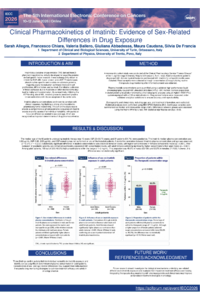
Imatinib is a tyrosine kinase inhibitor (TKI) derived from 2-phenylaminopyrimidine, initially developed to target the platelet-derived growth factor receptor. It was subsequently shown to inhibit the BCR-ABL fusion protein and c-KIT. These kinases phosphorylate specific amino acids on substrate proteins, triggering signal transduction pathways involved in cell proliferation, differentiation, and survival. Constitutive activation of these pathways due to mutations or other mechanisms may lead to malignant transformation. By competitively inhibiting the ATP-binding site of ABL, imatinib prevents persistent tyrosine kinase activation and induces apoptosis in leukemic cells.
Imatinib plasma concentrations are known to correlate with clinical response, highlighting a strong pharmacokinetic–pharmacodynamic relationship. The aim of this study was to provide a comprehensive pharmacokinetic evaluation of imatinib exposure and to assess interindividual variability, with particular focus on differences related to sex and age, which are recognized as important determinants of drug pharmacokinetics.
Using a validated chromatographic method, plasma concentration data were collected from 329 treated patients. A statistically significant difference in imatinib concentrations was observed between sexes, with higher concentrations in females compared to males (p < 0.001). After exclusion of paediatric patients, sex remained significantly associated with concentration levels, with adult females exhibiting significantly higher concentrations than adult males (p < 0.001). Among adult patients, 156 out of 325 (48.0%) had concentrations within the range of 1–3 mg/mL. This proportion was 45.0% in males (85/189) and 52.2% in females (71/136); however, this difference was not statistically significant.
These findings confirm substantial interindividual variability in imatinib exposure and identify sex as a significant determinant of plasma concentration in adult patients. Consideration of sex- and age-related differences may support more individualized therapeutic drug monitoring strategies to optimize treatment efficacy and safety in oncology practice.
Keywords
TKI
IMATINIB
TDM
PRECISION MEDICINE
GENDER PHARMACOLOGY
GENDER ONCOLOGY
Poster
POSTER Allegra.pdf
Decoding Therapy-induced Senescence EVs: Proteomic and miRNomic Clues to NSCLC Chemoresistance
A Statistically Rigorous Multi-Scale Texture Analysis Framework for 3D Spheroid Characterization: Temporal Autocorrelation Correction and Molecular Validation