Event submissions
Published
This submission belongs to the session S4. Applied Mathematics of the event The 2nd International Online Conference on Mathematics and Applications
Published date
05 Jun, 2026
Academic Editor
'%3e%3cpath%20d='M12.6657%2010.9104C12.4185%2010.325%2012.0599%209.79327%2011.6097%209.34482C11.1609%208.89508%2010.6293%208.5365%2010.0442%208.28888C10.0389%208.28626%2010.0337%208.28495%2010.0285%208.28233C10.8446%207.69279%2011.3752%206.73249%2011.3752%205.64904C11.3752%203.8542%209.92103%202.39999%208.1262%202.39999C6.33136%202.39999%204.87715%203.8542%204.87715%205.64904C4.87715%206.73249%205.40774%207.69279%206.22393%208.28364C6.21869%208.28626%206.21345%208.28757%206.20821%208.29019C5.62129%208.5378%205.09463%208.89284%204.64265%209.34613C4.1929%209.79493%203.83432%2010.3266%203.58671%2010.9117C3.34345%2011.4845%203.21226%2012.0987%203.20023%2012.7209C3.19988%2012.7349%203.20233%2012.7488%203.20744%2012.7619C3.21255%2012.7749%203.22022%2012.7867%203.22998%2012.7968C3.23975%2012.8068%203.25142%2012.8147%203.26431%2012.8202C3.2772%2012.8256%203.29105%2012.8284%203.30504%2012.8284H4.09109C4.14874%2012.8284%204.19459%2012.7825%204.1959%2012.7262C4.2221%2011.7148%204.62823%2010.7676%205.34617%2010.0497C6.08899%209.30683%207.0755%208.89808%208.1262%208.89808C9.17689%208.89808%2010.1634%209.30683%2010.9062%2010.0497C11.6242%2010.7676%2012.0303%2011.7148%2012.0565%2012.7262C12.0578%2012.7838%2012.1037%2012.8284%2012.1613%2012.8284H12.9474C12.9613%2012.8284%2012.9752%2012.8256%2012.9881%2012.8202C13.001%2012.8147%2013.0126%2012.8068%2013.0224%2012.7968C13.0322%2012.7867%2013.0398%2012.7749%2013.0449%2012.7619C13.0501%2012.7488%2013.0525%2012.7349%2013.0522%2012.7209C13.0391%2012.0947%2012.9094%2011.4855%2012.6657%2010.9104ZM8.1262%207.9024C7.52486%207.9024%206.9589%207.6679%206.53312%207.24211C6.10733%206.81633%205.87283%206.25037%205.87283%205.64904C5.87283%205.0477%206.10733%204.48174%206.53312%204.05596C6.9589%203.63018%207.52486%203.39567%208.1262%203.39567C8.72753%203.39567%209.29349%203.63018%209.71927%204.05596C10.1451%204.48174%2010.3796%205.0477%2010.3796%205.64904C10.3796%206.25037%2010.1451%206.81633%209.71927%207.24211C9.29349%207.6679%208.72753%207.9024%208.1262%207.9024Z'%20fill='%235D1EE1'/%3e%3c/g%3e%3c/svg%3e) Francisco Chiclana
Francisco ChiclanaCitation
David Carfì, From Hamilton–Jacobi Theory to the Relativistic Schrödinger picture via von Neumann-like linear extension in tempered distribution spaces, in Proceedings of The 2nd International Online Conference on Mathematics and Applications, 10 June–12 June 2026, MDPI: Basel, Switzerland
Share
Email
Facebook
Twitter
LinkedIn
From Hamilton–Jacobi Theory to the Relativistic Schrödinger picture via von Neumann-like linear extension in tempered distribution spaces

David Carfì 1
1. Department of Physics (MIFT), University of Messina, 98100, Messina, Italy
Abstract
Introduction
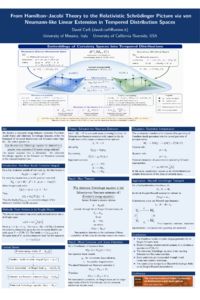
This work establishes a novel connection between the relativistic Hamilton–Jacobi equation (HJE) and the relativistic massive Schrödinger equation (RSE) in free space, achieved without relying on the semiclassical limit (ℏ → 0). The approach operates mode-by-mode on spectral fibers associating with any Minkowski momentum bra Sp = <p, . > the de Broglie wave ηp. The families S and η generate distinct subspaces in tempered distribution spaces: the former spans a real four-dimensional vector space isomorphic to Minkowski momentum space, while the latter comprises the full space of complex tempered distributions on Minkowski space.
Methods
The key families of distributions — Minkowski bras (S) and de Broglie basis (η) — span (via suitable subfamilies) the solution spaces of the HJE’s and RSE’s, respectively. Employing Schwartz linear algebra for complex tempered fields, we apply a von Neumann-style linear-continuous operator extension to lift the HJE (formulated in complex variables) from certainty momentum states |p⟩ to complex amplitude-probability states ψ. This extension mirrors procedures used in game theory and follows standard von Neumann techniques. The construction is further extended to the Maxwell–Schrödinger formalism - in complex tempered distribution 3-field - through de Broglie-Maxwell isomorphisms (Fe), which map wave distributions to corresponding electromagnetic-like fields while preserving translation representations, dispersion relations, and polarization structures.
Results
The principal finding demonstrates that the relativistic massive Schrödinger equations are von Neumann-like linear extensions of the relativistic HJE in complex form. These equations are uniquely determined spectrally by the Einstein energy-momentum relation within the tempered distribution framework.
Conclusions
This framework provides a vast, concrete (although partial) unification of classical relativistic mechanics, relativistic quantum mechanics for massive particles, and Maxwellian field theory - all within the setting of tempered distributions - offering new insights into the foundational relationships among these domains.
Keywords
Relativistic Hamilton–Jacobi equation
Relativistic Schrödinger equation
Von Neumann extension
Tempered distributions
Minkowski momentum space
De Broglie waves
Maxwell–Schrödinger isomorphism
Poster
beamerIOCMA.pdf
Classification of Finite Preordered Semigroups via Group Action induced by Pushforward
Geometry and Physics