Event submissions
Published
This submission belongs to the session S3. Drug Resistance and Anti-cancer Drug Development and Screening of the event The 5th International Electronic Conference on Cancers
Published date
05 Jun, 2026
Academic Editor
'%3e%3cpath%20d='M12.6657%2010.9104C12.4185%2010.325%2012.0599%209.79327%2011.6097%209.34482C11.1609%208.89508%2010.6293%208.5365%2010.0442%208.28888C10.0389%208.28626%2010.0337%208.28495%2010.0285%208.28233C10.8446%207.69279%2011.3752%206.73249%2011.3752%205.64904C11.3752%203.8542%209.92103%202.39999%208.1262%202.39999C6.33136%202.39999%204.87715%203.8542%204.87715%205.64904C4.87715%206.73249%205.40774%207.69279%206.22393%208.28364C6.21869%208.28626%206.21345%208.28757%206.20821%208.29019C5.62129%208.5378%205.09463%208.89284%204.64265%209.34613C4.1929%209.79493%203.83432%2010.3266%203.58671%2010.9117C3.34345%2011.4845%203.21226%2012.0987%203.20023%2012.7209C3.19988%2012.7349%203.20233%2012.7488%203.20744%2012.7619C3.21255%2012.7749%203.22022%2012.7867%203.22998%2012.7968C3.23975%2012.8068%203.25142%2012.8147%203.26431%2012.8202C3.2772%2012.8256%203.29105%2012.8284%203.30504%2012.8284H4.09109C4.14874%2012.8284%204.19459%2012.7825%204.1959%2012.7262C4.2221%2011.7148%204.62823%2010.7676%205.34617%2010.0497C6.08899%209.30683%207.0755%208.89808%208.1262%208.89808C9.17689%208.89808%2010.1634%209.30683%2010.9062%2010.0497C11.6242%2010.7676%2012.0303%2011.7148%2012.0565%2012.7262C12.0578%2012.7838%2012.1037%2012.8284%2012.1613%2012.8284H12.9474C12.9613%2012.8284%2012.9752%2012.8256%2012.9881%2012.8202C13.001%2012.8147%2013.0126%2012.8068%2013.0224%2012.7968C13.0322%2012.7867%2013.0398%2012.7749%2013.0449%2012.7619C13.0501%2012.7488%2013.0525%2012.7349%2013.0522%2012.7209C13.0391%2012.0947%2012.9094%2011.4855%2012.6657%2010.9104ZM8.1262%207.9024C7.52486%207.9024%206.9589%207.6679%206.53312%207.24211C6.10733%206.81633%205.87283%206.25037%205.87283%205.64904C5.87283%205.0477%206.10733%204.48174%206.53312%204.05596C6.9589%203.63018%207.52486%203.39567%208.1262%203.39567C8.72753%203.39567%209.29349%203.63018%209.71927%204.05596C10.1451%204.48174%2010.3796%205.0477%2010.3796%205.64904C10.3796%206.25037%2010.1451%206.81633%209.71927%207.24211C9.29349%207.6679%208.72753%207.9024%208.1262%207.9024Z'%20fill='%235D1EE1'/%3e%3c/g%3e%3c/svg%3e) Farrukh Aqil
Farrukh AqilCitation
Mikhail Karpushin, Nikita Shelepin, Elena Komarova, Irina Balalaeva, Specific expression profile of genes associated with extracellular matrix and phenotypic plasticity in triple-negative breast cancer, in Proceedings of The 5th International Electronic Conference on Cancers, 10 June–12 June 2026, MDPI: Basel, Switzerland
Share
Email
Facebook
Twitter
LinkedIn
Specific expression profile of genes associated with extracellular matrix and phenotypic plasticity in triple-negative breast cancer
'%3e%3cpath%20d='M12.6647%2010.9104C12.4176%2010.325%2012.0589%209.7933%2011.6088%209.34485C11.16%208.89511%2010.6283%208.53653%2010.0432%208.28891C10.038%208.28629%2010.0327%208.28498%2010.0275%208.28236C10.8437%207.69282%2011.3743%206.73252%2011.3743%205.64907C11.3743%203.85423%209.92005%202.40002%208.12522%202.40002C6.33038%202.40002%204.87618%203.85423%204.87618%205.64907C4.87618%206.73252%205.40677%207.69282%206.22296%208.28367C6.21772%208.28629%206.21248%208.2876%206.20724%208.29022C5.62031%208.53783%205.09365%208.89287%204.64167%209.34616C4.19192%209.79496%203.83334%2010.3266%203.58573%2010.9117C3.34247%2011.4846%203.21128%2012.0987%203.19925%2012.721C3.1989%2012.735%203.20135%2012.7489%203.20646%2012.7619C3.21157%2012.7749%203.21924%2012.7868%203.22901%2012.7968C3.23877%2012.8068%203.25045%2012.8148%203.26334%2012.8202C3.27623%2012.8256%203.29007%2012.8284%203.30406%2012.8284H4.09012C4.14776%2012.8284%204.19362%2012.7825%204.19493%2012.7262C4.22113%2011.7148%204.62726%2010.7676%205.34519%2010.0497C6.08802%209.30686%207.07452%208.89811%208.12522%208.89811C9.17592%208.89811%2010.1624%209.30686%2010.9052%2010.0497C11.6232%2010.7676%2012.0293%2011.7148%2012.0555%2012.7262C12.0568%2012.7839%2012.1027%2012.8284%2012.1603%2012.8284H12.9464C12.9604%2012.8284%2012.9742%2012.8256%2012.9871%2012.8202C13%2012.8148%2013.0117%2012.8068%2013.0214%2012.7968C13.0312%2012.7868%2013.0389%2012.7749%2013.044%2012.7619C13.0491%2012.7489%2013.0515%2012.735%2013.0512%2012.721C13.0381%2012.0947%2012.9084%2011.4856%2012.6647%2010.9104ZM8.12522%207.90243C7.52388%207.90243%206.95792%207.66793%206.53214%207.24215C6.10636%206.81636%205.87185%206.2504%205.87185%205.64907C5.87185%205.04773%206.10636%204.48177%206.53214%204.05599C6.95792%203.63021%207.52388%203.3957%208.12522%203.3957C8.72655%203.3957%209.29252%203.63021%209.7183%204.05599C10.1441%204.48177%2010.3786%205.04773%2010.3786%205.64907C10.3786%206.2504%2010.1441%206.81636%209.7183%207.24215C9.29252%207.66793%208.72655%207.90243%208.12522%207.90243Z'%20fill='%235D1EE1'/%3e%3c/g%3e%3c/svg%3e)
Mikhail Karpushin 1
Nikita Shelepin 2
Elena Komarova 1

Irina Balalaeva 1
1. Department of Biophysics, Institute of Biology and Biomedicine, Lobachevsky University Gagarina Ave. 23, Nizhny Novgorod, 603950 Russian Federation
2. Institute of Biology and Biomedicine, Lobachevsky University Gagarina Ave. 23, Nizhny Novgorod, 603950 Russian Federation
Abstract
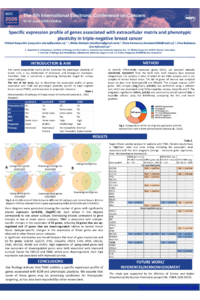
The tumor extracellular matrix (ECM) promotes the phenotypic plasticity of tumor cells, a key mechanism of metastasis and therapeutic resistance. Therefore, ECM is considered a promising therapeutic target for various cancer subtypes.
The aim of the study was to determine the expression profile of genes associated with ECM and phenotypic plasticity specific to triple-negative breast cancer (TNBC), and to evaluate its prognostic relevance.
To identify differentially expressed genes (DEG), we analyzed datasets (GSE65194, GSE45827) from the NCBI GEO. Both datasets have identical composition: 155 samples in total, of which 41 are TNBC samples and 11 are samples of normal breast tissue. The list of genes of interest was compiled based on data from MatrisomeDB and MSigDB. DEG analysis (|log2FC|>1, p>0.05) was performed using a software tool, which was developed using Python (pandas, numpy, matpolib) and R. The prognostic significance (HR≠1, p>0.05) was assessed by overall survival (OS) in basal-like cohorts using the KM-Plotter, comparing the first and fourth quartiles.
The analysis covered 1,027 genes. 31 genes with differential expression specific for TNBC compared to normal tissue and other BC subtypes were identified (14 elevated, 17 decreased). A significant relationship was found between the level of gene expression and OS for genes: CLEC4A, CLEC7A, IFNG, COL22A1, CRLF3, HPSE, CXCL12, OMD, and HTRA1. High expression of upregulated genes and low expression of downregulated genes were both associated with improved survival. Except for CXCL12 and OMD, which were downregulated, their high expression was associated with improved survival.
Our findings indicate that TNBC exhibits a specific expression profile of genes associated with ECM and phenotypic plasticity. We assume that some of these genes may be promising candidates for therapeutic targeting, as has also been reported by other researchers.
The study was supported by the Ministry of Science and Higher Education of the Russian Federation (project No. FSWR-2026-0015).
Keywords
Triple-negative breast cancer
extracellular matrix
phenotypic plasticity
therapeutic targets
prognostic biomarkers
Poster
sciforum_171346_S3_slides_Karpushin_s_poster.pdf
The role of the European Cancer Information System on pancreatic cancer surveillance
Decision-making patterns of adjuvant endocrine therapy among women with breast cancer: A qualitative study