Event submissions
Published
This submission belongs to the session S3. Drug Resistance and Anti-cancer Drug Development and Screening of the event The 5th International Electronic Conference on Cancers
Published date
05 Jun, 2026
Academic Editor
'%3e%3cpath%20d='M12.6657%2010.9104C12.4185%2010.325%2012.0599%209.79327%2011.6097%209.34482C11.1609%208.89508%2010.6293%208.5365%2010.0442%208.28888C10.0389%208.28626%2010.0337%208.28495%2010.0285%208.28233C10.8446%207.69279%2011.3752%206.73249%2011.3752%205.64904C11.3752%203.8542%209.92103%202.39999%208.1262%202.39999C6.33136%202.39999%204.87715%203.8542%204.87715%205.64904C4.87715%206.73249%205.40774%207.69279%206.22393%208.28364C6.21869%208.28626%206.21345%208.28757%206.20821%208.29019C5.62129%208.5378%205.09463%208.89284%204.64265%209.34613C4.1929%209.79493%203.83432%2010.3266%203.58671%2010.9117C3.34345%2011.4845%203.21226%2012.0987%203.20023%2012.7209C3.19988%2012.7349%203.20233%2012.7488%203.20744%2012.7619C3.21255%2012.7749%203.22022%2012.7867%203.22998%2012.7968C3.23975%2012.8068%203.25142%2012.8147%203.26431%2012.8202C3.2772%2012.8256%203.29105%2012.8284%203.30504%2012.8284H4.09109C4.14874%2012.8284%204.19459%2012.7825%204.1959%2012.7262C4.2221%2011.7148%204.62823%2010.7676%205.34617%2010.0497C6.08899%209.30683%207.0755%208.89808%208.1262%208.89808C9.17689%208.89808%2010.1634%209.30683%2010.9062%2010.0497C11.6242%2010.7676%2012.0303%2011.7148%2012.0565%2012.7262C12.0578%2012.7838%2012.1037%2012.8284%2012.1613%2012.8284H12.9474C12.9613%2012.8284%2012.9752%2012.8256%2012.9881%2012.8202C13.001%2012.8147%2013.0126%2012.8068%2013.0224%2012.7968C13.0322%2012.7867%2013.0398%2012.7749%2013.0449%2012.7619C13.0501%2012.7488%2013.0525%2012.7349%2013.0522%2012.7209C13.0391%2012.0947%2012.9094%2011.4855%2012.6657%2010.9104ZM8.1262%207.9024C7.52486%207.9024%206.9589%207.6679%206.53312%207.24211C6.10733%206.81633%205.87283%206.25037%205.87283%205.64904C5.87283%205.0477%206.10733%204.48174%206.53312%204.05596C6.9589%203.63018%207.52486%203.39567%208.1262%203.39567C8.72753%203.39567%209.29349%203.63018%209.71927%204.05596C10.1451%204.48174%2010.3796%205.0477%2010.3796%205.64904C10.3796%206.25037%2010.1451%206.81633%209.71927%207.24211C9.29349%207.6679%208.72753%207.9024%208.1262%207.9024Z'%20fill='%235D1EE1'/%3e%3c/g%3e%3c/svg%3e) Farrukh Aqil
Farrukh AqilCitation
Imene DERARDJA, Redouane REBAI, Luc Jasmin, Abdennacer Boudah, Network pharmacology-based elucidation of the multi-target mechanisms of piperlongumine targeting oncogenic survival and immune-evasive pathways in pancreatic cancer, in Proceedings of The 5th International Electronic Conference on Cancers, 10 June–12 June 2026, MDPI: Basel, Switzerland
Share
Email
Facebook
Twitter
LinkedIn
Network pharmacology-based elucidation of the multi-target mechanisms of piperlongumine targeting oncogenic survival and immune-evasive pathways in pancreatic cancer
'%3e%3cpath%20d='M12.6647%2010.9104C12.4176%2010.325%2012.0589%209.7933%2011.6088%209.34485C11.16%208.89511%2010.6283%208.53653%2010.0432%208.28891C10.038%208.28629%2010.0327%208.28498%2010.0275%208.28236C10.8437%207.69282%2011.3743%206.73252%2011.3743%205.64907C11.3743%203.85423%209.92005%202.40002%208.12522%202.40002C6.33038%202.40002%204.87618%203.85423%204.87618%205.64907C4.87618%206.73252%205.40677%207.69282%206.22296%208.28367C6.21772%208.28629%206.21248%208.2876%206.20724%208.29022C5.62031%208.53783%205.09365%208.89287%204.64167%209.34616C4.19192%209.79496%203.83334%2010.3266%203.58573%2010.9117C3.34247%2011.4846%203.21128%2012.0987%203.19925%2012.721C3.1989%2012.735%203.20135%2012.7489%203.20646%2012.7619C3.21157%2012.7749%203.21924%2012.7868%203.22901%2012.7968C3.23877%2012.8068%203.25045%2012.8148%203.26334%2012.8202C3.27623%2012.8256%203.29007%2012.8284%203.30406%2012.8284H4.09012C4.14776%2012.8284%204.19362%2012.7825%204.19493%2012.7262C4.22113%2011.7148%204.62726%2010.7676%205.34519%2010.0497C6.08802%209.30686%207.07452%208.89811%208.12522%208.89811C9.17592%208.89811%2010.1624%209.30686%2010.9052%2010.0497C11.6232%2010.7676%2012.0293%2011.7148%2012.0555%2012.7262C12.0568%2012.7839%2012.1027%2012.8284%2012.1603%2012.8284H12.9464C12.9604%2012.8284%2012.9742%2012.8256%2012.9871%2012.8202C13%2012.8148%2013.0117%2012.8068%2013.0214%2012.7968C13.0312%2012.7868%2013.0389%2012.7749%2013.044%2012.7619C13.0491%2012.7489%2013.0515%2012.735%2013.0512%2012.721C13.0381%2012.0947%2012.9084%2011.4856%2012.6647%2010.9104ZM8.12522%207.90243C7.52388%207.90243%206.95792%207.66793%206.53214%207.24215C6.10636%206.81636%205.87185%206.2504%205.87185%205.64907C5.87185%205.04773%206.10636%204.48177%206.53214%204.05599C6.95792%203.63021%207.52388%203.3957%208.12522%203.3957C8.72655%203.3957%209.29252%203.63021%209.7183%204.05599C10.1441%204.48177%2010.3786%205.04773%2010.3786%205.64907C10.3786%206.2504%2010.1441%206.81636%209.7183%207.24215C9.29252%207.66793%208.72655%207.90243%208.12522%207.90243Z'%20fill='%235D1EE1'/%3e%3c/g%3e%3c/svg%3e)
Imene DERARDJA 1
Redouane REBAI 2
Luc Jasmin 3
Abdennacer Boudah 2
1. Laboratory Promotion of Innovation in Agriculture in Arid Regions (PIARA), Faculty of nature and life sciences. University of Mohamed Khider, Biskra 07000, Algeria
2. Laboratory of Biotechnology, National Higher School of Biotechnology, Constantine 25000, Algeria
3. Department of Oral and Maxillofacial Surgery, University of California, San Francisco, 707 Parnassus Ave Suite D-1201, San Francisco, CA, 94143, USA.
Abstract
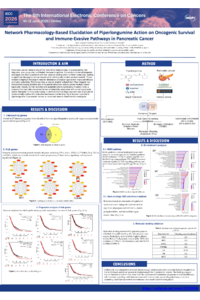
Pancreatic cancer (PC) remains one of the most aggressive malignancies, largely due to late diagnosis, rapid metastatic progression, and the limited efficacy of current therapeuties. Piperlongumine, a bioactive alkaloid isolated from Piper longum, has attracted attention for its selective cytotoxicity toward cancer cells and its ability to modulate multiple oncogenic pathways. However, its molecular mechanisms in PC remain insufficiently understood. In this computational systems pharmacology study, a network pharmacology strategy combined with molecular docking was used to investigate the molecular targets and pathways associated with piperlongumine’s anticancer activity. Targets of piperlongumine and PC-related genes were retrieved from public databases and intersected to identify shared targets. Overlapping targets were used to construct a proteinprotein interaction network using STRING platform. Hub genes were identified using the CytoHubba plugin using six topological algorithms. Functional enrichment analyses (Gene Ontology and KEGG pathways) were performed using ShinyGO 0.85 platform. Prognostic relevance of the hub targets was evaluated using Kaplan–Meier Plotter, while immune cell infiltration patterns were explored using TIMER. Molecular docking was conducted using AutoDock Vina to validate ligand-target interactions. A total of 237 intersecting genes were identified. Network analysis revealed several central hub genes, including TP53, Akt-1, STAT-3, CTNNB-1, IL-6, TNF-α, and Bcl-2. KEGG pathway analysis highlighted PC as the most enriched pathway, together with the PD-1/PD-L1 pathway, TNF signaling, and other cancer-related pathways. Survival analysis revealed significant prognostic associations for several hub genes, while TIMER analysis suggested correlations with tumor-associated immune cell infiltration. Molecular docking confirmed favorable binding affinities of piperlongumine toward key oncogenic targets, particularly Bcl-2 (-7.2 kcal/mol), TP53 (-6.2 kcal/mol), CTNNB-1 (-6.2 kcal/mol), and Akt-1 (-5.8 kcal/mol). Collectively, this study uncovers piperlongumine's anticancer potential in PC, mediated through coordinated regulation of apoptosis, inflammatory, and immune pathways, highlighting its promise for future experimental and translational investigations.
Keywords
Key words: Pancreatic cancer
piperlongumine
network pharmacology
molecular docking
selective anticancer.
Poster
Poster-DERARDJA Imene.pdf
Decision-making patterns of adjuvant endocrine therapy among women with breast cancer: A qualitative study
Brain Cancer Gene Expression Analysis for Subtype Classification and Biomarker Discovery Using Machine Learning