Event submissions
Published
This submission belongs to the session S5. Causes, Diagnosis and Treatment of Cancer of the event The 5th International Electronic Conference on Cancers
Published date
05 Jun, 2026
Academic Editor
'%3e%3cpath%20d='M12.6657%2010.9104C12.4185%2010.325%2012.0599%209.79327%2011.6097%209.34482C11.1609%208.89508%2010.6293%208.5365%2010.0442%208.28888C10.0389%208.28626%2010.0337%208.28495%2010.0285%208.28233C10.8446%207.69279%2011.3752%206.73249%2011.3752%205.64904C11.3752%203.8542%209.92103%202.39999%208.1262%202.39999C6.33136%202.39999%204.87715%203.8542%204.87715%205.64904C4.87715%206.73249%205.40774%207.69279%206.22393%208.28364C6.21869%208.28626%206.21345%208.28757%206.20821%208.29019C5.62129%208.5378%205.09463%208.89284%204.64265%209.34613C4.1929%209.79493%203.83432%2010.3266%203.58671%2010.9117C3.34345%2011.4845%203.21226%2012.0987%203.20023%2012.7209C3.19988%2012.7349%203.20233%2012.7488%203.20744%2012.7619C3.21255%2012.7749%203.22022%2012.7867%203.22998%2012.7968C3.23975%2012.8068%203.25142%2012.8147%203.26431%2012.8202C3.2772%2012.8256%203.29105%2012.8284%203.30504%2012.8284H4.09109C4.14874%2012.8284%204.19459%2012.7825%204.1959%2012.7262C4.2221%2011.7148%204.62823%2010.7676%205.34617%2010.0497C6.08899%209.30683%207.0755%208.89808%208.1262%208.89808C9.17689%208.89808%2010.1634%209.30683%2010.9062%2010.0497C11.6242%2010.7676%2012.0303%2011.7148%2012.0565%2012.7262C12.0578%2012.7838%2012.1037%2012.8284%2012.1613%2012.8284H12.9474C12.9613%2012.8284%2012.9752%2012.8256%2012.9881%2012.8202C13.001%2012.8147%2013.0126%2012.8068%2013.0224%2012.7968C13.0322%2012.7867%2013.0398%2012.7749%2013.0449%2012.7619C13.0501%2012.7488%2013.0525%2012.7349%2013.0522%2012.7209C13.0391%2012.0947%2012.9094%2011.4855%2012.6657%2010.9104ZM8.1262%207.9024C7.52486%207.9024%206.9589%207.6679%206.53312%207.24211C6.10733%206.81633%205.87283%206.25037%205.87283%205.64904C5.87283%205.0477%206.10733%204.48174%206.53312%204.05596C6.9589%203.63018%207.52486%203.39567%208.1262%203.39567C8.72753%203.39567%209.29349%203.63018%209.71927%204.05596C10.1451%204.48174%2010.3796%205.0477%2010.3796%205.64904C10.3796%206.25037%2010.1451%206.81633%209.71927%207.24211C9.29349%207.6679%208.72753%207.9024%208.1262%207.9024Z'%20fill='%235D1EE1'/%3e%3c/g%3e%3c/svg%3e) Masaharu Seno
Masaharu SenoCitation
Eva González-Cantó, Laia Barrachina-Bonet, Guillermo Bargues-Navarro, Clara Cavero-Carbonell, Carmen Martos, Geographical and temporal incidence patterns of childhood central nervous system tumours in Europe: Insights from the European Cancer Information System, in Proceedings of The 5th International Electronic Conference on Cancers, 10 June–12 June 2026, MDPI: Basel, Switzerland
Share
Email
Facebook
Twitter
LinkedIn
Geographical and temporal incidence patterns of childhood central nervous system tumours in Europe: Insights from the European Cancer Information System
'%3e%3cpath%20d='M12.6647%2010.9104C12.4176%2010.325%2012.0589%209.7933%2011.6088%209.34485C11.16%208.89511%2010.6283%208.53653%2010.0432%208.28891C10.038%208.28629%2010.0327%208.28498%2010.0275%208.28236C10.8437%207.69282%2011.3743%206.73252%2011.3743%205.64907C11.3743%203.85423%209.92005%202.40002%208.12522%202.40002C6.33038%202.40002%204.87618%203.85423%204.87618%205.64907C4.87618%206.73252%205.40677%207.69282%206.22296%208.28367C6.21772%208.28629%206.21248%208.2876%206.20724%208.29022C5.62031%208.53783%205.09365%208.89287%204.64167%209.34616C4.19192%209.79496%203.83334%2010.3266%203.58573%2010.9117C3.34247%2011.4846%203.21128%2012.0987%203.19925%2012.721C3.1989%2012.735%203.20135%2012.7489%203.20646%2012.7619C3.21157%2012.7749%203.21924%2012.7868%203.22901%2012.7968C3.23877%2012.8068%203.25045%2012.8148%203.26334%2012.8202C3.27623%2012.8256%203.29007%2012.8284%203.30406%2012.8284H4.09012C4.14776%2012.8284%204.19362%2012.7825%204.19493%2012.7262C4.22113%2011.7148%204.62726%2010.7676%205.34519%2010.0497C6.08802%209.30686%207.07452%208.89811%208.12522%208.89811C9.17592%208.89811%2010.1624%209.30686%2010.9052%2010.0497C11.6232%2010.7676%2012.0293%2011.7148%2012.0555%2012.7262C12.0568%2012.7839%2012.1027%2012.8284%2012.1603%2012.8284H12.9464C12.9604%2012.8284%2012.9742%2012.8256%2012.9871%2012.8202C13%2012.8148%2013.0117%2012.8068%2013.0214%2012.7968C13.0312%2012.7868%2013.0389%2012.7749%2013.044%2012.7619C13.0491%2012.7489%2013.0515%2012.735%2013.0512%2012.721C13.0381%2012.0947%2012.9084%2011.4856%2012.6647%2010.9104ZM8.12522%207.90243C7.52388%207.90243%206.95792%207.66793%206.53214%207.24215C6.10636%206.81636%205.87185%206.2504%205.87185%205.64907C5.87185%205.04773%206.10636%204.48177%206.53214%204.05599C6.95792%203.63021%207.52388%203.3957%208.12522%203.3957C8.72655%203.3957%209.29252%203.63021%209.7183%204.05599C10.1441%204.48177%2010.3786%205.04773%2010.3786%205.64907C10.3786%206.2504%2010.1441%206.81636%209.7183%207.24215C9.29252%207.66793%208.72655%207.90243%208.12522%207.90243Z'%20fill='%235D1EE1'/%3e%3c/g%3e%3c/svg%3e)
Eva González-Cantó 1
Laia Barrachina-Bonet 1
Guillermo Bargues-Navarro 1
Clara Cavero-Carbonell 1
Carmen Martos 1
1. Rare Diseases Research Area. Foundation for the Promotion of Health and Biomedical Research (FISABIO), Valencia, Spain
Abstract
Introduction:
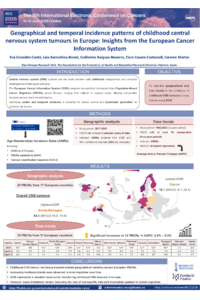
Central nervous system tumours (CNSTs) are the most common solid childhood malignancies and comprise heterogeneous histological subtypes. The European Cancer Information System (ECIS) collects incidence data from Population-Based Cancer Registries (PBCR) across Europe. Identifying spatial and temporal variations is essential for cancer control and hypothesis generation on potential risk factors. This study analysed geographical and temporal incidence patterns of childhood CNST in Europe.
Methods:
Incidence data for children under 15 years were obtained from the ECIS. PBCRs updated to ≥2019 were selected. Geographical analyses covered the 2017–2021 period (29 PBCRs, 17 countries). Temporal trends were assessed in 16 PBCRs with ≥10 consecutive three‑year periods (1982-2023). Age-standardised incidence rates (ASIR) with 95% confidence intervals (95%CI) were computed. The Joinpoint regression estimated Average Annual Percent Change (AAPC).
Results:
Astrocytoma was the most frequent subtype (26%-47%). Geographical variations were observed for overall CNST, ASIRs ranging from 15 per million children-year (95%CI: 6.1–24.1) in Cyprus to 64 (95%CI: 54.0–74.6) in Emilia‑Romagna, which are the lowest and highest values. Astrocytoma ASIRs varied from 5.8 (95%CI 3.4–8.2) in Austria to 25.2 (95%CI 19.4–31.0) in Croatia. Significant increases in overall CNST were observed in 11 PBCRs with AAPCs between 2.4% (95%CI 1.0–3.9) and 8.3% (95%CI 6.1–9.8), and mainly for other specified intracranial and intraspinal neoplasms in 9 PBCRs, with AAPCs between 7.6% (95%CI 1.9–13.3) and 73.6% (95%CI 20.5–148.6). The incidence remained stable in the Basque and Veneto PBCRs.
Conclusion:
Childhood CNST incidence shows marked geographical variations and increasing time trends in most European PBCRs. ECIS is a valuable tool for monitoring these tumours, though with some limitations such as lack of sex-specific data and incomplete updates in some registries.
Keywords
Childhood cancer
Central nervous system tumours
Geographical variation
Temporal trends
Population-based cancer registries
Poster
Póster IECC 2026_v3 EGC.pdf
Restoring therapeutic vulnerability in Multidrug-Resistant Ovarian Cancer with a first-in-class disruptor of the BRCA1–BARD1 interaction
Electrochemical Reduction of Copper (II) As a Potent and Versatile Approach for Tumor Cell Eradication