Event submissions
Published
This submission belongs to the session S3. Drug Resistance and Anti-cancer Drug Development and Screening of the event The 5th International Electronic Conference on Cancers
Published date
05 Jun, 2026
Academic Editor
'%3e%3cpath%20d='M12.6657%2010.9104C12.4185%2010.325%2012.0599%209.79327%2011.6097%209.34482C11.1609%208.89508%2010.6293%208.5365%2010.0442%208.28888C10.0389%208.28626%2010.0337%208.28495%2010.0285%208.28233C10.8446%207.69279%2011.3752%206.73249%2011.3752%205.64904C11.3752%203.8542%209.92103%202.39999%208.1262%202.39999C6.33136%202.39999%204.87715%203.8542%204.87715%205.64904C4.87715%206.73249%205.40774%207.69279%206.22393%208.28364C6.21869%208.28626%206.21345%208.28757%206.20821%208.29019C5.62129%208.5378%205.09463%208.89284%204.64265%209.34613C4.1929%209.79493%203.83432%2010.3266%203.58671%2010.9117C3.34345%2011.4845%203.21226%2012.0987%203.20023%2012.7209C3.19988%2012.7349%203.20233%2012.7488%203.20744%2012.7619C3.21255%2012.7749%203.22022%2012.7867%203.22998%2012.7968C3.23975%2012.8068%203.25142%2012.8147%203.26431%2012.8202C3.2772%2012.8256%203.29105%2012.8284%203.30504%2012.8284H4.09109C4.14874%2012.8284%204.19459%2012.7825%204.1959%2012.7262C4.2221%2011.7148%204.62823%2010.7676%205.34617%2010.0497C6.08899%209.30683%207.0755%208.89808%208.1262%208.89808C9.17689%208.89808%2010.1634%209.30683%2010.9062%2010.0497C11.6242%2010.7676%2012.0303%2011.7148%2012.0565%2012.7262C12.0578%2012.7838%2012.1037%2012.8284%2012.1613%2012.8284H12.9474C12.9613%2012.8284%2012.9752%2012.8256%2012.9881%2012.8202C13.001%2012.8147%2013.0126%2012.8068%2013.0224%2012.7968C13.0322%2012.7867%2013.0398%2012.7749%2013.0449%2012.7619C13.0501%2012.7488%2013.0525%2012.7349%2013.0522%2012.7209C13.0391%2012.0947%2012.9094%2011.4855%2012.6657%2010.9104ZM8.1262%207.9024C7.52486%207.9024%206.9589%207.6679%206.53312%207.24211C6.10733%206.81633%205.87283%206.25037%205.87283%205.64904C5.87283%205.0477%206.10733%204.48174%206.53312%204.05596C6.9589%203.63018%207.52486%203.39567%208.1262%203.39567C8.72753%203.39567%209.29349%203.63018%209.71927%204.05596C10.1451%204.48174%2010.3796%205.0477%2010.3796%205.64904C10.3796%206.25037%2010.1451%206.81633%209.71927%207.24211C9.29349%207.6679%208.72753%207.9024%208.1262%207.9024Z'%20fill='%235D1EE1'/%3e%3c/g%3e%3c/svg%3e) Farrukh Aqil
Farrukh AqilCitation
Mariarosa Fava, Sofia Spadafora, Marianna Strumbo, Antonella Galati, Ivan Casaburi, Rosa Sirianni, Marilena Lanzino, Diego Sisci, Ines Barone, Catia Morelli, Lamotrigine Inhibits Breast Cancer Progression Through FoxO3a/TXNIP axis, in Proceedings of The 5th International Electronic Conference on Cancers, 10 June–12 June 2026, MDPI: Basel, Switzerland
Share
Email
Facebook
Twitter
LinkedIn
Lamotrigine Inhibits Breast Cancer Progression Through FoxO3a/TXNIP axis
'%3e%3cpath%20d='M12.6647%2010.9104C12.4176%2010.325%2012.0589%209.7933%2011.6088%209.34485C11.16%208.89511%2010.6283%208.53653%2010.0432%208.28891C10.038%208.28629%2010.0327%208.28498%2010.0275%208.28236C10.8437%207.69282%2011.3743%206.73252%2011.3743%205.64907C11.3743%203.85423%209.92005%202.40002%208.12522%202.40002C6.33038%202.40002%204.87618%203.85423%204.87618%205.64907C4.87618%206.73252%205.40677%207.69282%206.22296%208.28367C6.21772%208.28629%206.21248%208.2876%206.20724%208.29022C5.62031%208.53783%205.09365%208.89287%204.64167%209.34616C4.19192%209.79496%203.83334%2010.3266%203.58573%2010.9117C3.34247%2011.4846%203.21128%2012.0987%203.19925%2012.721C3.1989%2012.735%203.20135%2012.7489%203.20646%2012.7619C3.21157%2012.7749%203.21924%2012.7868%203.22901%2012.7968C3.23877%2012.8068%203.25045%2012.8148%203.26334%2012.8202C3.27623%2012.8256%203.29007%2012.8284%203.30406%2012.8284H4.09012C4.14776%2012.8284%204.19362%2012.7825%204.19493%2012.7262C4.22113%2011.7148%204.62726%2010.7676%205.34519%2010.0497C6.08802%209.30686%207.07452%208.89811%208.12522%208.89811C9.17592%208.89811%2010.1624%209.30686%2010.9052%2010.0497C11.6232%2010.7676%2012.0293%2011.7148%2012.0555%2012.7262C12.0568%2012.7839%2012.1027%2012.8284%2012.1603%2012.8284H12.9464C12.9604%2012.8284%2012.9742%2012.8256%2012.9871%2012.8202C13%2012.8148%2013.0117%2012.8068%2013.0214%2012.7968C13.0312%2012.7868%2013.0389%2012.7749%2013.044%2012.7619C13.0491%2012.7489%2013.0515%2012.735%2013.0512%2012.721C13.0381%2012.0947%2012.9084%2011.4856%2012.6647%2010.9104ZM8.12522%207.90243C7.52388%207.90243%206.95792%207.66793%206.53214%207.24215C6.10636%206.81636%205.87185%206.2504%205.87185%205.64907C5.87185%205.04773%206.10636%204.48177%206.53214%204.05599C6.95792%203.63021%207.52388%203.3957%208.12522%203.3957C8.72655%203.3957%209.29252%203.63021%209.7183%204.05599C10.1441%204.48177%2010.3786%205.04773%2010.3786%205.64907C10.3786%206.2504%2010.1441%206.81636%209.7183%207.24215C9.29252%207.66793%208.72655%207.90243%208.12522%207.90243Z'%20fill='%235D1EE1'/%3e%3c/g%3e%3c/svg%3e)
Mariarosa Fava 1
Sofia Spadafora 1
Marianna Strumbo 1
Antonella Galati 1
Ivan Casaburi 1
Rosa Sirianni 1

Marilena Lanzino 1
Diego Sisci 1

Ines Barone 1

Catia Morelli 1
1. Department of Pharmacy and Health and Nutritional Sciences, University of Calabria, Rende, Cosenza, 87036, Italy
Abstract
Background
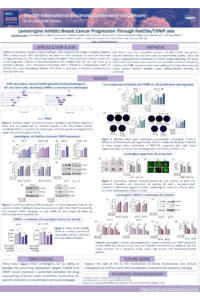
Endocrine resistance remains a major challenge in the treatment of estrogen receptor a-positive (ER+) breast cancer (BC), highlighting the need for novel strategies to overcome hormonal therapy resistance. The antiepileptic drug Lamotrigine (LTG), previously shown to induce the tumor suppressor FoxO3a in Tamoxifen-sensitive and resistant ER+ BC, may serve as a potential adjuvant. This study investigated LTG’s effects on another key tumor suppressor, Thioredoxin-Interacting Protein (TXNIP), thought to be transcriptionally regulated by FoxO3a.
Methods
ER+ MCF-7 cells, their tamoxifen-resistant counterpart (TamR), and patient-derived metastatic BC cells were used as experimental models. Gene and protein expression and functional effects were evaluated by RT-qPCR, Western blotting, ChIP assays, Trypan Blue exclusion assay, Boyden chamber migration and invasion assays, and siRNA-mediated gene silencing.
Results
LTG induced ROS production and increased mRNA and protein expression of FoxO3a and TXNIP in MCF-7 and TamR cells. Consistently, ChIP assays demonstrated that LTG promotes FoxO3a recruitment to a FoxO-responsive element within the TXNIP promoter in both cell lines. Silencing of TXNIP partially reversed LTG’s inhibitory effect on cell proliferation in MCF-7 and TamR cells. Similarly, FoxO3a or TXNIP silencing significantly attenuated the effects of LTG on cell proliferation and migration, with enhanced impact observed upon combined silencing of both genes, particularly in TamR cells. Finally, LTG reduced tumor spheroid size in MCF-7 and TamR cells. Moreover, LTG inhibited proliferation and migration and induced FoxO3a and TXNIP expression in patient-derived metastatic BC cells.
Conclusions
These data suggest that Lamotrigine, for its ability to activate the promising therapeutic targets FoxO3a and TXNIP, could represent a potential candidate for drug repurposing in BC treatment, particularly for patients resistant to conventional hormonal therapies.
This research was funded by the PRIN PNRR 2022 (#P2022T7FXB, CUP H53D23011190001) forCatia Morelli.
Keywords
Breast Cancer
Lamotrigine
drug repurposing
FoxO3a
Poster
poster IECC.pdf
Electrochemical Reduction of Copper (II) As a Potent and Versatile Approach for Tumor Cell Eradication
RENAL ONCOCYTOMA: THE GREAT MIMICKER OF CHROMOPHOBE RENAL CELL CARCINOMA: A CASE REPORT