Event submissions
Published
This submission belongs to the session S3. Drug Resistance and Anti-cancer Drug Development and Screening of the event The 5th International Electronic Conference on Cancers
Published date
05 Jun, 2026
Academic Editor
'%3e%3cpath%20d='M12.6657%2010.9104C12.4185%2010.325%2012.0599%209.79327%2011.6097%209.34482C11.1609%208.89508%2010.6293%208.5365%2010.0442%208.28888C10.0389%208.28626%2010.0337%208.28495%2010.0285%208.28233C10.8446%207.69279%2011.3752%206.73249%2011.3752%205.64904C11.3752%203.8542%209.92103%202.39999%208.1262%202.39999C6.33136%202.39999%204.87715%203.8542%204.87715%205.64904C4.87715%206.73249%205.40774%207.69279%206.22393%208.28364C6.21869%208.28626%206.21345%208.28757%206.20821%208.29019C5.62129%208.5378%205.09463%208.89284%204.64265%209.34613C4.1929%209.79493%203.83432%2010.3266%203.58671%2010.9117C3.34345%2011.4845%203.21226%2012.0987%203.20023%2012.7209C3.19988%2012.7349%203.20233%2012.7488%203.20744%2012.7619C3.21255%2012.7749%203.22022%2012.7867%203.22998%2012.7968C3.23975%2012.8068%203.25142%2012.8147%203.26431%2012.8202C3.2772%2012.8256%203.29105%2012.8284%203.30504%2012.8284H4.09109C4.14874%2012.8284%204.19459%2012.7825%204.1959%2012.7262C4.2221%2011.7148%204.62823%2010.7676%205.34617%2010.0497C6.08899%209.30683%207.0755%208.89808%208.1262%208.89808C9.17689%208.89808%2010.1634%209.30683%2010.9062%2010.0497C11.6242%2010.7676%2012.0303%2011.7148%2012.0565%2012.7262C12.0578%2012.7838%2012.1037%2012.8284%2012.1613%2012.8284H12.9474C12.9613%2012.8284%2012.9752%2012.8256%2012.9881%2012.8202C13.001%2012.8147%2013.0126%2012.8068%2013.0224%2012.7968C13.0322%2012.7867%2013.0398%2012.7749%2013.0449%2012.7619C13.0501%2012.7488%2013.0525%2012.7349%2013.0522%2012.7209C13.0391%2012.0947%2012.9094%2011.4855%2012.6657%2010.9104ZM8.1262%207.9024C7.52486%207.9024%206.9589%207.6679%206.53312%207.24211C6.10733%206.81633%205.87283%206.25037%205.87283%205.64904C5.87283%205.0477%206.10733%204.48174%206.53312%204.05596C6.9589%203.63018%207.52486%203.39567%208.1262%203.39567C8.72753%203.39567%209.29349%203.63018%209.71927%204.05596C10.1451%204.48174%2010.3796%205.0477%2010.3796%205.64904C10.3796%206.25037%2010.1451%206.81633%209.71927%207.24211C9.29349%207.6679%208.72753%207.9024%208.1262%207.9024Z'%20fill='%235D1EE1'/%3e%3c/g%3e%3c/svg%3e) Farrukh Aqil
Farrukh AqilCitation
Onochie Peter Eze, Lubov V Krylova, Elizaveta Mikhailovna Pnachina, Vasilii F Otvagin, Natalia S Kuzmina, Alexander V Nyuchev, Alexey Yu Fedorov, Irina V Balalaeva, Bioorthogonally Activatable Chlorin e6 Photosensitizer for Targeted Photodynamic Therapy: Photophysical and Biological Properties in vitro, in Proceedings of The 5th International Electronic Conference on Cancers, 10 June–12 June 2026, MDPI: Basel, Switzerland
Share
Email
Facebook
Twitter
LinkedIn
Bioorthogonally Activatable Chlorin e6 Photosensitizer for Targeted Photodynamic Therapy: Photophysical and Biological Properties in vitro
'%3e%3cpath%20d='M12.6647%2010.9104C12.4176%2010.325%2012.0589%209.7933%2011.6088%209.34485C11.16%208.89511%2010.6283%208.53653%2010.0432%208.28891C10.038%208.28629%2010.0327%208.28498%2010.0275%208.28236C10.8437%207.69282%2011.3743%206.73252%2011.3743%205.64907C11.3743%203.85423%209.92005%202.40002%208.12522%202.40002C6.33038%202.40002%204.87618%203.85423%204.87618%205.64907C4.87618%206.73252%205.40677%207.69282%206.22296%208.28367C6.21772%208.28629%206.21248%208.2876%206.20724%208.29022C5.62031%208.53783%205.09365%208.89287%204.64167%209.34616C4.19192%209.79496%203.83334%2010.3266%203.58573%2010.9117C3.34247%2011.4846%203.21128%2012.0987%203.19925%2012.721C3.1989%2012.735%203.20135%2012.7489%203.20646%2012.7619C3.21157%2012.7749%203.21924%2012.7868%203.22901%2012.7968C3.23877%2012.8068%203.25045%2012.8148%203.26334%2012.8202C3.27623%2012.8256%203.29007%2012.8284%203.30406%2012.8284H4.09012C4.14776%2012.8284%204.19362%2012.7825%204.19493%2012.7262C4.22113%2011.7148%204.62726%2010.7676%205.34519%2010.0497C6.08802%209.30686%207.07452%208.89811%208.12522%208.89811C9.17592%208.89811%2010.1624%209.30686%2010.9052%2010.0497C11.6232%2010.7676%2012.0293%2011.7148%2012.0555%2012.7262C12.0568%2012.7839%2012.1027%2012.8284%2012.1603%2012.8284H12.9464C12.9604%2012.8284%2012.9742%2012.8256%2012.9871%2012.8202C13%2012.8148%2013.0117%2012.8068%2013.0214%2012.7968C13.0312%2012.7868%2013.0389%2012.7749%2013.044%2012.7619C13.0491%2012.7489%2013.0515%2012.735%2013.0512%2012.721C13.0381%2012.0947%2012.9084%2011.4856%2012.6647%2010.9104ZM8.12522%207.90243C7.52388%207.90243%206.95792%207.66793%206.53214%207.24215C6.10636%206.81636%205.87185%206.2504%205.87185%205.64907C5.87185%205.04773%206.10636%204.48177%206.53214%204.05599C6.95792%203.63021%207.52388%203.3957%208.12522%203.3957C8.72655%203.3957%209.29252%203.63021%209.7183%204.05599C10.1441%204.48177%2010.3786%205.04773%2010.3786%205.64907C10.3786%206.2504%2010.1441%206.81636%209.7183%207.24215C9.29252%207.66793%208.72655%207.90243%208.12522%207.90243Z'%20fill='%235D1EE1'/%3e%3c/g%3e%3c/svg%3e)
Onochie Peter Eze 1
Lubov V Krylova 1,2
Elizaveta Mikhailovna Pnachina 1

Vasilii F Otvagin 1
Natalia S Kuzmina 1
Alexander V Nyuchev 1

Alexey Yu Fedorov 1
Irina V Balalaeva 1
1. Lobachevsky State University of Nizhny Novgorod, Gagarin Avenue, 23, 603022 Nizhny Novgorod, Russia
2. Sirius University of Science and Technology, Olympic Avenue, 1, 354340 Sirius Federal Territory, Russia
Abstract
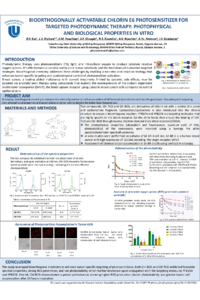
The application of photodynamic therapy is limited by the lack of selectivity of photosensitisers (PS) to tumour cells. This study employed bioorthogonal chemistry to enhance photosensitiser selectivity and improve tumour accumulation, using Chl-BCN, a chlorin e6 derivative with a carbohydrate moiety conjugated to cyclooctyne paired with tetrazine-containing targeting moieties YPB374 and YPB254 that selectively bind to biotin receptors on tumour cell surfaces. The two components interact via the inverse electron demand Diels–Alder reaction. The study aims to demonstrate that this bioorthogonal approach can enhance the selectivity of photosensitisers and improve tumour accumulation
The photophysical properties of conjugated and unconjugated photosensitisers were characterised by absorption and fluorescence spectroscopy following irradiation. The assessment of reactive oxygen species (ROS) generation quantum yield (ΦΔ) was conducted using ROS-sensitive chemical traps. We used a 1,3-diphenylisobenzofuran trap for dimethyl sulfoxide solutions and an anthracene-9,10-diylbis-methylmalonate trap to study singlet oxygen generation in phosphate-buffered saline solutions, with Photoditazine as standard. Photostability assessment was done by monitoring the fluorescence under increasing irradiation power.
In vitro cytotoxicity evaluation was done using the 3-(4,5-dimethyl thiazol-2-yl)-2,5-diphenyltetrazolium bromide (MTT) assay in MDA-MB-231 breast cancer cells and non-malignant CHO cells following photodynamic activation at 20 J/cm² (655–675 nm).
The results showed intensive Soret (416 nm) and Q-band (640 nm) absorption with 644 nm fluorescence emission (ΦΔ ~ 3%). Chl-BCN showed high photostability. Activation with YPB254/YPB374 significantly enhanced the quantum yield of ROS generation, up to 38.6% (3-fold compared to Chl-BCN alone); however, it reduced photostability by 10-fold. ROS generation was significantly more efficient in hydrophobic environments.
Chl-BCN showed minimal dark toxicity and photodynamic activity (IC₅₀ ~18.4 μM) against cancer cells. Importantly, CHO cells maintained >80% viability at equivalent doses.
Chl-BCN demonstrates favourable spectra, potent ROS generation, and high stability. Its ability to selectively reduce tumor cell viability while sparing non-tumor cells shows its promising tumor-targeting potential
Keywords
Bioorthogonaal chemistry
Photodynamic Therapy
Photosensitizers
Selective Tumor Targeting
Poster
Poster - Bioorthogonal PDT_UNN.pdf
“Induction of apoptosis by extracts from transformed hairy roots of Plectranthus venteri in an in vitro cancer model”
Ratiometric TGF-β–MMP Biomarkers Capture Pathway Imbalance and Stratify Colorectal Cancer Progression