Event submissions
Published
This submission belongs to the session S7. Novel Methods and Technologies for Research and Treatment of the event The 5th International Electronic Conference on Cancers
Published date
05 Jun, 2026
Academic Editor
'%3e%3cpath%20d='M12.6657%2010.9104C12.4185%2010.325%2012.0599%209.79327%2011.6097%209.34482C11.1609%208.89508%2010.6293%208.5365%2010.0442%208.28888C10.0389%208.28626%2010.0337%208.28495%2010.0285%208.28233C10.8446%207.69279%2011.3752%206.73249%2011.3752%205.64904C11.3752%203.8542%209.92103%202.39999%208.1262%202.39999C6.33136%202.39999%204.87715%203.8542%204.87715%205.64904C4.87715%206.73249%205.40774%207.69279%206.22393%208.28364C6.21869%208.28626%206.21345%208.28757%206.20821%208.29019C5.62129%208.5378%205.09463%208.89284%204.64265%209.34613C4.1929%209.79493%203.83432%2010.3266%203.58671%2010.9117C3.34345%2011.4845%203.21226%2012.0987%203.20023%2012.7209C3.19988%2012.7349%203.20233%2012.7488%203.20744%2012.7619C3.21255%2012.7749%203.22022%2012.7867%203.22998%2012.7968C3.23975%2012.8068%203.25142%2012.8147%203.26431%2012.8202C3.2772%2012.8256%203.29105%2012.8284%203.30504%2012.8284H4.09109C4.14874%2012.8284%204.19459%2012.7825%204.1959%2012.7262C4.2221%2011.7148%204.62823%2010.7676%205.34617%2010.0497C6.08899%209.30683%207.0755%208.89808%208.1262%208.89808C9.17689%208.89808%2010.1634%209.30683%2010.9062%2010.0497C11.6242%2010.7676%2012.0303%2011.7148%2012.0565%2012.7262C12.0578%2012.7838%2012.1037%2012.8284%2012.1613%2012.8284H12.9474C12.9613%2012.8284%2012.9752%2012.8256%2012.9881%2012.8202C13.001%2012.8147%2013.0126%2012.8068%2013.0224%2012.7968C13.0322%2012.7867%2013.0398%2012.7749%2013.0449%2012.7619C13.0501%2012.7488%2013.0525%2012.7349%2013.0522%2012.7209C13.0391%2012.0947%2012.9094%2011.4855%2012.6657%2010.9104ZM8.1262%207.9024C7.52486%207.9024%206.9589%207.6679%206.53312%207.24211C6.10733%206.81633%205.87283%206.25037%205.87283%205.64904C5.87283%205.0477%206.10733%204.48174%206.53312%204.05596C6.9589%203.63018%207.52486%203.39567%208.1262%203.39567C8.72753%203.39567%209.29349%203.63018%209.71927%204.05596C10.1451%204.48174%2010.3796%205.0477%2010.3796%205.64904C10.3796%206.25037%2010.1451%206.81633%209.71927%207.24211C9.29349%207.6679%208.72753%207.9024%208.1262%207.9024Z'%20fill='%235D1EE1'/%3e%3c/g%3e%3c/svg%3e) Andrew A. Gumbs
Andrew A. GumbsCitation
Ali Moghimi-Khorasgani, Naeimeh Rezaei, Abbas Kiani-Isfahani, Kianoush Dormiani,
Reprogramming T Cells via Minicircle DNA Platforms: A Novel Nonviral Strategy for CD19-Directed CAR-T Therapy in Leukemia
, in Proceedings of The 5th International Electronic Conference on Cancers, 10 June–12 June 2026, MDPI: Basel, Switzerland
Share
Email
Facebook
Twitter
LinkedIn
-
Reprogramming T Cells via Minicircle DNA Platforms: A Novel Nonviral Strategy for CD19-Directed CAR-T Therapy in Leukemia
-
Reprogramming T Cells via Minicircle DNA Platforms: A Novel Nonviral Strategy for CD19-Directed CAR-T Therapy in Leukemia
'%3e%3cpath%20d='M12.6647%2010.9104C12.4176%2010.325%2012.0589%209.7933%2011.6088%209.34485C11.16%208.89511%2010.6283%208.53653%2010.0432%208.28891C10.038%208.28629%2010.0327%208.28498%2010.0275%208.28236C10.8437%207.69282%2011.3743%206.73252%2011.3743%205.64907C11.3743%203.85423%209.92005%202.40002%208.12522%202.40002C6.33038%202.40002%204.87618%203.85423%204.87618%205.64907C4.87618%206.73252%205.40677%207.69282%206.22296%208.28367C6.21772%208.28629%206.21248%208.2876%206.20724%208.29022C5.62031%208.53783%205.09365%208.89287%204.64167%209.34616C4.19192%209.79496%203.83334%2010.3266%203.58573%2010.9117C3.34247%2011.4846%203.21128%2012.0987%203.19925%2012.721C3.1989%2012.735%203.20135%2012.7489%203.20646%2012.7619C3.21157%2012.7749%203.21924%2012.7868%203.22901%2012.7968C3.23877%2012.8068%203.25045%2012.8148%203.26334%2012.8202C3.27623%2012.8256%203.29007%2012.8284%203.30406%2012.8284H4.09012C4.14776%2012.8284%204.19362%2012.7825%204.19493%2012.7262C4.22113%2011.7148%204.62726%2010.7676%205.34519%2010.0497C6.08802%209.30686%207.07452%208.89811%208.12522%208.89811C9.17592%208.89811%2010.1624%209.30686%2010.9052%2010.0497C11.6232%2010.7676%2012.0293%2011.7148%2012.0555%2012.7262C12.0568%2012.7839%2012.1027%2012.8284%2012.1603%2012.8284H12.9464C12.9604%2012.8284%2012.9742%2012.8256%2012.9871%2012.8202C13%2012.8148%2013.0117%2012.8068%2013.0214%2012.7968C13.0312%2012.7868%2013.0389%2012.7749%2013.044%2012.7619C13.0491%2012.7489%2013.0515%2012.735%2013.0512%2012.721C13.0381%2012.0947%2012.9084%2011.4856%2012.6647%2010.9104ZM8.12522%207.90243C7.52388%207.90243%206.95792%207.66793%206.53214%207.24215C6.10636%206.81636%205.87185%206.2504%205.87185%205.64907C5.87185%205.04773%206.10636%204.48177%206.53214%204.05599C6.95792%203.63021%207.52388%203.3957%208.12522%203.3957C8.72655%203.3957%209.29252%203.63021%209.7183%204.05599C10.1441%204.48177%2010.3786%205.04773%2010.3786%205.64907C10.3786%206.2504%2010.1441%206.81636%209.7183%207.24215C9.29252%207.66793%208.72655%207.90243%208.12522%207.90243Z'%20fill='%235D1EE1'/%3e%3c/g%3e%3c/svg%3e)
Ali Moghimi-Khorasgani 1
Naeimeh Rezaei 1
Abbas Kiani-Isfahani 1
Kianoush Dormiani 1
1. Department of Animal Biotechnology, Cell Science Research Center, Royan Institute for Biotechnology, ACECR, Isfahan, Iran.
Abstract
Background:
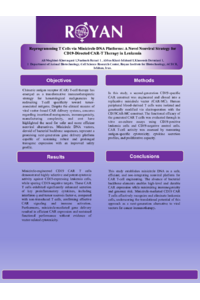
Chimeric antigen receptor (CAR) T-cell therapy has emerged as a transformative immunotherapeutic strategy for hematological malignancies by redirecting T-cell specificity toward tumor-associated antigens. Despite the clinical success of viral vector–based CAR delivery systems, concerns regarding insertional mutagenesis, immunogenicity, manufacturing complexity, and cost have highlighted the need for safer and more efficient nonviral alternatives. Minicircle DNA vectors, devoid of bacterial backbone sequences, represent a promising next-generation gene delivery platform capable of sustaining robust and prolonged transgene expression with an improved safety profile.
Materials and Methods:
In this study, a second-generation CD19-specific CAR construct was engineered and cloned into a replicative minicircle vector (CAR-MC). Human peripheral blood–derived T cells were isolated and genetically modified via electroporation with the CD19CAR-MC construct. The functional efficacy of the generated CAR T cells was evaluated through in vitro co-culture assays using CD19-positive leukemia cells and CD19-negative control cells. CAR T-cell activity was assessed by measuring antigen-specific cytotoxicity, cytokine secretion profiles, and proliferative capacity.
Results:
Minicircle-engineered CD19 CAR T cells demonstrated highly selective and potent cytotoxic activity against CD19-expressing leukemia cells, while sparing CD19-negative targets. These CAR T cells exhibited significantly enhanced secretion of key proinflammatory cytokines, including interferon-γ and tumor necrosis factor-α, compared with non-transduced T cells, confirming effective CAR signaling and immune activation. Furthermore, minicircle-mediated gene delivery resulted in efficient CAR expression and sustained functional performance without evidence of vector-related cytotoxicity.
Conclusion:
This study establishes minicircle DNA as a safe, efficient, and non-integrating nonviral platform for CAR T-cell engineering. The absence of bacterial backbone elements enables high-level and durable CAR expression while minimizing immunogenicity and genomic risk. Minicircle-mediated CD19 CAR T cells effectively recognize and eliminate leukemia cells, underscoring the translational potential of this approach as a next-generation alternative to viral vectors for cancer immunotherapy.
Keywords
CAR T cell
CD19
Minicircle DNA
Nonviral gene delivery
Leukemia
Cancer immunotherapy
Poster
sciforum_172100_S7_slides_Ali_Moghimi_MDPI.pdf
Exploring the anticancer mechanism of isolated compounds from endophytic fungi of the Meliaceae family by a network pharmacological analysis
Integrated Clinical and Functional Analysis Identifies miR-16-1-3p as an Active Passenger Strand Associated with Osteosarcoma Progression and Chemoresistance