Event submissions
Published
This submission belongs to the session S3. Drug Resistance and Anti-cancer Drug Development and Screening of the event The 5th International Electronic Conference on Cancers
Published date
05 Jun, 2026
Academic Editor
'%3e%3cpath%20d='M12.6657%2010.9104C12.4185%2010.325%2012.0599%209.79327%2011.6097%209.34482C11.1609%208.89508%2010.6293%208.5365%2010.0442%208.28888C10.0389%208.28626%2010.0337%208.28495%2010.0285%208.28233C10.8446%207.69279%2011.3752%206.73249%2011.3752%205.64904C11.3752%203.8542%209.92103%202.39999%208.1262%202.39999C6.33136%202.39999%204.87715%203.8542%204.87715%205.64904C4.87715%206.73249%205.40774%207.69279%206.22393%208.28364C6.21869%208.28626%206.21345%208.28757%206.20821%208.29019C5.62129%208.5378%205.09463%208.89284%204.64265%209.34613C4.1929%209.79493%203.83432%2010.3266%203.58671%2010.9117C3.34345%2011.4845%203.21226%2012.0987%203.20023%2012.7209C3.19988%2012.7349%203.20233%2012.7488%203.20744%2012.7619C3.21255%2012.7749%203.22022%2012.7867%203.22998%2012.7968C3.23975%2012.8068%203.25142%2012.8147%203.26431%2012.8202C3.2772%2012.8256%203.29105%2012.8284%203.30504%2012.8284H4.09109C4.14874%2012.8284%204.19459%2012.7825%204.1959%2012.7262C4.2221%2011.7148%204.62823%2010.7676%205.34617%2010.0497C6.08899%209.30683%207.0755%208.89808%208.1262%208.89808C9.17689%208.89808%2010.1634%209.30683%2010.9062%2010.0497C11.6242%2010.7676%2012.0303%2011.7148%2012.0565%2012.7262C12.0578%2012.7838%2012.1037%2012.8284%2012.1613%2012.8284H12.9474C12.9613%2012.8284%2012.9752%2012.8256%2012.9881%2012.8202C13.001%2012.8147%2013.0126%2012.8068%2013.0224%2012.7968C13.0322%2012.7867%2013.0398%2012.7749%2013.0449%2012.7619C13.0501%2012.7488%2013.0525%2012.7349%2013.0522%2012.7209C13.0391%2012.0947%2012.9094%2011.4855%2012.6657%2010.9104ZM8.1262%207.9024C7.52486%207.9024%206.9589%207.6679%206.53312%207.24211C6.10733%206.81633%205.87283%206.25037%205.87283%205.64904C5.87283%205.0477%206.10733%204.48174%206.53312%204.05596C6.9589%203.63018%207.52486%203.39567%208.1262%203.39567C8.72753%203.39567%209.29349%203.63018%209.71927%204.05596C10.1451%204.48174%2010.3796%205.0477%2010.3796%205.64904C10.3796%206.25037%2010.1451%206.81633%209.71927%207.24211C9.29349%207.6679%208.72753%207.9024%208.1262%207.9024Z'%20fill='%235D1EE1'/%3e%3c/g%3e%3c/svg%3e) Farrukh Aqil
Farrukh AqilCitation
Antonella Galati, Camilla Longobucco, Marzia De Santo, Rocco Marinaro, Natascia De Cicco, Laura De Lellis, Alessandro Cama, Rosalba Florio, Serena Veschi, Mariarosa Fava, Sofia Spadafora, Diego Sisci, Luigi Pasqua, Antonella Leggio, Catia Morelli, FOLATE-FUNCTIONALIZED MESOPOROUS SILICA NANOPARTICLES FOR TARGETED DELIVERY OF MEBENDAZOLE IN FR+ BREAST CANCER CELLS , in Proceedings of The 5th International Electronic Conference on Cancers, 10 June–12 June 2026, MDPI: Basel, Switzerland
Share
Email
Facebook
Twitter
LinkedIn
FOLATE-FUNCTIONALIZED MESOPOROUS SILICA NANOPARTICLES FOR TARGETED DELIVERY OF MEBENDAZOLE IN FR+ BREAST CANCER CELLS
'%3e%3cpath%20d='M12.6647%2010.9104C12.4176%2010.325%2012.0589%209.7933%2011.6088%209.34485C11.16%208.89511%2010.6283%208.53653%2010.0432%208.28891C10.038%208.28629%2010.0327%208.28498%2010.0275%208.28236C10.8437%207.69282%2011.3743%206.73252%2011.3743%205.64907C11.3743%203.85423%209.92005%202.40002%208.12522%202.40002C6.33038%202.40002%204.87618%203.85423%204.87618%205.64907C4.87618%206.73252%205.40677%207.69282%206.22296%208.28367C6.21772%208.28629%206.21248%208.2876%206.20724%208.29022C5.62031%208.53783%205.09365%208.89287%204.64167%209.34616C4.19192%209.79496%203.83334%2010.3266%203.58573%2010.9117C3.34247%2011.4846%203.21128%2012.0987%203.19925%2012.721C3.1989%2012.735%203.20135%2012.7489%203.20646%2012.7619C3.21157%2012.7749%203.21924%2012.7868%203.22901%2012.7968C3.23877%2012.8068%203.25045%2012.8148%203.26334%2012.8202C3.27623%2012.8256%203.29007%2012.8284%203.30406%2012.8284H4.09012C4.14776%2012.8284%204.19362%2012.7825%204.19493%2012.7262C4.22113%2011.7148%204.62726%2010.7676%205.34519%2010.0497C6.08802%209.30686%207.07452%208.89811%208.12522%208.89811C9.17592%208.89811%2010.1624%209.30686%2010.9052%2010.0497C11.6232%2010.7676%2012.0293%2011.7148%2012.0555%2012.7262C12.0568%2012.7839%2012.1027%2012.8284%2012.1603%2012.8284H12.9464C12.9604%2012.8284%2012.9742%2012.8256%2012.9871%2012.8202C13%2012.8148%2013.0117%2012.8068%2013.0214%2012.7968C13.0312%2012.7868%2013.0389%2012.7749%2013.044%2012.7619C13.0491%2012.7489%2013.0515%2012.735%2013.0512%2012.721C13.0381%2012.0947%2012.9084%2011.4856%2012.6647%2010.9104ZM8.12522%207.90243C7.52388%207.90243%206.95792%207.66793%206.53214%207.24215C6.10636%206.81636%205.87185%206.2504%205.87185%205.64907C5.87185%205.04773%206.10636%204.48177%206.53214%204.05599C6.95792%203.63021%207.52388%203.3957%208.12522%203.3957C8.72655%203.3957%209.29252%203.63021%209.7183%204.05599C10.1441%204.48177%2010.3786%205.04773%2010.3786%205.64907C10.3786%206.2504%2010.1441%206.81636%209.7183%207.24215C9.29252%207.66793%208.72655%207.90243%208.12522%207.90243Z'%20fill='%235D1EE1'/%3e%3c/g%3e%3c/svg%3e)
Antonella Galati 1
Camilla Longobucco 2
Marzia De Santo 1
Rocco Marinaro 2
Natascia De Cicco 2

Laura De Lellis 3

Alessandro Cama 3
Rosalba Florio 3
Serena Veschi 3
Mariarosa Fava 2
Sofia Spadafora 2
Diego Sisci 2

Luigi Pasqua 4
Antonella Leggio 2

Catia Morelli 2
1. NanoSiliCal Devices Srl, Rende, 87036, Italy
2. Department of Pharmacy, Health and Nutritional Sciences, University of Calabria, Rende, 87036, Italy
3. Department of Pharmacy, Università degli Studi “G. D’Annunzio”, Chieti Pescara, Italy
4. Department of Environmental Engineering, University of Calabria, Rende, 87036, Italy
Abstract
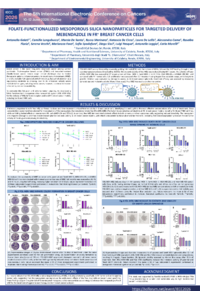
Breast cancer is the most frequently diagnosed cancer among women worldwide. In recent years, mebendazole (MBZ), an orally available FDA-approved anthelmintic drug, has gained attention as a repurposing candidate in oncology due to its anticancer activity across multiple tumor types, including breast cancer; however, its clinical translation is limited by low oral bioavailability. To overcome this limitation and enhance tumor targeting, we developed a folate-functionalized mesoporous silica nanoparticle system (FOL-MSN-MBZ) for the delivery of MBZ to folate receptor-positive (FR+) breast cancer cells, including tamoxifen-resistant and triple-negative breast cancer (TNBC) models.
FOL-MSN-MBZ was synthesized by covalently grafting folic acid (FOL) onto the surface of MSNs, followed by MBZ loading through a two-step impregnation process (drug loading: 8.80%). The cytotoxic activity of free MBZ was evaluated using MTT assays. The selective efficacy of FOL-MSN-MBZ was assessed in FR+ breast cancer cell lines—MCF-7, tamoxifen-resistant MCF-7 (TamR), TamR T47D, MDA-MB-231, and MDA-MB-468—and in FR− normal 3T3-L1 fibroblasts, using cell proliferation and clonogenic assays. The efficacy of the nanosystem was further evaluated in 3D breast cancer models.
Our data demonstrate that FOL-MSN-MBZ effectively induces selective cell death in all FR+ breast cancer cell lines, while sparing normal FR− 3T3-L1 fibroblasts. The nanosystem also inhibits clonogenic potential in tumor cells and reduces spheroid size and viability in 3D breast cancer models. In contrast, free MBZ demonstrated cytotoxic effects across all tested cell lines, including the non-cancerous ones.
Our results indicate that FOL-MSN-MBZ enables targeted delivery of MBZ, inducing cytotoxicity specifically in FR+ tumor cells while sparing normal cells, suggesting that the nanosystem can reproduce the antitumoral effects of the free drug with enhanced tumor specificity. This study was sSupported by NextGenerationEU-PNRR e PRIN—Project Title “Drug repositioning as a safer and sustainable way to fight hard-to-treat cancer”—P2022T7FXB.
Keywords
Breast cancer
Mebendazole
Drug repurposing
Mesoporous silica nanoparticles
Folate receptor targeting
Triple-negative breast cancer
Tamoxifen resistance
Poster
Poster IECC2026 PDF Antonella Galati.pdf
Phenotypic Heterogeneity of Circulating Tumor Cells in Lung Cancer Revealed by Immunocytochemical Profiling
Giant Gastric Gastrointestinal Stromal Tumor with Schwannian-Like Features: A Diagnostic Pitfall