Event submissions
Published
This submission belongs to the session S2. Tumor Heterogeneity of the event The 5th International Electronic Conference on Cancers
Published date
05 Jun, 2026
Academic Editor
'%3e%3cpath%20d='M12.6657%2010.9104C12.4185%2010.325%2012.0599%209.79327%2011.6097%209.34482C11.1609%208.89508%2010.6293%208.5365%2010.0442%208.28888C10.0389%208.28626%2010.0337%208.28495%2010.0285%208.28233C10.8446%207.69279%2011.3752%206.73249%2011.3752%205.64904C11.3752%203.8542%209.92103%202.39999%208.1262%202.39999C6.33136%202.39999%204.87715%203.8542%204.87715%205.64904C4.87715%206.73249%205.40774%207.69279%206.22393%208.28364C6.21869%208.28626%206.21345%208.28757%206.20821%208.29019C5.62129%208.5378%205.09463%208.89284%204.64265%209.34613C4.1929%209.79493%203.83432%2010.3266%203.58671%2010.9117C3.34345%2011.4845%203.21226%2012.0987%203.20023%2012.7209C3.19988%2012.7349%203.20233%2012.7488%203.20744%2012.7619C3.21255%2012.7749%203.22022%2012.7867%203.22998%2012.7968C3.23975%2012.8068%203.25142%2012.8147%203.26431%2012.8202C3.2772%2012.8256%203.29105%2012.8284%203.30504%2012.8284H4.09109C4.14874%2012.8284%204.19459%2012.7825%204.1959%2012.7262C4.2221%2011.7148%204.62823%2010.7676%205.34617%2010.0497C6.08899%209.30683%207.0755%208.89808%208.1262%208.89808C9.17689%208.89808%2010.1634%209.30683%2010.9062%2010.0497C11.6242%2010.7676%2012.0303%2011.7148%2012.0565%2012.7262C12.0578%2012.7838%2012.1037%2012.8284%2012.1613%2012.8284H12.9474C12.9613%2012.8284%2012.9752%2012.8256%2012.9881%2012.8202C13.001%2012.8147%2013.0126%2012.8068%2013.0224%2012.7968C13.0322%2012.7867%2013.0398%2012.7749%2013.0449%2012.7619C13.0501%2012.7488%2013.0525%2012.7349%2013.0522%2012.7209C13.0391%2012.0947%2012.9094%2011.4855%2012.6657%2010.9104ZM8.1262%207.9024C7.52486%207.9024%206.9589%207.6679%206.53312%207.24211C6.10733%206.81633%205.87283%206.25037%205.87283%205.64904C5.87283%205.0477%206.10733%204.48174%206.53312%204.05596C6.9589%203.63018%207.52486%203.39567%208.1262%203.39567C8.72753%203.39567%209.29349%203.63018%209.71927%204.05596C10.1451%204.48174%2010.3796%205.0477%2010.3796%205.64904C10.3796%206.25037%2010.1451%206.81633%209.71927%207.24211C9.29349%207.6679%208.72753%207.9024%208.1262%207.9024Z'%20fill='%235D1EE1'/%3e%3c/g%3e%3c/svg%3e) Henry Heng
Henry HengCitation
Samia BENMALI, ANASS HALOUI, nassira karich, AMAL BENNANI, Giant Gastric Gastrointestinal Stromal Tumor with Schwannian-Like Features: A Diagnostic Pitfall, in Proceedings of The 5th International Electronic Conference on Cancers, 10 June–12 June 2026, MDPI: Basel, Switzerland
Share
Email
Facebook
Twitter
LinkedIn
Giant Gastric Gastrointestinal Stromal Tumor with Schwannian-Like Features: A Diagnostic Pitfall
'%3e%3cpath%20d='M12.6647%2010.9104C12.4176%2010.325%2012.0589%209.7933%2011.6088%209.34485C11.16%208.89511%2010.6283%208.53653%2010.0432%208.28891C10.038%208.28629%2010.0327%208.28498%2010.0275%208.28236C10.8437%207.69282%2011.3743%206.73252%2011.3743%205.64907C11.3743%203.85423%209.92005%202.40002%208.12522%202.40002C6.33038%202.40002%204.87618%203.85423%204.87618%205.64907C4.87618%206.73252%205.40677%207.69282%206.22296%208.28367C6.21772%208.28629%206.21248%208.2876%206.20724%208.29022C5.62031%208.53783%205.09365%208.89287%204.64167%209.34616C4.19192%209.79496%203.83334%2010.3266%203.58573%2010.9117C3.34247%2011.4846%203.21128%2012.0987%203.19925%2012.721C3.1989%2012.735%203.20135%2012.7489%203.20646%2012.7619C3.21157%2012.7749%203.21924%2012.7868%203.22901%2012.7968C3.23877%2012.8068%203.25045%2012.8148%203.26334%2012.8202C3.27623%2012.8256%203.29007%2012.8284%203.30406%2012.8284H4.09012C4.14776%2012.8284%204.19362%2012.7825%204.19493%2012.7262C4.22113%2011.7148%204.62726%2010.7676%205.34519%2010.0497C6.08802%209.30686%207.07452%208.89811%208.12522%208.89811C9.17592%208.89811%2010.1624%209.30686%2010.9052%2010.0497C11.6232%2010.7676%2012.0293%2011.7148%2012.0555%2012.7262C12.0568%2012.7839%2012.1027%2012.8284%2012.1603%2012.8284H12.9464C12.9604%2012.8284%2012.9742%2012.8256%2012.9871%2012.8202C13%2012.8148%2013.0117%2012.8068%2013.0214%2012.7968C13.0312%2012.7868%2013.0389%2012.7749%2013.044%2012.7619C13.0491%2012.7489%2013.0515%2012.735%2013.0512%2012.721C13.0381%2012.0947%2012.9084%2011.4856%2012.6647%2010.9104ZM8.12522%207.90243C7.52388%207.90243%206.95792%207.66793%206.53214%207.24215C6.10636%206.81636%205.87185%206.2504%205.87185%205.64907C5.87185%205.04773%206.10636%204.48177%206.53214%204.05599C6.95792%203.63021%207.52388%203.3957%208.12522%203.3957C8.72655%203.3957%209.29252%203.63021%209.7183%204.05599C10.1441%204.48177%2010.3786%205.04773%2010.3786%205.64907C10.3786%206.2504%2010.1441%206.81636%209.7183%207.24215C9.29252%207.66793%208.72655%207.90243%208.12522%207.90243Z'%20fill='%235D1EE1'/%3e%3c/g%3e%3c/svg%3e)
Samia BENMALI 1
ANASS HALOUI 1
nassira karich 1
AMAL BENNANI 1
1. Laboratory of Anatomical and Cytopathology, Mohammed VI University Hospital, Faculty of Medicine and Pharmacy, Oujda, 60000, Morocco
Abstract
Introduction
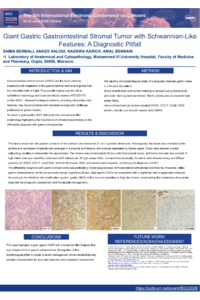
Gastrointestinal stromal tumors (GISTs) are the most common mesenchymal neoplasms of the gastrointestinal tract and originate from the interstitial cells of Cajal. They usually display spindle cell or epithelioid morphology and characteristically express KIT (CD117) and/or DOG1. Unusual histological patterns, including schwannian-like features, may be encountered and represent a diagnostic challenge, particularly in gastric tumors.
Methods
We report a clinicopathological study of a surgically resected gastric mass in a 64-year-old patient. Gross examination and routine histological analysis using hematoxylin and eosin staining were performed. Mitotic activity was assessed in high-power fields. Immunohistochemical studies included DOG1, CD117, CD34, S100 protein, desmin, and smooth muscle actin (SMA).
Results
The tumor arose from the greater curvature of the stomach and measured 21 cm in greatest dimension. Histologically, the lesion was ulcerated at the surface and composed of spindle cells arranged in a nodular architecture, with nodules separated by fibrous septa. Tumor cells showed nuclear palisading, creating a schwannian-like appearance. The stroma was predominantly fibrous with focal myxoid areas, and tumor necrosis was present. A high mitotic rate was identified, estimated at 25 mitoses per 21 high-power fields. Immunohistochemically, the tumor cells showed diffuse positivity for DOG1, CD117, and CD34, while S100 protein, desmin, and smooth muscle actin were negative.
Conclusions
This case highlights a giant gastric GIST with schwannian-like features that may closely mimic a gastric schwannoma. Recognition of this morphological pitfall is crucial to avoid misdiagnosis. Immunohistochemistry remains indispensable for accurate diagnosis and prognostic assessment.
Keywords
Gastrointestinal stromal tumors
mesenchymal neoplasms
Immunohistochemical studies
stomach
Poster
Poster Presentation IECC 2026.pdf
FOLATE-FUNCTIONALIZED MESOPOROUS SILICA NANOPARTICLES FOR TARGETED DELIVERY OF MEBENDAZOLE IN FR+ BREAST CANCER CELLS
Primary Cardiac Angiosarcoma: A Systematic Review of Clinical Presentation, Management, and Outcomes