Event submissions
Published
This submission belongs to the session S5. Causes, Diagnosis and Treatment of Cancer of the event The 5th International Electronic Conference on Cancers
Published date
05 Jun, 2026
Academic Editor
'%3e%3cpath%20d='M12.6657%2010.9104C12.4185%2010.325%2012.0599%209.79327%2011.6097%209.34482C11.1609%208.89508%2010.6293%208.5365%2010.0442%208.28888C10.0389%208.28626%2010.0337%208.28495%2010.0285%208.28233C10.8446%207.69279%2011.3752%206.73249%2011.3752%205.64904C11.3752%203.8542%209.92103%202.39999%208.1262%202.39999C6.33136%202.39999%204.87715%203.8542%204.87715%205.64904C4.87715%206.73249%205.40774%207.69279%206.22393%208.28364C6.21869%208.28626%206.21345%208.28757%206.20821%208.29019C5.62129%208.5378%205.09463%208.89284%204.64265%209.34613C4.1929%209.79493%203.83432%2010.3266%203.58671%2010.9117C3.34345%2011.4845%203.21226%2012.0987%203.20023%2012.7209C3.19988%2012.7349%203.20233%2012.7488%203.20744%2012.7619C3.21255%2012.7749%203.22022%2012.7867%203.22998%2012.7968C3.23975%2012.8068%203.25142%2012.8147%203.26431%2012.8202C3.2772%2012.8256%203.29105%2012.8284%203.30504%2012.8284H4.09109C4.14874%2012.8284%204.19459%2012.7825%204.1959%2012.7262C4.2221%2011.7148%204.62823%2010.7676%205.34617%2010.0497C6.08899%209.30683%207.0755%208.89808%208.1262%208.89808C9.17689%208.89808%2010.1634%209.30683%2010.9062%2010.0497C11.6242%2010.7676%2012.0303%2011.7148%2012.0565%2012.7262C12.0578%2012.7838%2012.1037%2012.8284%2012.1613%2012.8284H12.9474C12.9613%2012.8284%2012.9752%2012.8256%2012.9881%2012.8202C13.001%2012.8147%2013.0126%2012.8068%2013.0224%2012.7968C13.0322%2012.7867%2013.0398%2012.7749%2013.0449%2012.7619C13.0501%2012.7488%2013.0525%2012.7349%2013.0522%2012.7209C13.0391%2012.0947%2012.9094%2011.4855%2012.6657%2010.9104ZM8.1262%207.9024C7.52486%207.9024%206.9589%207.6679%206.53312%207.24211C6.10733%206.81633%205.87283%206.25037%205.87283%205.64904C5.87283%205.0477%206.10733%204.48174%206.53312%204.05596C6.9589%203.63018%207.52486%203.39567%208.1262%203.39567C8.72753%203.39567%209.29349%203.63018%209.71927%204.05596C10.1451%204.48174%2010.3796%205.0477%2010.3796%205.64904C10.3796%206.25037%2010.1451%206.81633%209.71927%207.24211C9.29349%207.6679%208.72753%207.9024%208.1262%207.9024Z'%20fill='%235D1EE1'/%3e%3c/g%3e%3c/svg%3e) Masaharu Seno
Masaharu SenoCitation
Jannat Ara Tina, Moontasir Ahmed, Shadman Newaz, Md Rubaiyat Tasfin Talukder, Ali Ahmed Shaju, Monami Ahmed, Arthi Roy, Antara Anika Eva, Arpita Kundu, Genetic Susceptibility to Chemotherapy-Induced Heart Failure: A Systematic Review, in Proceedings of The 5th International Electronic Conference on Cancers, 10 June–12 June 2026, MDPI: Basel, Switzerland
Share
Email
Facebook
Twitter
LinkedIn
Genetic Susceptibility to Chemotherapy-Induced Heart Failure: A Systematic Review
'%3e%3cpath%20d='M12.6647%2010.9104C12.4176%2010.325%2012.0589%209.7933%2011.6088%209.34485C11.16%208.89511%2010.6283%208.53653%2010.0432%208.28891C10.038%208.28629%2010.0327%208.28498%2010.0275%208.28236C10.8437%207.69282%2011.3743%206.73252%2011.3743%205.64907C11.3743%203.85423%209.92005%202.40002%208.12522%202.40002C6.33038%202.40002%204.87618%203.85423%204.87618%205.64907C4.87618%206.73252%205.40677%207.69282%206.22296%208.28367C6.21772%208.28629%206.21248%208.2876%206.20724%208.29022C5.62031%208.53783%205.09365%208.89287%204.64167%209.34616C4.19192%209.79496%203.83334%2010.3266%203.58573%2010.9117C3.34247%2011.4846%203.21128%2012.0987%203.19925%2012.721C3.1989%2012.735%203.20135%2012.7489%203.20646%2012.7619C3.21157%2012.7749%203.21924%2012.7868%203.22901%2012.7968C3.23877%2012.8068%203.25045%2012.8148%203.26334%2012.8202C3.27623%2012.8256%203.29007%2012.8284%203.30406%2012.8284H4.09012C4.14776%2012.8284%204.19362%2012.7825%204.19493%2012.7262C4.22113%2011.7148%204.62726%2010.7676%205.34519%2010.0497C6.08802%209.30686%207.07452%208.89811%208.12522%208.89811C9.17592%208.89811%2010.1624%209.30686%2010.9052%2010.0497C11.6232%2010.7676%2012.0293%2011.7148%2012.0555%2012.7262C12.0568%2012.7839%2012.1027%2012.8284%2012.1603%2012.8284H12.9464C12.9604%2012.8284%2012.9742%2012.8256%2012.9871%2012.8202C13%2012.8148%2013.0117%2012.8068%2013.0214%2012.7968C13.0312%2012.7868%2013.0389%2012.7749%2013.044%2012.7619C13.0491%2012.7489%2013.0515%2012.735%2013.0512%2012.721C13.0381%2012.0947%2012.9084%2011.4856%2012.6647%2010.9104ZM8.12522%207.90243C7.52388%207.90243%206.95792%207.66793%206.53214%207.24215C6.10636%206.81636%205.87185%206.2504%205.87185%205.64907C5.87185%205.04773%206.10636%204.48177%206.53214%204.05599C6.95792%203.63021%207.52388%203.3957%208.12522%203.3957C8.72655%203.3957%209.29252%203.63021%209.7183%204.05599C10.1441%204.48177%2010.3786%205.04773%2010.3786%205.64907C10.3786%206.2504%2010.1441%206.81636%209.7183%207.24215C9.29252%207.66793%208.72655%207.90243%208.12522%207.90243Z'%20fill='%235D1EE1'/%3e%3c/g%3e%3c/svg%3e)
Jannat Ara Tina 1

Moontasir Ahmed 1
Shadman Newaz 1
Md Rubaiyat Tasfin Talukder 2
Ali Ahmed Shaju 3
Monami Ahmed 4

Arthi Roy 5
Antara Anika Eva 6
Arpita Kundu 3
1. Department of Internal Medicine, Tangail Medical College Hospital, Tangail – 1900, Bangladesh
2. Department of Internal Medicine, Mymensingh Medical College Hospital, Mymensingh - 2200, Bangladesh
3. Department of Internal Medicine, Dinajpur Medical College Hospital, Dinajpur – 5200, Bangladesh
4. Department of Internal Medicine, Medical College for Women and Hospital, Dhaka – 1230, Bangladesh
5. Department of Internal Medicine, Pabna Medical College Hospital, Pabna – 6600, Bangladesh
6. Department of Internal Medicine, Sylhet MAG Osmani Medical College Hospital, Sylhet – 3100, Bangladesh
Abstract
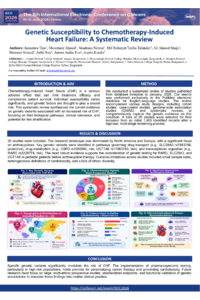
Background: Chemotherapy-induced heart failure (CHF) is a serious adverse effect that can limit treatment efficacy and compromise patient survival. Individual susceptibility varies significantly, and genetic factors are thought to play a crucial role. This systematic review synthesizes the current evidence on genetic variants associated with an increased risk of CHF, focusing on their biological pathways, clinical relevance, and potential for risk stratification.
Methods: We conducted a systematic review of studies published from database inception to December 2025. Our search was performed exclusively in the PubMed electronic database for English-language studies. The review encompassed various study designs, including cohort studies, case–control studies, genome-wide association studies (GWAS), and systematic reviews, to comprehensively capture the genetic evidence on this condition. A total of 20 studies were selected for final inclusion from an initial 1,405 identified records after a rigorous, multi-stage screening process.
Results: A total of 20 studies were included. The research landscape was dominated by North America and Europe, with a significant focus on anthracyclines. Key genetic variants were identified in pathways governing drug transport (e.g., SLC28A3 rs7853758, protective), drug metabolism (e.g., CBR3 rs1056892, risk; UGT1A6 rs17863783, risk), and transcriptional regulation (e.g., RARG rs2229774, risk). The most robust evidence supports the consideration of genetic testing for RARG, SLC28A3, and UGT1A6 in pediatric patients before anthracycline therapy. Common limitations across studies included small sample sizes, heterogeneous definitions of cardiotoxicity, and a lack of ethnic diversity.
Conclusion: Specific genetic variants significantly modulate the risk of CHF. The implementation of pharmacogenomic testing, particularly in high-risk populations, holds promise for personalizing cancer therapy and preventing cardiotoxicity. Future research must focus on large, multi-ethnic prospective studies, standardized endpoints, and functional validation of genetic associations to translate these findings into routine clinical practice.
Keywords
Chemotherapy-induced cardiotoxicity
Heart failure
Pharmacogenomics
Genetic susceptibility
Anthracyclines
Systematic review.
Poster
sciforum_171760_S5_slides_6.pdf
Primary Cardiac Angiosarcoma: A Systematic Review of Clinical Presentation, Management, and Outcomes
Immunomagnetic Fluorogenic ELISA Enabled by HRP-Catalyzed Resorufin Generation for Sensitive Quantification of Carcinoembryonic Antigen in Cancer Cells