Event submissions
Published
This submission belongs to the session S5. Causes, Diagnosis and Treatment of Cancer of the event The 5th International Electronic Conference on Cancers
Published date
05 Jun, 2026
Academic Editor
'%3e%3cpath%20d='M12.6657%2010.9104C12.4185%2010.325%2012.0599%209.79327%2011.6097%209.34482C11.1609%208.89508%2010.6293%208.5365%2010.0442%208.28888C10.0389%208.28626%2010.0337%208.28495%2010.0285%208.28233C10.8446%207.69279%2011.3752%206.73249%2011.3752%205.64904C11.3752%203.8542%209.92103%202.39999%208.1262%202.39999C6.33136%202.39999%204.87715%203.8542%204.87715%205.64904C4.87715%206.73249%205.40774%207.69279%206.22393%208.28364C6.21869%208.28626%206.21345%208.28757%206.20821%208.29019C5.62129%208.5378%205.09463%208.89284%204.64265%209.34613C4.1929%209.79493%203.83432%2010.3266%203.58671%2010.9117C3.34345%2011.4845%203.21226%2012.0987%203.20023%2012.7209C3.19988%2012.7349%203.20233%2012.7488%203.20744%2012.7619C3.21255%2012.7749%203.22022%2012.7867%203.22998%2012.7968C3.23975%2012.8068%203.25142%2012.8147%203.26431%2012.8202C3.2772%2012.8256%203.29105%2012.8284%203.30504%2012.8284H4.09109C4.14874%2012.8284%204.19459%2012.7825%204.1959%2012.7262C4.2221%2011.7148%204.62823%2010.7676%205.34617%2010.0497C6.08899%209.30683%207.0755%208.89808%208.1262%208.89808C9.17689%208.89808%2010.1634%209.30683%2010.9062%2010.0497C11.6242%2010.7676%2012.0303%2011.7148%2012.0565%2012.7262C12.0578%2012.7838%2012.1037%2012.8284%2012.1613%2012.8284H12.9474C12.9613%2012.8284%2012.9752%2012.8256%2012.9881%2012.8202C13.001%2012.8147%2013.0126%2012.8068%2013.0224%2012.7968C13.0322%2012.7867%2013.0398%2012.7749%2013.0449%2012.7619C13.0501%2012.7488%2013.0525%2012.7349%2013.0522%2012.7209C13.0391%2012.0947%2012.9094%2011.4855%2012.6657%2010.9104ZM8.1262%207.9024C7.52486%207.9024%206.9589%207.6679%206.53312%207.24211C6.10733%206.81633%205.87283%206.25037%205.87283%205.64904C5.87283%205.0477%206.10733%204.48174%206.53312%204.05596C6.9589%203.63018%207.52486%203.39567%208.1262%203.39567C8.72753%203.39567%209.29349%203.63018%209.71927%204.05596C10.1451%204.48174%2010.3796%205.0477%2010.3796%205.64904C10.3796%206.25037%2010.1451%206.81633%209.71927%207.24211C9.29349%207.6679%208.72753%207.9024%208.1262%207.9024Z'%20fill='%235D1EE1'/%3e%3c/g%3e%3c/svg%3e) Masaharu Seno
Masaharu SenoCitation
Moontasir Ahmed, Jannat Ara Tina, Shadman Newaz, Rashid Shahriar Sazal, M. F. Rabbi, Lamia Ashraf, Kumari Preity Rani Neogie, Md Hasanuzzaman, Mst Samanta Hoque, Global Longitudinal Strain Compared to Left Ventricular Ejection Fraction for Early Identification of Subclinical Cardiotoxicity in Cancer Patients: A Systematic Review, in Proceedings of The 5th International Electronic Conference on Cancers, 10 June–12 June 2026, MDPI: Basel, Switzerland
Share
Email
Facebook
Twitter
LinkedIn
Global Longitudinal Strain Compared to Left Ventricular Ejection Fraction for Early Identification of Subclinical Cardiotoxicity in Cancer Patients: A Systematic Review

Moontasir Ahmed 1
'%3e%3cpath%20d='M12.6647%2010.9104C12.4176%2010.325%2012.0589%209.7933%2011.6088%209.34485C11.16%208.89511%2010.6283%208.53653%2010.0432%208.28891C10.038%208.28629%2010.0327%208.28498%2010.0275%208.28236C10.8437%207.69282%2011.3743%206.73252%2011.3743%205.64907C11.3743%203.85423%209.92005%202.40002%208.12522%202.40002C6.33038%202.40002%204.87618%203.85423%204.87618%205.64907C4.87618%206.73252%205.40677%207.69282%206.22296%208.28367C6.21772%208.28629%206.21248%208.2876%206.20724%208.29022C5.62031%208.53783%205.09365%208.89287%204.64167%209.34616C4.19192%209.79496%203.83334%2010.3266%203.58573%2010.9117C3.34247%2011.4846%203.21128%2012.0987%203.19925%2012.721C3.1989%2012.735%203.20135%2012.7489%203.20646%2012.7619C3.21157%2012.7749%203.21924%2012.7868%203.22901%2012.7968C3.23877%2012.8068%203.25045%2012.8148%203.26334%2012.8202C3.27623%2012.8256%203.29007%2012.8284%203.30406%2012.8284H4.09012C4.14776%2012.8284%204.19362%2012.7825%204.19493%2012.7262C4.22113%2011.7148%204.62726%2010.7676%205.34519%2010.0497C6.08802%209.30686%207.07452%208.89811%208.12522%208.89811C9.17592%208.89811%2010.1624%209.30686%2010.9052%2010.0497C11.6232%2010.7676%2012.0293%2011.7148%2012.0555%2012.7262C12.0568%2012.7839%2012.1027%2012.8284%2012.1603%2012.8284H12.9464C12.9604%2012.8284%2012.9742%2012.8256%2012.9871%2012.8202C13%2012.8148%2013.0117%2012.8068%2013.0214%2012.7968C13.0312%2012.7868%2013.0389%2012.7749%2013.044%2012.7619C13.0491%2012.7489%2013.0515%2012.735%2013.0512%2012.721C13.0381%2012.0947%2012.9084%2011.4856%2012.6647%2010.9104ZM8.12522%207.90243C7.52388%207.90243%206.95792%207.66793%206.53214%207.24215C6.10636%206.81636%205.87185%206.2504%205.87185%205.64907C5.87185%205.04773%206.10636%204.48177%206.53214%204.05599C6.95792%203.63021%207.52388%203.3957%208.12522%203.3957C8.72655%203.3957%209.29252%203.63021%209.7183%204.05599C10.1441%204.48177%2010.3786%205.04773%2010.3786%205.64907C10.3786%206.2504%2010.1441%206.81636%209.7183%207.24215C9.29252%207.66793%208.72655%207.90243%208.12522%207.90243Z'%20fill='%235D1EE1'/%3e%3c/g%3e%3c/svg%3e)
Jannat Ara Tina 1
Shadman Newaz 1
Rashid Shahriar Sazal 2
M. F. Rabbi 3
Lamia Ashraf 1
Kumari Preity Rani Neogie 4
Md Hasanuzzaman 5
Mst Samanta Hoque 4
1. Department of Internal Medicine, Tangail Medical College Hospital, Tangail – 1900, Bangladesh
2. Department of Internal Medicine, Bangladesh Medical University, Dhaka - 1000, Bangladesh
3. Department of Internal Medicine, Shaheed Suhrawardy Medical College Hospital, Dhaka - 1207, Bangladesh
4. Department of Internal Medicine, Rajshahi Medical College Hospital, Rajshahi – 6100, Bangladesh
5. Department of Internal Medicine, Chattogram Medical College Hospital, Chattogram – 4203, Bangladesh
Abstract
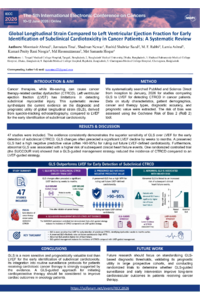
Background: Cancer therapies, while life-saving, can cause cancer therapy-related cardiac dysfunction (CTRCD). Left ventricular ejection fraction (LVEF) has limitations in detecting subclinical myocardial injury. This systematic review synthesizes the current evidence on the diagnostic and prognostic utility of global longitudinal strain (GLS), derived from speckle-tracking echocardiography, compared to LVEF for the early identification of subclinical cardiotoxicity.
Methods: We systematically searched PubMed and Science Direct from inception to September, 2025 for studies comparing GLS to LVEF for detecting CTRCD in cancer patients. Data on study characteristics, patient demographics, cancer and therapy types, diagnostic accuracy, and prognostic value were extracted. The risk of bias was assessed using the Cochrane Risk of Bias 2 (RoB 2) tool.
Results: A total of 47 studies were included. The evidence consistently demonstrates the superior sensitivity of GLS over LVEF for the early detection of subclinical CTRCD. GLS changes often preceded a significant LVEF decline by weeks to months. A preserved GLS had a high negative predictive value (often >90-95%) for ruling out future LVEF-defined cardiotoxicity. Furthermore, abnormal GLS was associated with a higher risk of subsequent clinical heart failure events. One randomized controlled trial (the SUCCOUR trial) showed that a GLS-guided management strategy reduced the incidence of CTRCD compared to an LVEF-guided strategy.
Conclusion: GLS is a more sensitive and prognostically valuable tool than LVEF for the early identification of subclinical cardiotoxicity. Its integration into routine surveillance protocols for patients receiving cardiotoxic cancer therapy is strongly supported by the evidence. A GLS-guided approach for initiating cardioprotective therapy should be considered to improve cardiac outcomes in oncology patients.
Keywords
Global Longitudinal Strain
GLS
Left Ventricular Ejection Fraction
LVEF
Cardiotoxicity
Cancer Therapy-Related Cardiac Dysfunction
CTRCD
Speckle-Tracking Echocardiography
Systematic Review.
Poster
sciforum_171751_S5_slides_5.pdf
Immunomagnetic Fluorogenic ELISA Enabled by HRP-Catalyzed Resorufin Generation for Sensitive Quantification of Carcinoembryonic Antigen in Cancer Cells
Lipid Dysregulation in Normal Tissues Following Cancer Therapy: Implications for Toxicity and Treatment Resistance