Event submissions
Published
This submission belongs to the session S5. Causes, Diagnosis and Treatment of Cancer of the event The 5th International Electronic Conference on Cancers
Published date
05 Jun, 2026
Academic Editor
'%3e%3cpath%20d='M12.6657%2010.9104C12.4185%2010.325%2012.0599%209.79327%2011.6097%209.34482C11.1609%208.89508%2010.6293%208.5365%2010.0442%208.28888C10.0389%208.28626%2010.0337%208.28495%2010.0285%208.28233C10.8446%207.69279%2011.3752%206.73249%2011.3752%205.64904C11.3752%203.8542%209.92103%202.39999%208.1262%202.39999C6.33136%202.39999%204.87715%203.8542%204.87715%205.64904C4.87715%206.73249%205.40774%207.69279%206.22393%208.28364C6.21869%208.28626%206.21345%208.28757%206.20821%208.29019C5.62129%208.5378%205.09463%208.89284%204.64265%209.34613C4.1929%209.79493%203.83432%2010.3266%203.58671%2010.9117C3.34345%2011.4845%203.21226%2012.0987%203.20023%2012.7209C3.19988%2012.7349%203.20233%2012.7488%203.20744%2012.7619C3.21255%2012.7749%203.22022%2012.7867%203.22998%2012.7968C3.23975%2012.8068%203.25142%2012.8147%203.26431%2012.8202C3.2772%2012.8256%203.29105%2012.8284%203.30504%2012.8284H4.09109C4.14874%2012.8284%204.19459%2012.7825%204.1959%2012.7262C4.2221%2011.7148%204.62823%2010.7676%205.34617%2010.0497C6.08899%209.30683%207.0755%208.89808%208.1262%208.89808C9.17689%208.89808%2010.1634%209.30683%2010.9062%2010.0497C11.6242%2010.7676%2012.0303%2011.7148%2012.0565%2012.7262C12.0578%2012.7838%2012.1037%2012.8284%2012.1613%2012.8284H12.9474C12.9613%2012.8284%2012.9752%2012.8256%2012.9881%2012.8202C13.001%2012.8147%2013.0126%2012.8068%2013.0224%2012.7968C13.0322%2012.7867%2013.0398%2012.7749%2013.0449%2012.7619C13.0501%2012.7488%2013.0525%2012.7349%2013.0522%2012.7209C13.0391%2012.0947%2012.9094%2011.4855%2012.6657%2010.9104ZM8.1262%207.9024C7.52486%207.9024%206.9589%207.6679%206.53312%207.24211C6.10733%206.81633%205.87283%206.25037%205.87283%205.64904C5.87283%205.0477%206.10733%204.48174%206.53312%204.05596C6.9589%203.63018%207.52486%203.39567%208.1262%203.39567C8.72753%203.39567%209.29349%203.63018%209.71927%204.05596C10.1451%204.48174%2010.3796%205.0477%2010.3796%205.64904C10.3796%206.25037%2010.1451%206.81633%209.71927%207.24211C9.29349%207.6679%208.72753%207.9024%208.1262%207.9024Z'%20fill='%235D1EE1'/%3e%3c/g%3e%3c/svg%3e) Masaharu Seno
Masaharu SenoCitation
Moontasir Ahmed, Shadman Newaz, Jannat Ara Tina, Ananya Sen, Lamia Ashraf, Kumari Preity Rani Neogie, Hafsha Akter Ava, Snigdho Hritom Sil, Tahea Zaman Deena, The Link Between Malignancy and Arterial Thrombotic Events: A Systematic Review Across Cancer Types, in Proceedings of The 5th International Electronic Conference on Cancers, 10 June–12 June 2026, MDPI: Basel, Switzerland
Share
Email
Facebook
Twitter
LinkedIn
The Link Between Malignancy and Arterial Thrombotic Events: A Systematic Review Across Cancer Types

Moontasir Ahmed 1
'%3e%3cpath%20d='M12.6647%2010.9104C12.4176%2010.325%2012.0589%209.7933%2011.6088%209.34485C11.16%208.89511%2010.6283%208.53653%2010.0432%208.28891C10.038%208.28629%2010.0327%208.28498%2010.0275%208.28236C10.8437%207.69282%2011.3743%206.73252%2011.3743%205.64907C11.3743%203.85423%209.92005%202.40002%208.12522%202.40002C6.33038%202.40002%204.87618%203.85423%204.87618%205.64907C4.87618%206.73252%205.40677%207.69282%206.22296%208.28367C6.21772%208.28629%206.21248%208.2876%206.20724%208.29022C5.62031%208.53783%205.09365%208.89287%204.64167%209.34616C4.19192%209.79496%203.83334%2010.3266%203.58573%2010.9117C3.34247%2011.4846%203.21128%2012.0987%203.19925%2012.721C3.1989%2012.735%203.20135%2012.7489%203.20646%2012.7619C3.21157%2012.7749%203.21924%2012.7868%203.22901%2012.7968C3.23877%2012.8068%203.25045%2012.8148%203.26334%2012.8202C3.27623%2012.8256%203.29007%2012.8284%203.30406%2012.8284H4.09012C4.14776%2012.8284%204.19362%2012.7825%204.19493%2012.7262C4.22113%2011.7148%204.62726%2010.7676%205.34519%2010.0497C6.08802%209.30686%207.07452%208.89811%208.12522%208.89811C9.17592%208.89811%2010.1624%209.30686%2010.9052%2010.0497C11.6232%2010.7676%2012.0293%2011.7148%2012.0555%2012.7262C12.0568%2012.7839%2012.1027%2012.8284%2012.1603%2012.8284H12.9464C12.9604%2012.8284%2012.9742%2012.8256%2012.9871%2012.8202C13%2012.8148%2013.0117%2012.8068%2013.0214%2012.7968C13.0312%2012.7868%2013.0389%2012.7749%2013.044%2012.7619C13.0491%2012.7489%2013.0515%2012.735%2013.0512%2012.721C13.0381%2012.0947%2012.9084%2011.4856%2012.6647%2010.9104ZM8.12522%207.90243C7.52388%207.90243%206.95792%207.66793%206.53214%207.24215C6.10636%206.81636%205.87185%206.2504%205.87185%205.64907C5.87185%205.04773%206.10636%204.48177%206.53214%204.05599C6.95792%203.63021%207.52388%203.3957%208.12522%203.3957C8.72655%203.3957%209.29252%203.63021%209.7183%204.05599C10.1441%204.48177%2010.3786%205.04773%2010.3786%205.64907C10.3786%206.2504%2010.1441%206.81636%209.7183%207.24215C9.29252%207.66793%208.72655%207.90243%208.12522%207.90243Z'%20fill='%235D1EE1'/%3e%3c/g%3e%3c/svg%3e)
Shadman Newaz 1
Jannat Ara Tina 1
Ananya Sen 2
Lamia Ashraf 1
Kumari Preity Rani Neogie 3
Hafsha Akter Ava 4
Snigdho Hritom Sil 1
Tahea Zaman Deena 1
1. Department of Internal Medicine, Tangail Medical College Hospital, Tangail – 1900, Bangladesh
2. Department of Internal Medicine, Chattogram Maa-O-Shishu Hospital Medical College Hospital, Chattogram - 4100, Bangladesh
3. Department of Internal Medicine, Rajshahi Medical College Hospital, Rajshahi – 6100, Bangladesh
4. Department of Internal Medicine, Cumilla Medical College Hospital, Cumilla – 3500, Bangladesh
Abstract
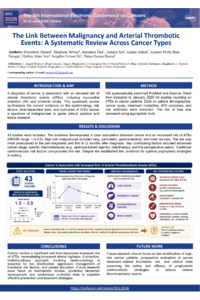
Background: A diagnosis of cancer is associated with an elevated risk of arterial thrombotic events (ATEs), including myocardial infarction (MI) and ischemic stroke. This systematic review synthesizes the current evidence on the epidemiology, risk factors, time-dependent risks, and outcomes of ATEs across a spectrum of malignancies to guide clinical practice and future research.
Methods: We systematically searched PubMed and Science Direct from inception to December 2025 for studies reporting on ATEs in cancer patients. Data on patient demographics, cancer types, treatment modalities, ATE outcomes, and risk estimates were extracted. The risk of bias was assessed using appropriate tools.
Results: We included 43 studies. The evidence demonstrates a clear association between cancer and an increased risk of ATEs (HR/OR range: 1.5-3.0). High-risk malignancies included lung, pancreatic, gastrointestinal, and brain cancers. The risk was most pronounced in the peri-diagnostic period and first 6–12 months after diagnosis. Key contributing factors included advanced cancer stage, specific chemotherapies (e.g., platinum-based agents), radiotherapy, and the perioperative period. Traditional cardiovascular risk factors compounded this risk. Despite the established link, evidence for optimal prophylactic strategies is lacking.
Conclusion: Cancer confers a significant and time-dependent increased risk of ATEs, necessitating increased clinical vigilance. A proactive, multidisciplinary approach involving cardio-oncology is essential for risk stratification, aggressive management of traditional risk factors, and patient education. Future research must focus on mechanistic studies, predictive biomarker development, and randomized controlled trials to establish effective prevention and treatment strategies.
Keywords
Arterial Thrombotic Events
Cancer
Myocardial Infarction
Ischemic Stroke
Thromboembolism
Cardio-Oncology
Systematic Review.
Poster
sciforum_171744_S5_slides_4.pdf
Lipid Dysregulation in Normal Tissues Following Cancer Therapy: Implications for Toxicity and Treatment Resistance
Immune Checkpoint Inhibitor-Associated Myocarditis in Cancer Patients: A Systematic Review of Clinical Presentation, Management, and Outcomes